
Journeys & Encounters · Place profile
Hjarnø and the Kalvestenene: Ship-Shaped Graves at a Fjord Entrance
In Brief
The Kalvestenene on Hjarnø are stone ship settings near the entrance to Horsens Fjord. Their visible forms make them an evocative Viking-Age burial landscape. They should be understood as monuments built from stones, not as preserved hulls or proof of the historical existence of a legendary king.
Present-day location: Denmark · East Jutland
Names and search variants: Hjarnø and the Kalvestenene · Hjarno · Kalvestenene · Hjarne
Browse places by country →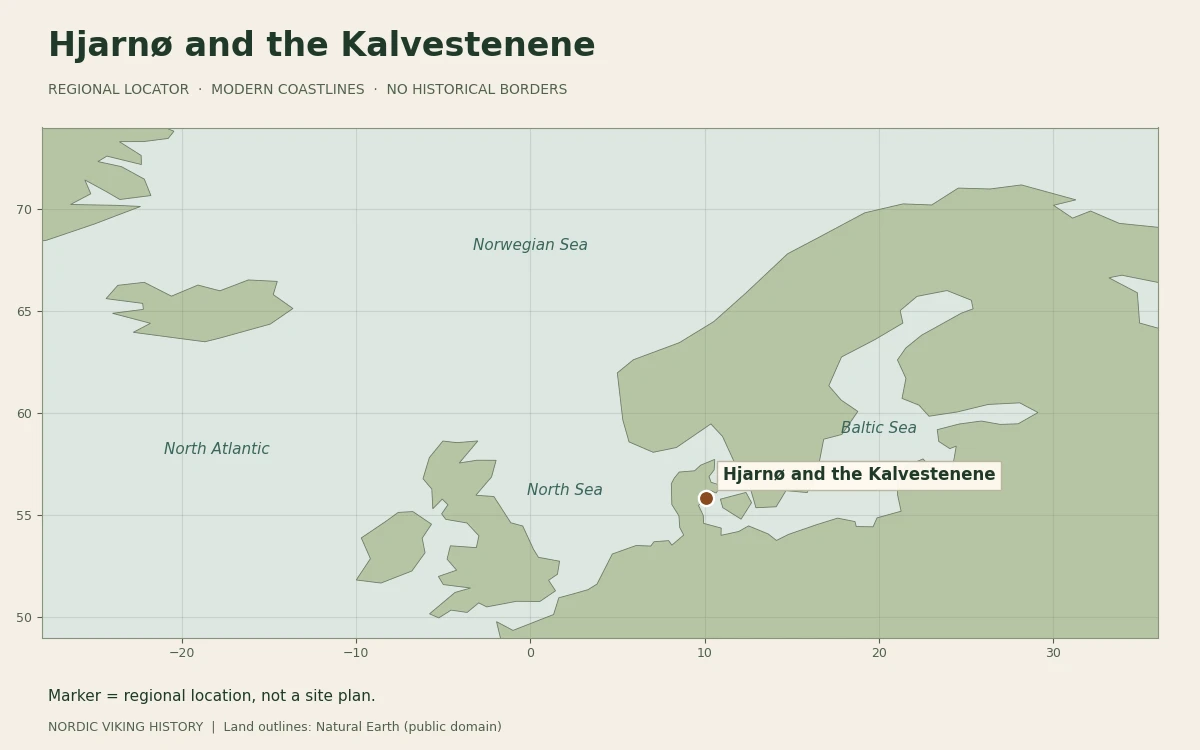
The historical setting
Ole Worm’s drawing from 1650 depicts more than twenty settings, but a modern reassessment questions how accurately it records the site. Investigation and restoration in the twentieth century identified ten surviving arrangements, with excavation of several revealing cremation evidence. The monuments are generally placed in the Viking Age, while their precise original appearance has been affected by disturbance and reconstruction.
What the evidence shows
Later tradition connects the island and graves with King Hjarne. That story belongs to legendary history rather than a securely identified burial. Popular interpretations also link ship forms with particular gods or journeys after death, but the monument shape alone cannot establish exactly which deity participants invoked or what they believed happened to the dead.
How to read this place
The site is best approached through the relationship between land, water, and remembrance. A ship-shaped grave beside a sailing route could make maritime imagery visible to a community, but its meaning still needs cautious interpretation. Compare the surviving stones with excavation records and later stories. Each offers a different kind of evidence, and the strongest account does not force them to tell the same literal narrative.
Explore more Viking-Age places →
Explore this record and its sources in the map collection →
This entry is searchable by place and country. No verified burial-site coordinate is supplied, so it has no map marker or directions.
The Evidence
The sources below support this article. Interpretations and limits are explained in the text; this is not an exhaustive research review.