
Journeys & Encounters · Place profile
Hørning Church near Randers: A Burial beneath a Changing Sacred Place
In Brief
Hørning church near Randers preserves evidence of a striking sequence: an elite woman’s burial mound was followed by a wooden church, and later by the standing stone church. This is not the Hørning near Skanderborg associated with the Fregerslev rider burial.
Present-day location: Denmark · East Jutland
Names and search variants: Hørning Church near Randers · Hørning Kirke · Horning church Randers · Hørning plank
Browse places by country →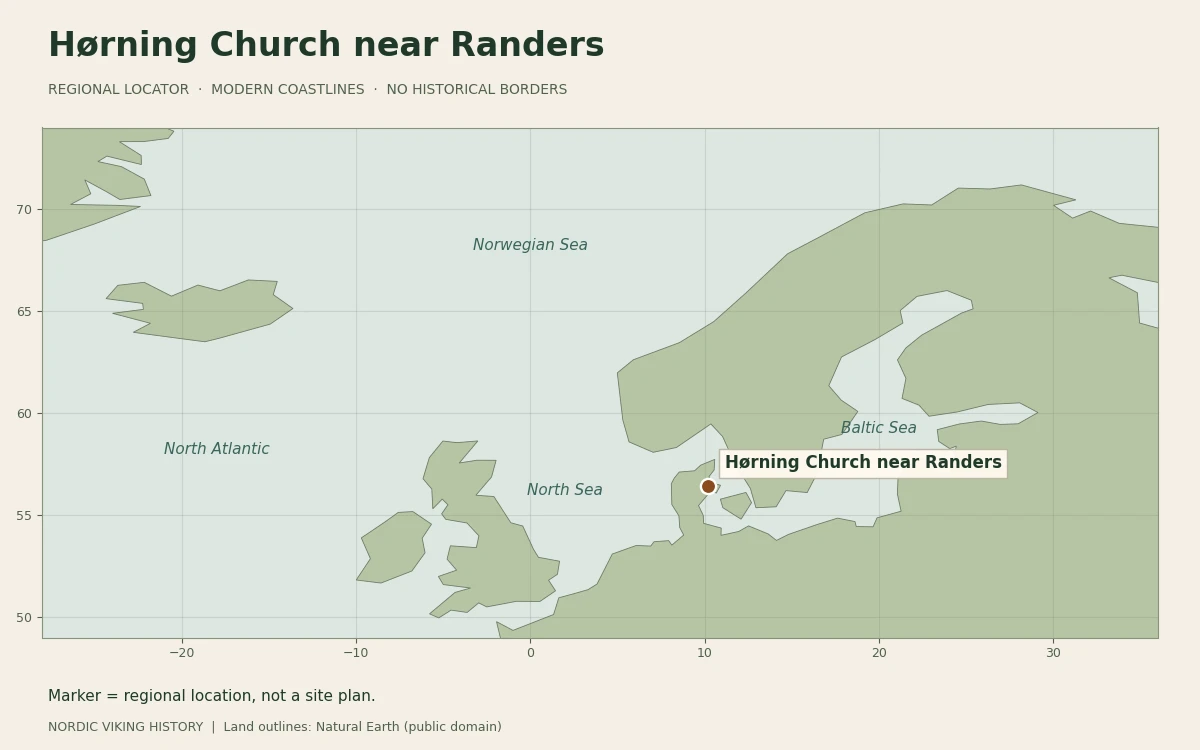
The historical setting
The woman was buried in a chamber with rich furnishings and a wagon body used in the burial arrangement. Sources differ in the precision of the dating, placing the grave within the later Viking period. The sequence, rather than a single exact year, is the strongest foundation for understanding the site.
What the evidence shows
A decorated timber known as the Hørning plank came from the earlier wooden church, usually dated around 1060. Its Urnes-style ornament and traces of paint show how late Viking artistic traditions could appear in Christian architecture. A reconstruction at Moesgaard represents that wooden building; it is not the original church transported intact.
How to read this place
The burial-to-church sequence raises difficult questions about memory and authority. Did the builders honor an ancestor, claim a prestigious location, or transform an established sacred place? The physical order is clearer than the motives. Avoid turning proximity into a complete conversion story: an important burial beneath a church does not reveal the deceased’s beliefs or prove that her descendants commissioned the later structure.
Explore more Viking-Age places →
Explore this record and its sources in the map collection →
This entry is searchable by place and country. No verified burial-site coordinate is supplied, so it has no map marker or directions.
The Evidence
The sources below support this article. Interpretations and limits are explained in the text; this is not an exhaustive research review.