
Journeys & Encounters · Place profile
Hvilehøj: A Woman’s Clothing Recovered from Fragments
In Brief
Hvilehøj near Randers is known for a late tenth-century female burial containing unusually informative textile remains. It offers a different view of Viking wealth from a display of swords or ships: clothing can reveal expensive materials, specialized labor, and the choices made when preparing a person for burial.
Present-day location: Denmark · East Jutland
Names and search variants: Hvilehøj · Hvilehoj · Hvilshøj · Hvilshoj
Browse places by country →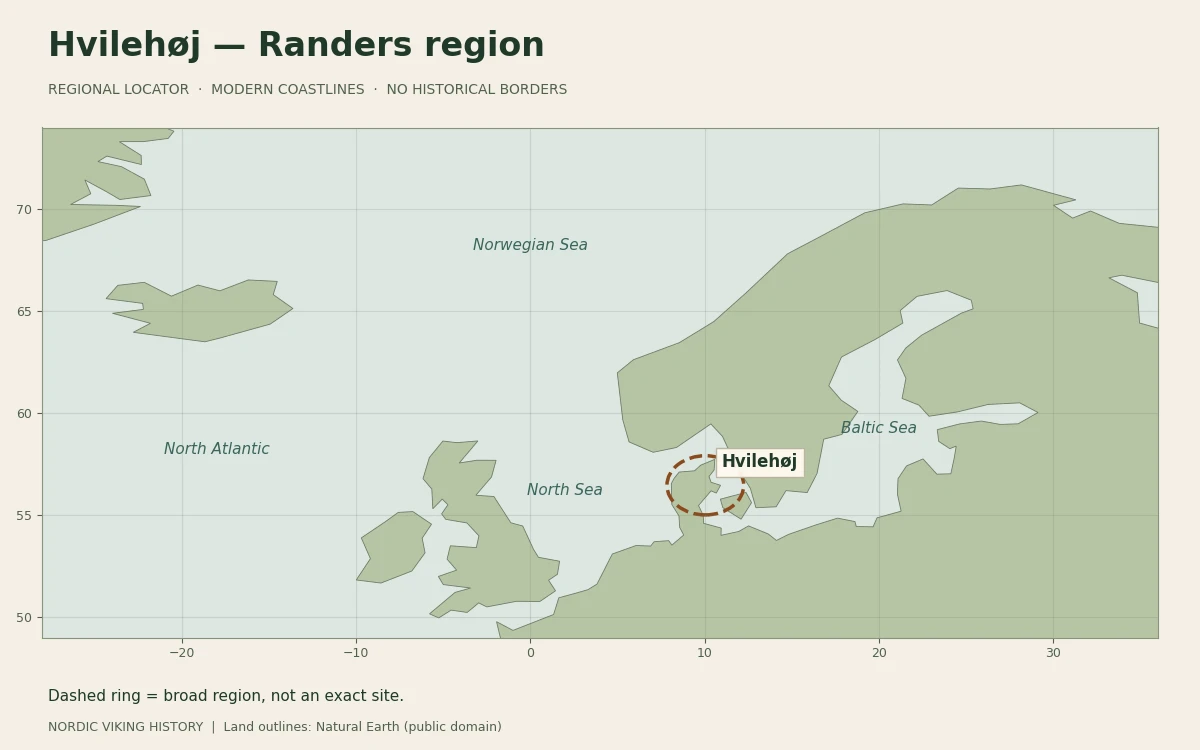
The historical setting
The National Museum’s Fashioning the Viking Age project used Hvilehøj alongside the male burial at Bjerringhøj to investigate dress. These were selected because their surviving fragments were relatively substantial compared with many Danish Viking graves. They are nevertheless exceptional burials, not a statistical sample of what everyone wore.
What the evidence shows
The surviving evidence includes wool and silk, documented in historical records and studied through modern textile analysis. Reconstructed outfits bring the material together into a visible whole, but no complete garment ensemble survived intact. Decisions about cut, placement, missing sections, and appearance must therefore be distinguished from directly observed fibers and woven structures.
How to read this place
This distinction is especially important when an attractive reconstruction circulates online as a standard Viking costume. Ask which part comes from Hvilehøj, which from comparison, and which is needed simply to make a wearable garment. The grave can support a richly detailed discussion of one elite burial without proving that all Danish women dressed alike or that clothing tells us the occupant’s personal biography.
Explore more Viking-Age places →
Explore this record and its sources in the map collection →
This entry is searchable by place and country. No verified burial-site coordinate is supplied, so it has no map marker or directions.
The Evidence
The sources below support this article. Interpretations and limits are explained in the text; this is not an exhaustive research review.