
Journeys & Encounters · Place profile
Kaup and Wiskiauten: A Baltic Cemetery with Scandinavian Connections
In Brief
Kaup, near the former Wiskiauten in present-day Kaliningrad region, is a major archaeological location on the southeastern Baltic. Its Viking-Age burial evidence links it with Scandinavian networks, while the surrounding archaeological landscape also includes local Prussian communities and periods well outside the Viking Age.
On this page
A contact zone, not an empty shoreWhy old excavation records need checkingNames and changing bordersSourcesPresent-day location: Russia · Eastern Baltic
Names and search variants: Kaup / Wiskiauten · Wiskiauten · Viskiautai · Mokhovoye · Kaup
Browse places by country →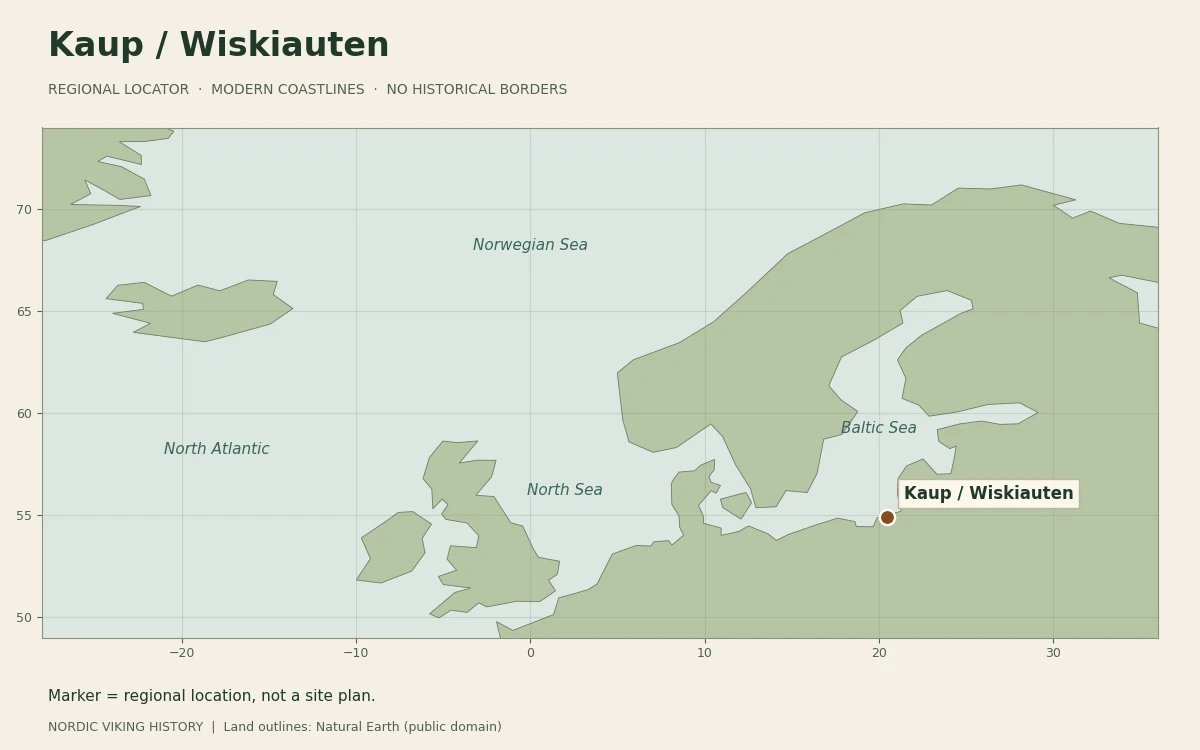
A contact zone, not an empty shore
The ZBSA research project describes a cemetery with a substantial body of Viking-Age Scandinavian finds. Its renewed study uses surviving excavation records and objects from the former Prussia Museum collections. These sources support the cemetery’s cultural connections while allowing individual graves and finds to be assessed in their own contexts.
Why old excavation records need checking
A published field report on work in 2014 revisited earlier interpretations using renewed excavation. Its principal investigated mound was Neolithic, despite standing in a landscape famous for Viking-Age burials. The result is a useful warning: even within one cemetery area, an ancient mound's date cannot safely be inferred from the reputation of the whole site.
Names and changing borders
Kaup, Wiskiauten, Viskiautai and Mokhovoye occur in different languages and historical records. Keeping these names together helps readers locate research without imagining separate archaeological places. Political borders changed long after the period being studied, so modern nationality should not be projected backward onto the people represented by the graves.
Explore more Viking-Age places →
Explore this record and its sources in the map collection →
This entry is searchable by place and country. No verified burial-site coordinate is supplied, so it has no map marker or directions.
The Evidence
The sources below support this article. Interpretations and limits are explained in the text; this is not an exhaustive research review.