
Journeys & Encounters · Place profile
Lade: The Earls’ Seat and Its Missing Landscape
In Brief
Lade, now part of Trondheim, is closely associated with the earls who challenged and negotiated with Norwegian kings. Later sagas make it a major political center. Archaeological study adds a longer and more complicated landscape than the image of a single famous residence suggests.
Present-day location: Norway · Trøndelag
Names and search variants: Lade · Hlaðir · Hladir · Lademoen
Browse places by country →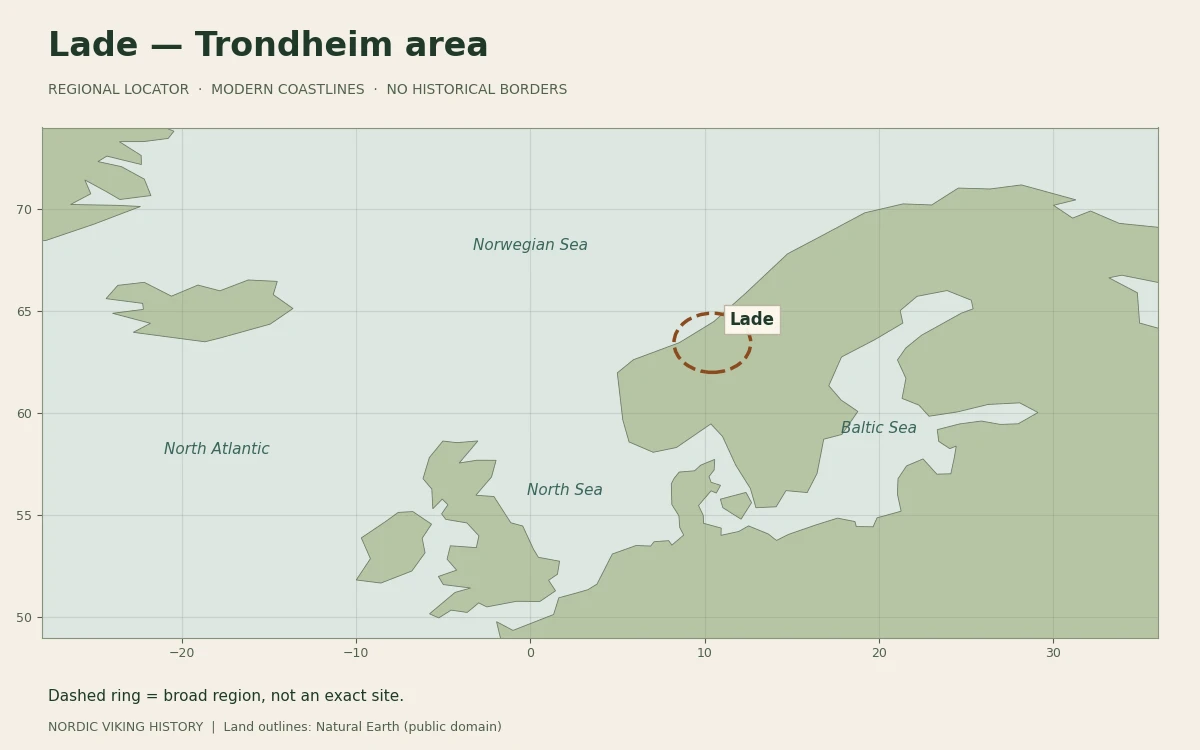
The historical setting
The Lade earls belong to the struggle over authority in late Viking-Age Norway. A powerful regional household could compete with royal ambitions while drawing support from its own followers and districts. Yet a place named in a saga does not automatically give us the location, appearance, or continuous occupation of a particular hall.
What the evidence shows
A modern study of the burial mounds of Lademoen brought together early antiquarian descriptions and more recent archaeological information. Its central contribution is methodological: material that had often been quoted selectively was examined as a whole. The resulting picture emphasizes chronological depth and multiple kinds of activity around the remembered seat of the earls.
How to read this place
For a reader, Lade is a useful test of how written and excavated histories interact. Ask whether a claim concerns a named person in a narrative, a dated object, or a feature recorded before modern development. Those categories can support one another, but they are not interchangeable. A dramatic saga scene cannot supply missing wall lines, while an impressive burial cannot by itself identify the deceased as an earl.
Explore more Viking-Age places →
The Evidence
The sources below support this article. Interpretations and limits are explained in the text; this is not an exhaustive research review.