
Journeys & Encounters · Place profile
Langeid: An Extraordinary Burial at the End of the Viking Age
In Brief
Langeid in Setesdal produced a late Viking-Age cemetery during road-related excavations in 2011. Grave 8 was especially remarkable: a decorated sword and broad axe were placed beside a coffin, with evidence suggesting a small roofed structure above the burial. The combination resists a simple religious classification.
Present-day location: Norway · Agder
Names and search variants: Langeid · Langeid grave 8 · Setesdal · Langeidsverdet
Browse places by country →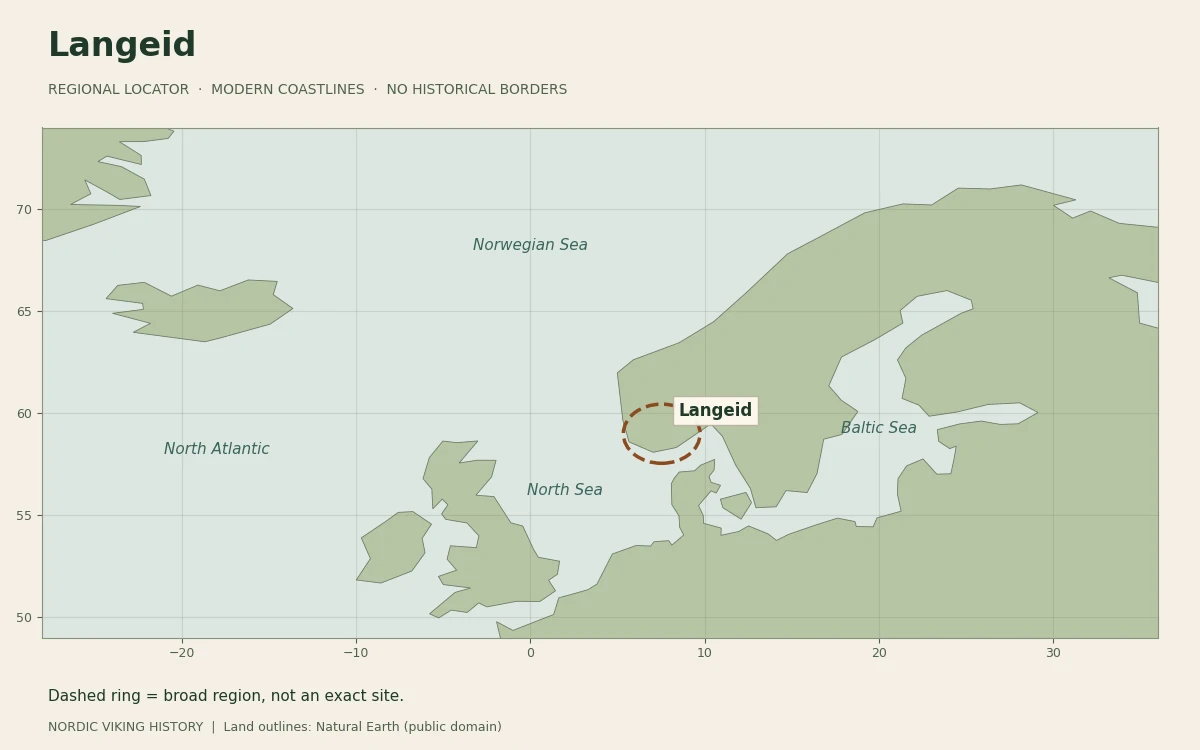
The historical setting
The cemetery contained several dozen flat graves. In grave 8, four substantial postholes surrounded the coffin area without clear evidence of chamber walls between them. Researchers therefore interpret the posts as supporting a funerary superstructure. This is an archaeological reconstruction of the arrangement, not the survival of a complete miniature house.
What the evidence shows
Dating combines a radiocarbon sample with weapon typology and a fragment of an English coin of Æthelred II. Together these indicate the first half of the eleventh century. The sword’s precious-metal decoration includes Christian symbolism, yet it was deposited in a furnished burial following practices usually described as pre-Christian.
How to read this place
The important question is why objects and funeral practices do not always line up into one neat religious category. A decorated weapon could carry meanings associated with status, allegiance, craftsmanship, or belief simultaneously. The absence of surviving human remains also limits identification. Wealth cannot provide a name, and an English coin fragment cannot alone prove that the deceased fought in England.
Explore more Viking-Age places →
Explore this record and its sources in the map collection →
This entry is searchable by place and country. No verified burial-site coordinate is supplied, so it has no map marker or directions.
The Evidence
The sources below support this article. Interpretations and limits are explained in the text; this is not an exhaustive research review.