
Journeys & Encounters · Place profile
Mammen and Bjerringhøj: An Elite Burial with Ambiguous Religious Signals
In Brief
Bjerringhøj at Mammen is the burial place behind one of the most famous decorated Viking axes. The grave was first opened in 1868 and later investigated again. Its importance lies in the combination of dating, luxurious clothing, weapons, and objects that resist a simple religious label.
Present-day location: Denmark · Central Jutland
Names and search variants: Mammen and Bjerringhøj · Mammen · Bjerringhøj · Bjerringhoj
Browse places by country →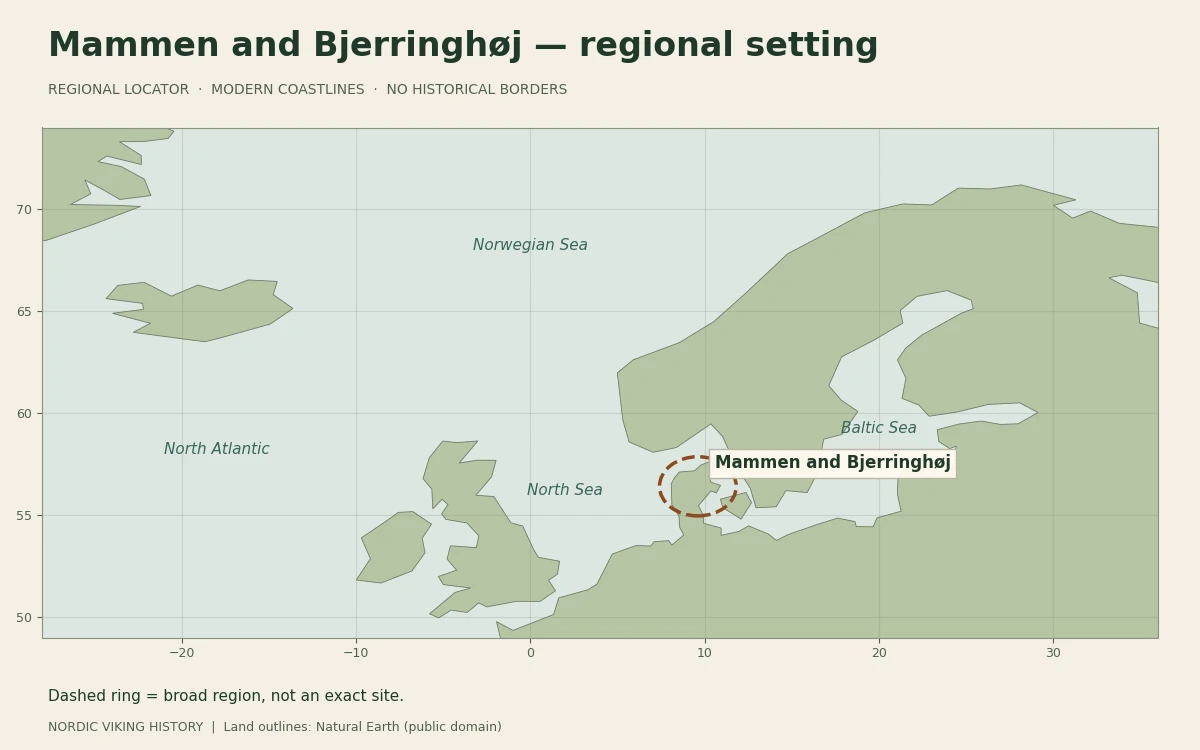
The historical setting
The burial is dated to the winter of 970–971 through timber evidence. The deceased was placed in a wooden chamber with exceptionally rich furnishings. Silk and embroidery demonstrate access to costly materials and skilled work, while the silver-decorated axe made the grave central to the study of Viking animal ornament.
What the evidence shows
A large wax candle was among the objects deposited with the dead. The National Museum discusses its possible Christian significance while acknowledging that the burial cannot confidently be assigned to a single religious identity. The elaborate chamber and equipment do not fit a straightforward story in which an official royal conversion instantly transformed every funeral.
How to read this place
Mammen is most revealing when read as a set of choices made by the living. Clothing, bedding, containers, and weapons all contributed to the presentation of the deceased. Ask what those choices say about wealth and remembrance before using them as a checklist for paganism or Christianity. The absence of a personal name also matters: elite status does not identify the occupant as a particular courtier.
Explore more Viking-Age places →
The Evidence
The sources below support this article. Interpretations and limits are explained in the text; this is not an exhaustive research review.