
Journeys & Encounters · Place profile
Menzlin: Trade and Burial beside the Peene
In Brief
Menzlin near Anklam was a Viking-Age trading place beside the Peene. Its cemetery includes stone settings associated with Scandinavian burial traditions, while the wider settlement belongs to a Slavic region. The site is a strong example of connection across cultures rather than a neatly bounded Viking territory.
Present-day location: Germany · Mecklenburg-Vorpommern
Names and search variants: Menzlin · Altes Lager Menzlin · Peeneberg
Browse places by country →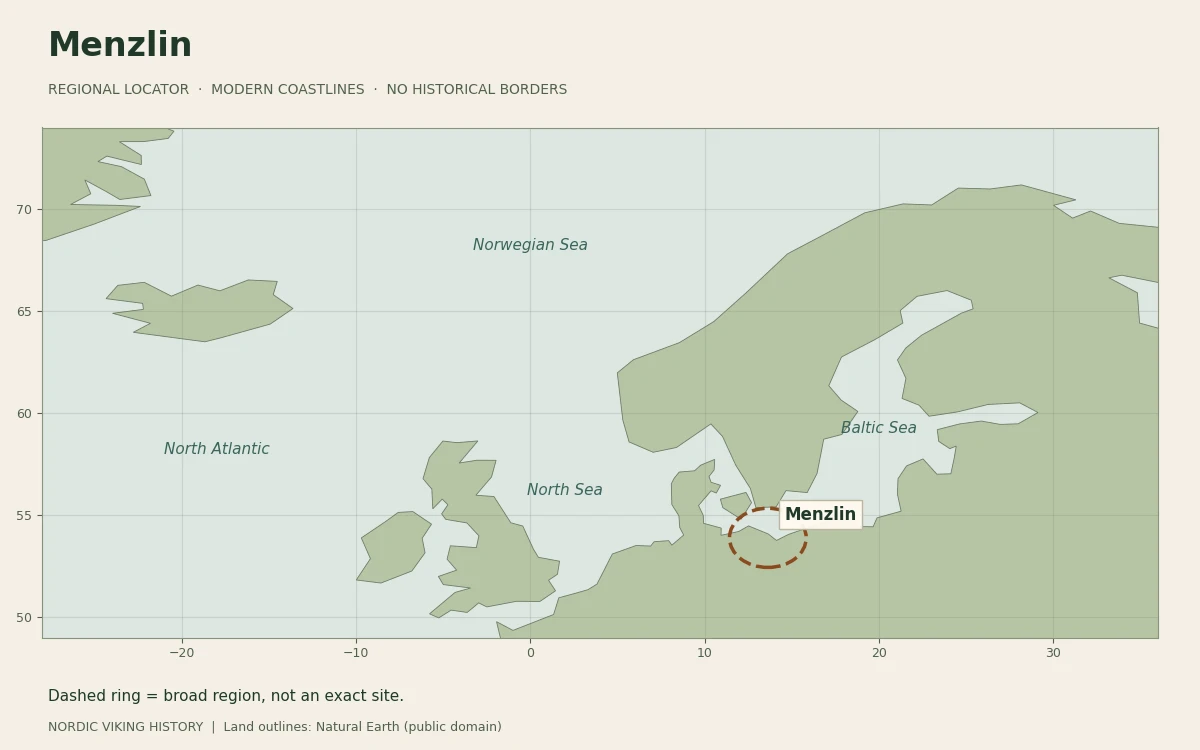
The historical setting
The river offered access to the Baltic and to inland movement. University of Greifswald research describes the Anklam region as an early medieval settlement center linked through Menzlin to Scandinavian exchange. Imported objects and nearby silver finds help demonstrate those connections without revealing the identity of every person who handled them.
What the evidence shows
The visible burial area known as Altes Lager preserves some excavated monuments. Regional archaeological interpretation associates the trading settlement with a slight rise near the river and its cemetery with adjacent woodland. The stone arrangements represent burial monuments, not the remains of wooden ships standing upright in the ground.
How to read this place
Menzlin’s most useful question is how people lived together in a contact zone. Similarities in burial form and dress equipment can suggest connections, but they do not provide a complete ethnic census. Nor does mixed material culture prove that relations were always peaceful. The evidence is strongest when used to examine repeated interaction, exchange, and shared space, with individual identities left more open.
Explore more Viking-Age places →
Explore this record and its sources in the map collection →
This entry is searchable by place and country. No verified burial-site coordinate is supplied, so it has no map marker or directions.
The Evidence
The sources below support this article. Interpretations and limits are explained in the text; this is not an exhaustive research review.