
Journeys & Encounters · Place profile

Moster: Christian Law and the Limits of a Founding Story

In Brief

Moster is associated with the Christian law traditionally adopted in 1024 under Olaf Haraldsson and Bishop Grimkell. It provides a useful way into the late Viking-Age relationship between conversion, assembly politics, and rules governing ordinary life, rather than only royal battles.

On this page

The historical settingWhat the evidence showsHow to read this placeSources

Present-day location: Norway · Vestland

Names and search variants: Moster · Mosterhamn · Moster thing

Browse places by country →
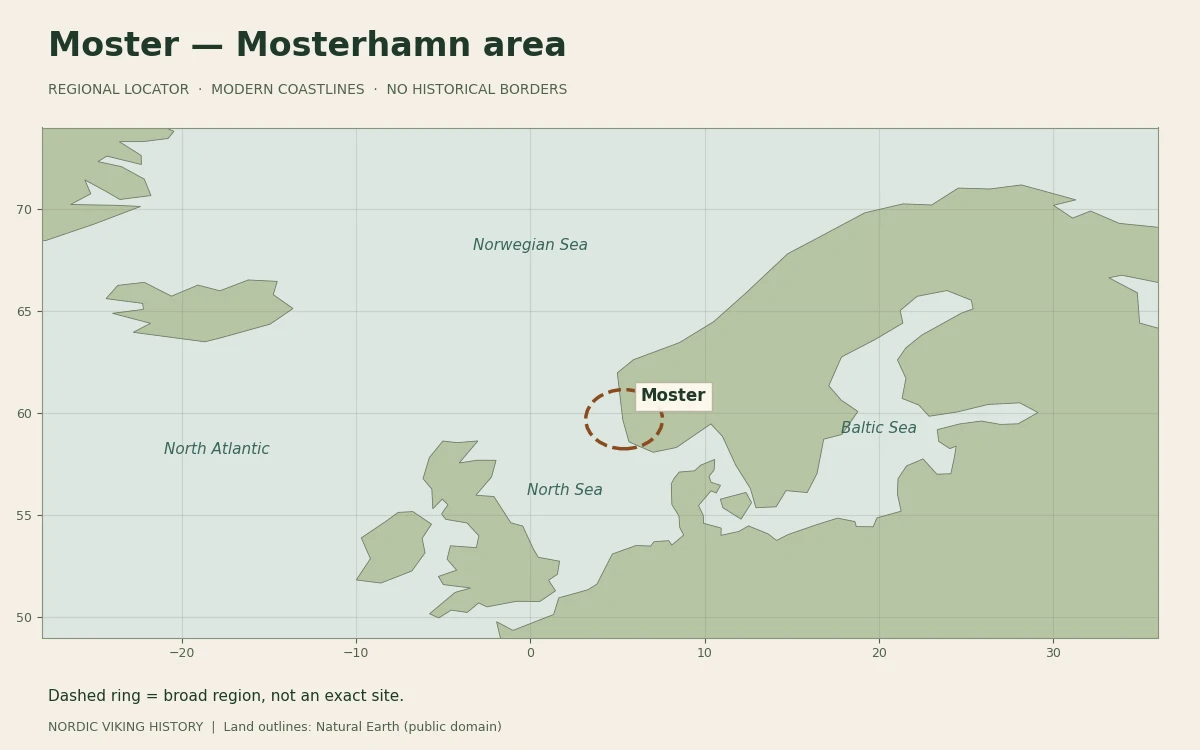
Regional locator map highlighting Moster — Mosterhamn area against generalized modern coastlines.
Original geographic locator diagram with generalized modern land outlines; not a photograph, historical reconstruction or navigation map. The ring locates the Mosterhamn area on Moster, not the exact position of an assembly in 1024. The ring locates the Mosterhamn area on Moster, not the exact position of an assembly in 1024.Image: Nordic Viking History; base geography: Natural Earth · Base land data: public domain

The historical setting

Christianization affected burial, marriage, holy days, church maintenance, and religious obligations. At Moster, the remembered legal settlement brought church demands into negotiation with an assembly. This was not an instant replacement of every older custom, and the king’s ambitions should not be confused with the immediate practical reach of his authority.

What the evidence shows

Legal historian Jørn Øyrehagen Sunde emphasizes that most surviving sources are at least 150 years later than the event they describe. By the twelfth century there was an established tradition of an earlier Olaf-associated Christian law. That tradition is evidence, but reconstructing the exact wording agreed in 1024 is a different and more difficult task.

How to read this place

The site invites a concrete question: what would conversion change for a household? A new burial rule or a duty to support a church could affect land, labor, kinship, and expenditure. Thinking in those terms makes the legal transformation more tangible than a simple statement that Norway became Christian in one year. It also reveals how religious change could be both negotiated and coercive.

Explore more Viking-Age places →

The Evidence

The sources below support this article. Interpretations and limits are explained in the text; this is not an exhaustive research review.

  1. Moster 2024: Christian law ↗
  2. Jørn Øyrehagen Sunde: sources and uncertainty ↗
FacebookPinterestXEmail

Places & evidence

Locations and coordinate sources

These points identify the places described in the source notes. A regional, historical or museum reference is not a surveyed entrance, parking place or guarantee of public access. Check the linked institution or visitor information before traveling.

Moster

Exact location unknown

The exact archaeological feature or event coordinate has not been verified. Modern visitor venues and broad locality illustrations do not establish that position.

No verified object-reference coordinate is supplied. A separately verified visitor destination, if available, is listed below.

Original findspot: The exact archaeological feature or event coordinate has not been verified. Modern visitor venues and broad locality illustrations do not establish that position. moster2024.no · Jørn Øyrehagen Sunde / University of Oslo, published by Moster 2024

Current location: Moster gamle kyrkje is a current visitor site managed for tours by Moster Amfi; 2026 summer dates have ended and other visits are on request. fortidsminneforeningen.no · mosteramfi.no · moster2024.no · Jørn Øyrehagen Sunde / University of Oslo, published by Moster 2024

Access information: Moster gamle kyrkje is a current visitor site managed for tours by Moster Amfi; 2026 summer dates have ended and other visits are on request. 1024 meeting position, entrance/parking coordinates and current off-season booking availability remain unknown. The church-owner page gives postcode 5440 while the Amfi operator gives 5447 for its separate no.2 address; retain source values and do not silently normalize. fortidsminneforeningen.no · mosteramfi.no · moster2024.no · Jørn Øyrehagen Sunde / University of Oslo, published by Moster 2024

Location-source review: 2026-10-30. This is a source check, not a field survey.

Visitor / navigation point: Moster gamle kyrkje. related medieval church. Moster gamle kyrkje is a current visitor site managed for tours by Moster Amfi; 2026 summer dates have ended and other visits are on request. This point is separate from the unverified historical feature or event position. It does not identify a surveyed doorway or parking bay.

59.699186, 5.385784 · WGS84 latitude, longitude

Open visitor location in Google Maps ↗

Visitor source: fortidsminneforeningen.no. Last source check: 2026-10-30.

Visitor context: mosteramfi.no — Moster — current location or visitor information.

Visitor context: moster2024.no — Moster 2024: Christian law.

Visitor context: Jørn Øyrehagen Sunde / University of Oslo, published by Moster 2024 — Jørn Øyrehagen Sunde: sources and uncertainty.

Coordinate source: moster2024.no — Moster 2024: Christian law ↗

Open Moster in Interactive Viking Map →