
Journeys & Encounters · Place profile
Næs near Vordingborg: Flax Production beside Avnø Fjord
In Brief
Næs near Vordingborg is an excavated settlement associated with flax production during the early Viking period. Its coastal position and numerous working features reveal a landscape of processing and labor. It belongs to the economic foundations of the Viking world, not merely its spectacular voyages.
Present-day location: Denmark · Zealand
Names and search variants: Næs near Vordingborg · Næs · Naes · Avnø Fjord · Avno Fjord
Browse places by country →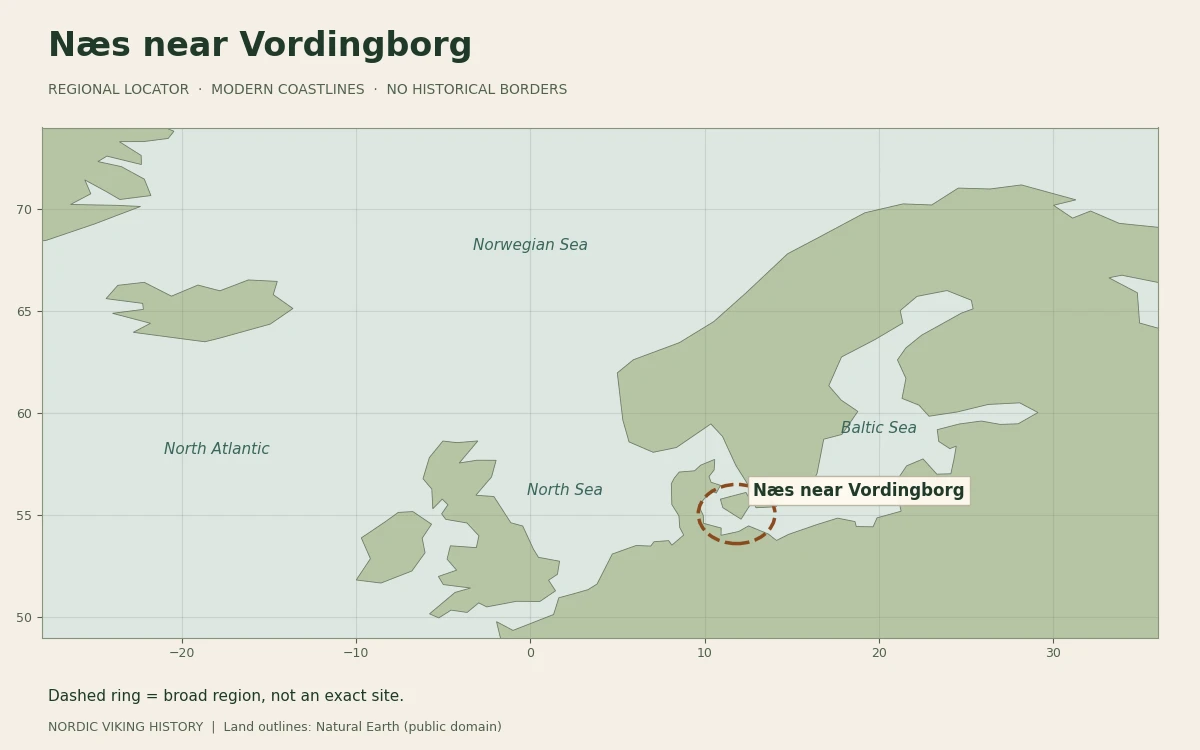
The historical setting
The site came to archaeological attention through finds collected near a nursery and earlier observations during utility work. Investigation in the late 1990s revealed a farm with repeatedly renewed buildings, many sunken-featured structures, and numerous wells. The occupation was dated broadly from the later eighth into the tenth century.
What the evidence shows
Oak from two wells produced tree-ring dates of 784 and 785, giving unusually precise anchors within the broader chronology. The published study interprets the settlement in connection with flax processing. That interpretation depends on combinations of features and material evidence, not simply the presence of a spindle whorl or the assumption that all wells served one purpose.
How to read this place
Næs makes textile production visible as a sequence of tasks before a finished garment existed. Growing and processing fiber required space, water, time, and coordination. Ask how specialized work fitted around ordinary household needs, and whether production served only the residents or wider exchange. The evidence can support discussion of scale without yielding exact annual output or the names of the people who performed the work.
Explore more Viking-Age places →
The Evidence
The sources below support this article. Interpretations and limits are explained in the text; this is not an exhaustive research review.