
Journeys & Encounters · Place profile
Rynkeby near Ringe: A Village Older than Its Written Record
In Brief
Rynkeby near Ringe demonstrates how archaeology can extend a village’s history far beyond its first appearance in documents. Excavations identified Viking-Age and medieval occupation, while dated well timbers point to activity around the transition into the Viking period. This is not the better-known Rynkeby elsewhere on Funen.
Present-day location: Denmark · Funen
Names and search variants: Rynkeby near Ringe · Rynkeby Ringe · Rynkeby
Browse places by country →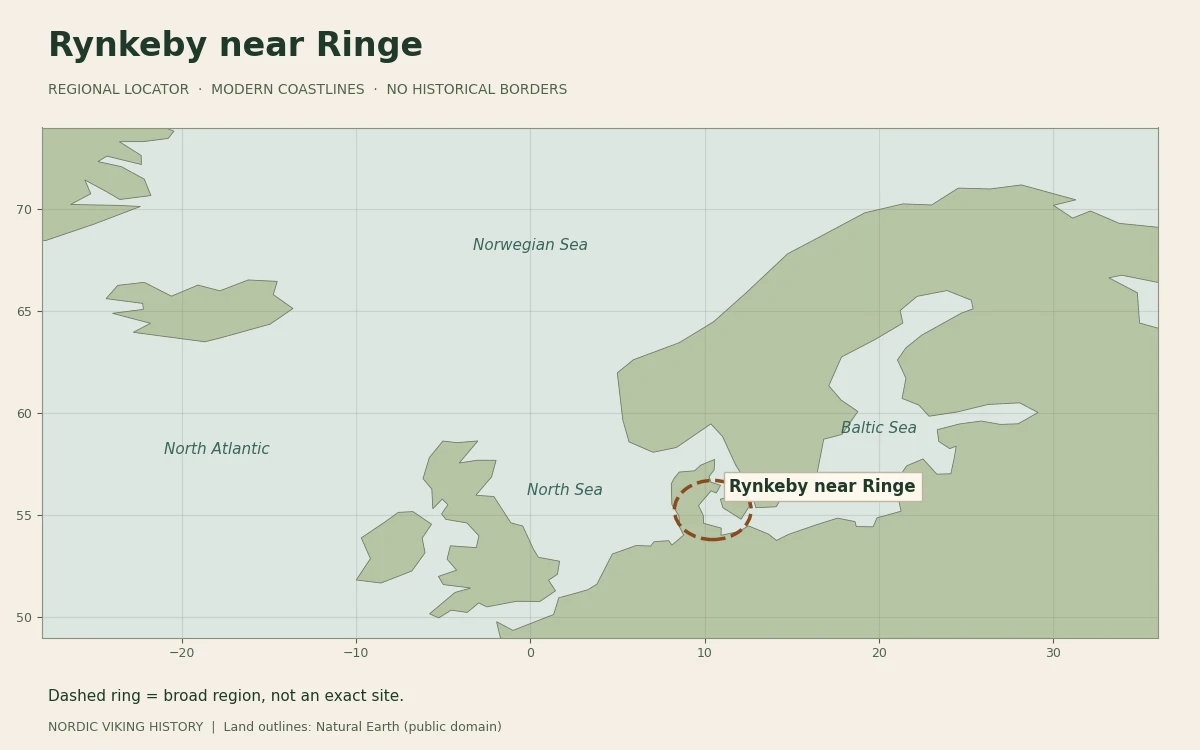
The historical setting
The written record first names this Rynkeby in 1277. Excavation revealed house plots, fences, wells, and repeated rebuilding over a much longer period. The site-name has been interpreted as referring to warriors, but neither that interpretation nor a later riding spur proves that the excavated inhabitants formed a military garrison.
What the evidence shows
Well timbers were dated to the middle of the eighth and beginning of the ninth centuries. Curved-wall houses and later medieval buildings show further occupation, although the precise relationship between the earliest wells and particular houses was not fully resolved in the published account. A separate well dated to the tenth century contained wheel components and an axle.
How to read this place
This is a strong example of why an excavation plan must be broken into phases. Buildings drawn together may have replaced each other, and a dated well does not automatically date every nearby posthole. The wheel remains also move the story beyond house architecture: a farming community depended on transport, repair, and reuse, and discarded components can preserve details absent from standing monuments.
Explore more Viking-Age places →
The Evidence
The sources below support this article. Interpretations and limits are explained in the text; this is not an exhaustive research review.