
Journeys & Encounters · Place profile
Skei in Sparbu: Gathering Houses among the Dead
In Brief
Skei in Sparbu combines a large Late Iron Age cemetery with a courtyard arrangement of buildings. The relationship between gathering places and burial monuments makes it particularly valuable for considering how communities organized authority, memory, and assembly before and during the Viking Age.
Present-day location: Norway · Trøndelag
Names and search variants: Skei in Sparbu · Skei · Sparbu · Skeifeltet
Browse places by country →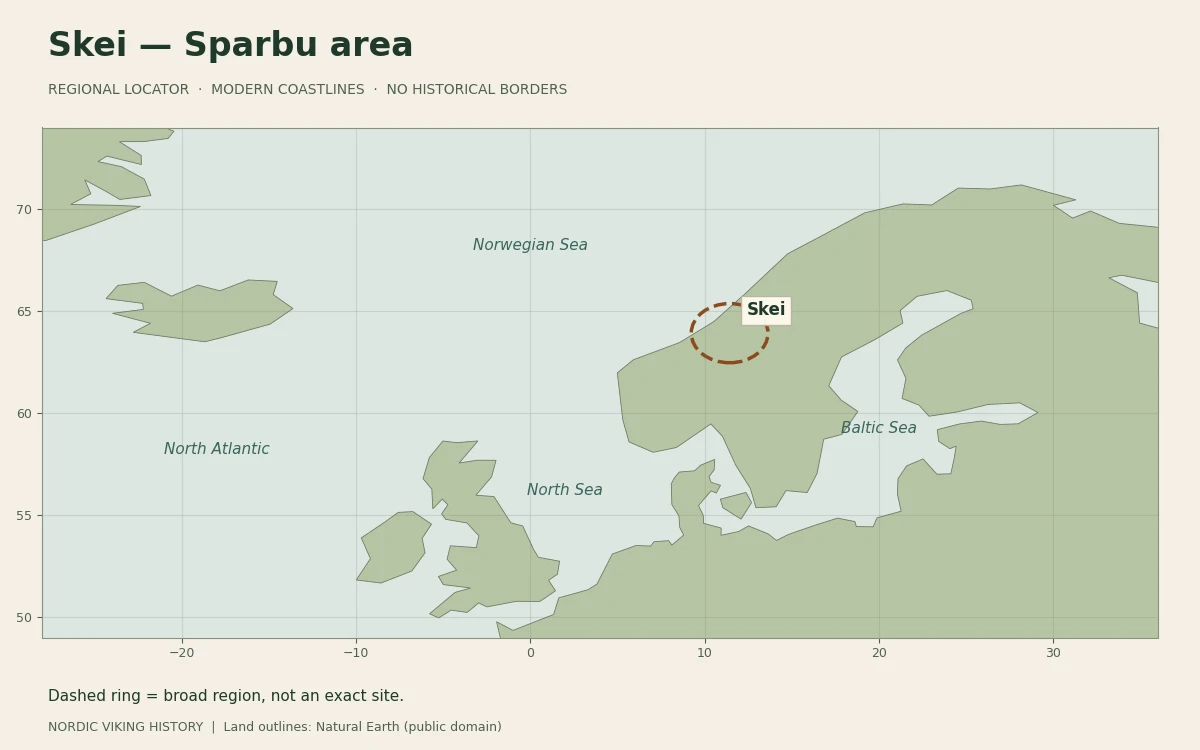
The historical setting
A courtyard site is not simply a village with an unusual street plan. Archaeologists have debated the functions of these grouped buildings, including their relationship to periodic gatherings and political organization. At Skei, the surrounding graves provide an important setting for those discussions, but they do not settle every question about who assembled there.
What the evidence shows
Research on assemblies in Trøndelag places the courtyard site in use into the early eleventh century. The cemetery includes numerous burial monuments of different shapes and sizes. A wealthy woman’s grave dating around 800 was excavated near the courtyard. These observations place several kinds of social activity in close proximity without proving that every feature was contemporary.
How to read this place
The useful exercise is to separate a plan from a single moment. An archaeological drawing can show structures and graves that accumulated across generations. Ask which dates overlap before imagining a meeting surrounded by all the monuments visible on the map. The wealthy female burial also challenges any account that treats the public significance of this landscape as an exclusively male story.
Explore more Viking-Age places →
Explore this burial record and its sources in the map collection →
No precise burial-site coordinate or current visitor access has been verified. This entry supports reading and search.
The Evidence
The sources below support this article. Interpretations and limits are explained in the text; this is not an exhaustive research review.