
Journeys & Encounters · Place profile

Tursiannotko: Houses and everyday materials

In Brief

Tursiannotko beside Lake Pyhäjärvi in Pirkkala offers something especially valuable: evidence for life in a settlement, not only the objects selected for graves. Its Viking-Age remains form part of a much longer sequence continuing through the Middle Ages.

On this page

Houses and everyday materialsDates from timberA different view of the Viking worldSources

Present-day location: Finland · Pirkanmaa

Names and search variants: Tursiannotko · Pirkkala Tursiannotko · Pirkkalankylä

Browse places by country →
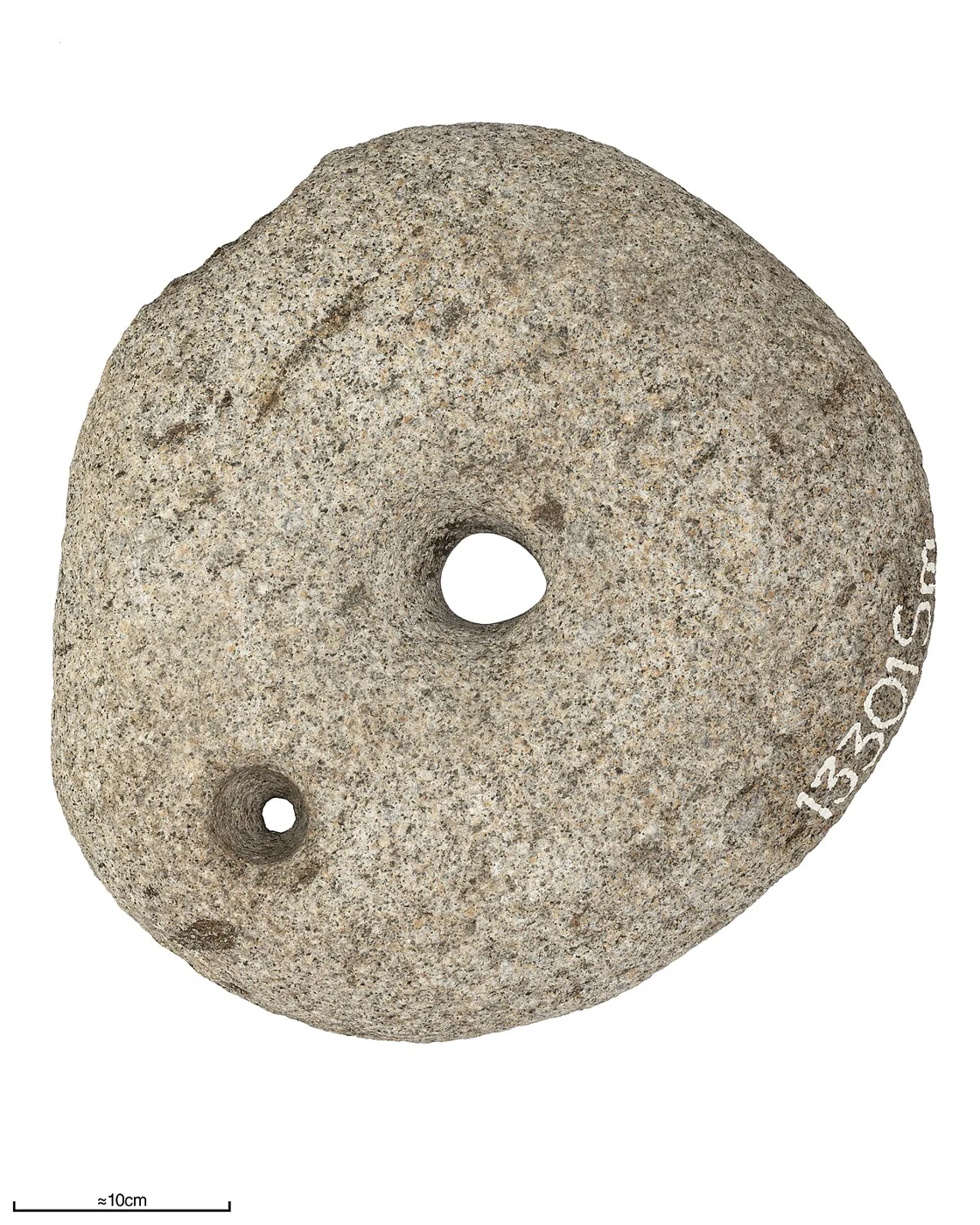
Round quernstone with a central opening and a smaller handle hole.
Upper stone of a Viking-Age rotary quern from Odenslanda in Småland, dated 800–1100 (Swedish History Museum, object 44279_HST). Turning this stone over a fixed lower stone ground the grain. Contextual comparison: a Viking-Age quernstone from Småland illustrates household grain processing, not a find from Tursiannotko.Image: Helena Bonnevier, Swedish History Museum · CC BY 4.0

Houses and everyday materials

The regional museum describes part of a Viking-Age house alongside tools, beads, coins, and decorated bone or antler spoons. Objects arriving from both eastern and western directions show connections, but each find needs its own context and date. A settlement assemblage records repeated activities and losses rather than a single funerary selection.

Dates from timber

Research reported by the museum includes radiocarbon results from wooden remains spanning several parts of the later first millennium and beyond. A date belongs to a sample and its context, not automatically to every neighboring structure. Long-lived settlement makes careful separation of layers particularly important.

A different view of the Viking world

Tursiannotko encourages questions about meals, building, repair, and the use of small household objects. Those activities were fundamental to regional life whether or not residents ever sailed to Scandinavia. Compare the settlement evidence with contemporary cemeteries, while recognizing that different preservation conditions leave different records. A reconstructed scene should be described as interpretation rather than a photograph of a proven complete house.

Explore more Viking-Age places →

The Evidence

The sources below support this article. Interpretations and limits are explained in the text; this is not an exhaustive research review.

  1. Pirkanmaa Regional Museum: Tursiannotko overview ↗
  2. Museum research updates ↗
FacebookPinterestXEmail

Places & evidence

Locations and coordinate sources

These points identify the places described in the source notes. A regional, historical or museum reference is not a surveyed entrance, parking place or guarantee of public access. Check the linked institution or visitor information before traveling.

Tursiannotko

Published heritage-register reference point

The national register places its reference point in a field near the middle of the settlement where surface survey yielded the most finds. The excavated house occupied part of this wider settlement.

WGS84 · latitude, longitude
61.452584, 23.558524

Original findspot: Excavated layers and structures extend over several parts of Pirkkalankylä on the northeastern shore of Kotolahti. Finnish Heritage Agency

Current location: Fields, roads and residential parcels occupy the wider registered settlement area. Finnish Heritage Agency

Access information: The field reference marks surface finds. The register describes mixed agricultural and residential land and supplies no visitor entrance for this point. Finnish Heritage Agency

Location-source review: 2026-11-20. This is a source check, not a field survey.

Visitor / navigation point: Not yet verified. The reference coordinate above must not be treated as a current visitor destination.

Coordinate source: Finnish Heritage Agency — Register of Ancient Monuments, Tursiannotko 604010015 ↗

Open Tursiannotko in Interactive Viking Map →