
Journeys & Encounters · Place profile

Utstein: A Remembered Royal Estate beneath Later History

In Brief

Utstein on Mosterøy is best known for its medieval monastery, but its historical tradition reaches back to a royal estate associated with Harald Fairhair. It belongs in a Viking-world guide precisely because the earlier association and the later standing buildings must be kept separate.

On this page

The historical settingWhat the evidence showsHow to read this placeSources

Present-day location: Norway · Rogaland

Names and search variants: Utstein · Utstein kloster · Mosterøy · Mosteroy

Browse places by country →
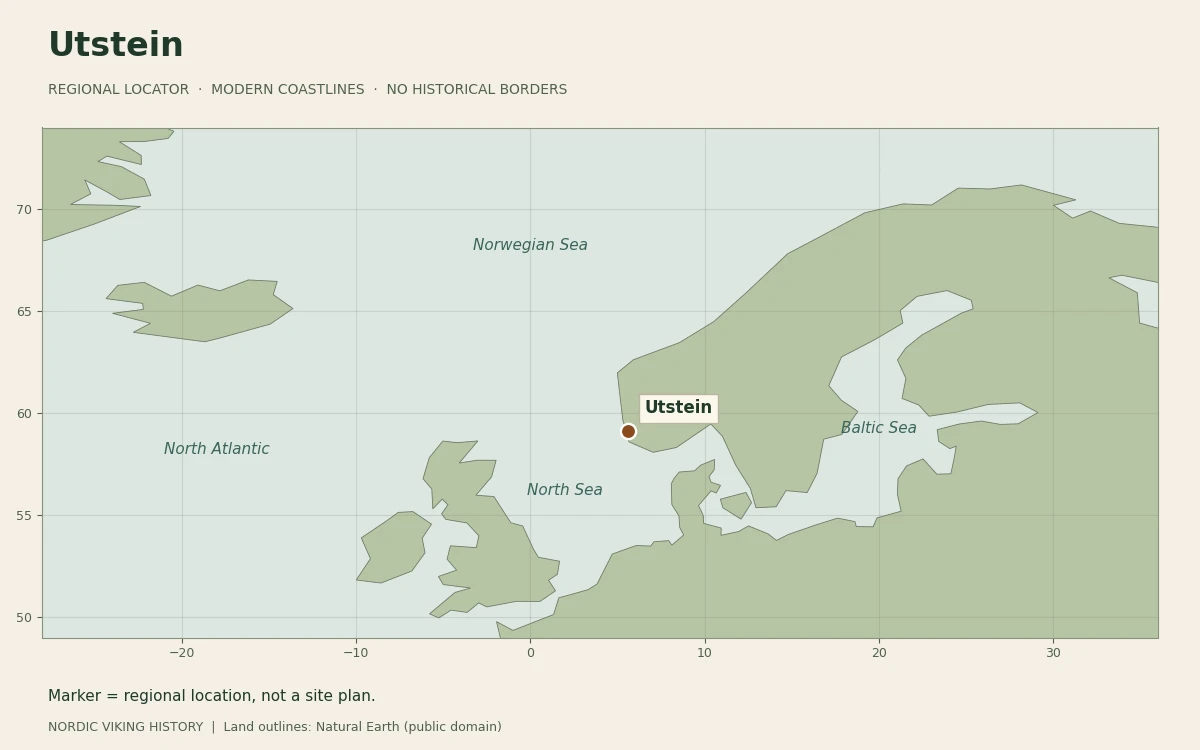
Regional locator map highlighting Utstein against generalized modern coastlines.
Original geographic locator diagram with generalized modern land outlines; not a photograph, historical reconstruction or navigation map. The later monastery is a geographic landmark within the Utstein landscape, not an intact Viking-Age royal residence. The later monastery is a geographic landmark within the Utstein landscape, not an intact Viking-Age royal residence.Image: Nordic Viking History; base geography: Natural Earth · Base land data: public domain

The historical setting

A coastal estate could support a traveling ruler and his household while providing access to the sea routes of southwestern Norway. That is the relevant Viking-Age context. It does not mean the surviving monastic church, cloister arrangements, or later manor buildings can be used as illustrations of Harald’s residence.

What the evidence shows

Museum Stavanger identifies Utstein with Harald’s royal-farm tradition and explains the later Augustinian monastery. The Norwegian heritage authority describes the complex as the country’s relatively well-preserved medieval monastery. Together these accounts establish the site’s long importance while also warning against treating a famous historical association as a complete excavated building history.

How to read this place

When looking at Utstein, ask which story each visible feature actually tells. Stone walls can illuminate monastic organization, while landscape may help explain the attraction of an earlier estate. Neither automatically supplies the floor plan of a Viking hall. The distinction matters because places with long occupation often borrow the prestige of their oldest story when presenting much younger architecture to visitors.

Explore more Viking-Age places →

The Evidence

The sources below support this article. Interpretations and limits are explained in the text; this is not an exhaustive research review.

  1. Museum Stavanger: institutional history ↗
  2. Riksantikvaren: medieval monasteries ↗
FacebookPinterestXEmail

Places & evidence

Locations and coordinate sources

These points identify the places described in the source notes. A regional, historical or museum reference is not a surveyed entrance, parking place or guarantee of public access. Check the linked institution or visitor information before traveling.

Utstein

Exact location unknown

The exact archaeological feature or event coordinate has not been verified. Modern visitor venues and broad locality illustrations do not establish that position.

No verified object-reference coordinate is supplied. A separately verified visitor destination, if available, is listed below.

Original findspot: The exact archaeological feature or event coordinate has not been verified. Modern visitor venues and broad locality illustrations do not establish that position. www.museumstavanger.no · riksantikvaren.no

Current location: The surviving medieval monastery is operated as a museum by Utstein Kloster / Museum Stavanger. The operator currently states that it is winter-closed. www.utsteinkloster.no · riksantikvaren.no

Access information: As checked on 30 October 2026, the operator states that Utstein is now winter-closed and lists all weekdays as closed. It announces a Christmas-market exception on 21–22 November, 11:00–15:00. The general winter closure is 1 November–28 February; confirm any special visit with the operator. The published point identifies the museum, not a surveyed entrance or parking bay. www.utsteinkloster.no

Location-source review: 2026-10-30. This is a source check, not a field survey.

Visitor / navigation point: Utstein kloster: the present medieval monastery museum. As checked on 30 October 2026, the operator states that Utstein is now winter-closed and lists all weekdays as closed. It announces a Christmas-market exception on 21–22 November, 11:00–15:00. The general winter closure is 1 November–28 February; confirm any special visit with the operator. The published point identifies the museum, not a surveyed entrance or parking bay. It does not locate the earlier royal farm.

59.103471, 5.591960 · WGS84 latitude, longitude

Open visitor location in Google Maps ↗

Visitor source: www.utsteinkloster.no. Last source check: 2026-10-30.

Visitor context: riksantikvaren.no — Riksantikvaren: medieval monasteries.

Coordinate source: www.museumstavanger.no — Museum Stavanger: institutional history ↗

Open Utstein in Interactive Viking Map →