
Journeys & Encounters · Place profile
Vang Cemetery at Oppdal: Mountain Communities with Distant Connections
In Brief
Vang at Oppdal is an extensive burial landscape in the Norwegian interior. Its many mounds, particularly those of the Viking Age, challenge the assumption that international connections belonged only to coastal towns. The mountain district was part of wider relationships linking farms, uplands, and fjords.
Present-day location: Norway · Trøndelag
Names and search variants: Vang Cemetery at Oppdal · Vang · Oppdal · Vang gravfelt
Browse places by country →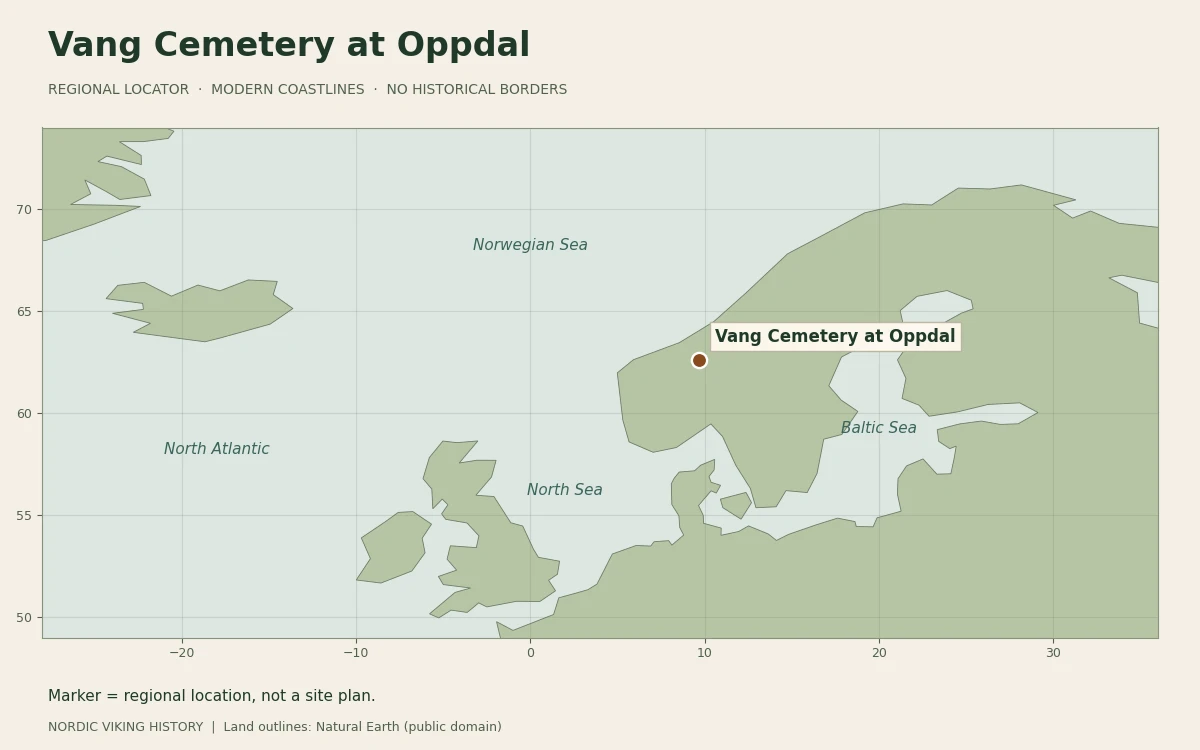
The historical setting
Oppdal Museum describes nearly nine hundred burial mounds, with a substantial Viking-Age component and older graves reaching back into the Migration Period. The cemetery therefore represents generations of activity. Its size cannot be turned directly into a population count without understanding the chronology and the proportion of graves investigated.
What the evidence shows
Finds include material associated with farming, hunting, and distant contacts, including objects with Irish connections. The archaeological collections are held by the university museum in Trondheim. The visible mounds and the museum objects answer different questions: one shows the landscape of commemoration, while the other can reveal details of equipment and exchange.
How to read this place
At Vang, think about the routes and resources that could connect an inland community with the wider world. The presence of a foreign object raises questions about how it traveled, but does not automatically prove that the buried person raided its place of origin. The cemetery is most informative when distant connections are considered alongside local livelihoods rather than replacing them with a story of adventurous outsiders.
Explore more Viking-Age places →
Explore this burial record and its sources in the map collection →
No precise burial-site coordinate or current visitor access has been verified. This entry supports reading and search.
The Evidence
The sources below support this article. Interpretations and limits are explained in the text; this is not an exhaustive research review.