
Journeys & Encounters · Place profile
Vinjeøra: Changing Burial Customs at Skeiet
In Brief
The cemetery at Skeiet in Vinjeøra gives a remarkably varied picture of how people treated the dead in the Late Iron Age and Viking Age. It is a place where cremation, inhumation, and boat burial must be understood together rather than assigned to separate, uniform peoples.
Present-day location: Norway · Trøndelag
Names and search variants: Vinjeøra · Vinjeora · Skeiet · Vinjefjord
Browse places by country →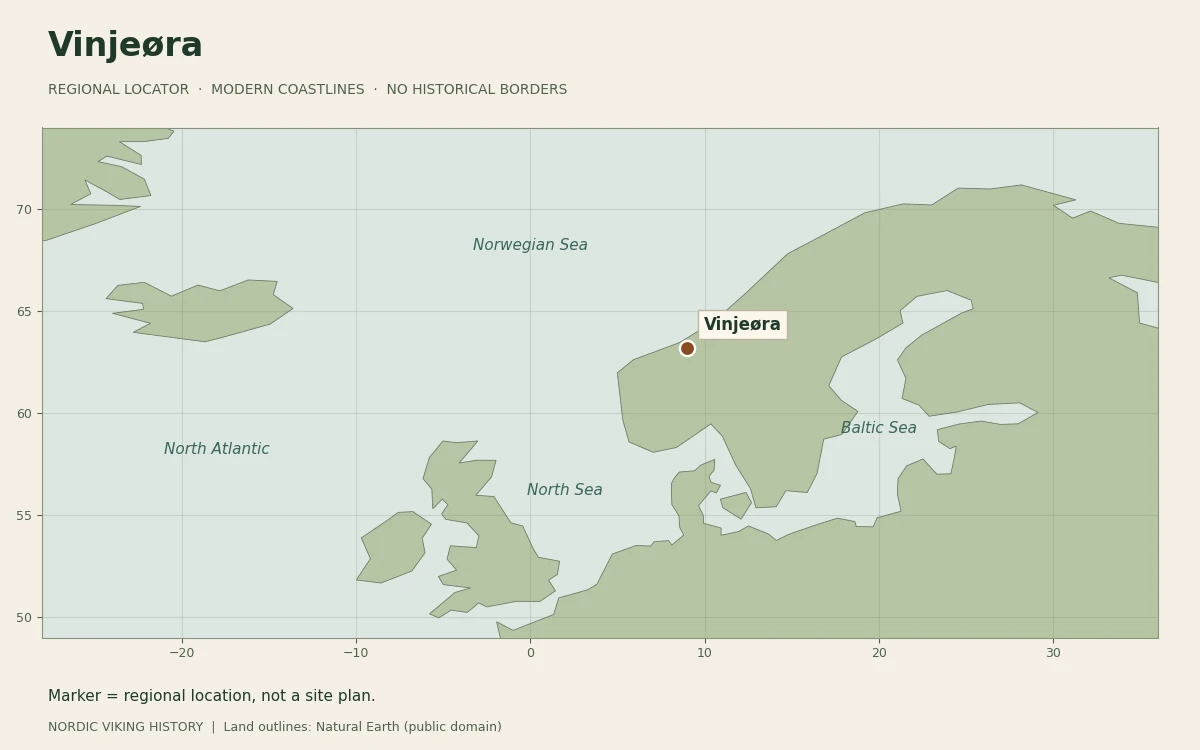
The historical setting
Excavation identified eighteen graves. Research describes cremation as particularly prominent around 600–800, followed by a growing preference for inhumation during approximately 800–950. Such patterns provide a local chronology, not a universal timetable that can be imposed on every Norwegian community.
What the evidence shows
The study also identified interventions in graves, including secondary burial, disturbance, and possible removal or rearrangement of remains. Boat burials formed part of this changing repertoire. The cemetery was therefore not necessarily a place where a funeral ended all contact with the deceased; its monuments could remain active elements in later social and ritual life.
How to read this place
Vinjeøra encourages a more demanding question than whether a grave was pagan or Christian. What actions took place, in what order, and how can they be recognized archaeologically? A disturbed burial might result from robbery, a later grave, or another deliberate practice. Distinguishing those possibilities requires attention to bones, cuts, deposits, and their relationships rather than a ready-made story about Viking beliefs.
Explore more Viking-Age places →
Explore this burial record and its sources in the map collection →
No precise burial-site coordinate or current visitor access has been verified. This entry supports reading and search.
The Evidence
The sources below support this article. Interpretations and limits are explained in the text; this is not an exhaustive research review.