
Journeys & Encounters · Place profile
Vorbasse: The Farming Village behind the Viking Voyages
In Brief
Vorbasse is an essential counterweight to histories built entirely around raids and royal monuments. Excavation of its settlement sequence has helped archaeologists understand how farms changed over time, including during the Viking Age. Its importance lies in the organization of ordinary production rather than a spectacular named king.
Present-day location: Denmark · South Jutland
Names and search variants: Vorbasse · Vorbasse village
Browse places by country →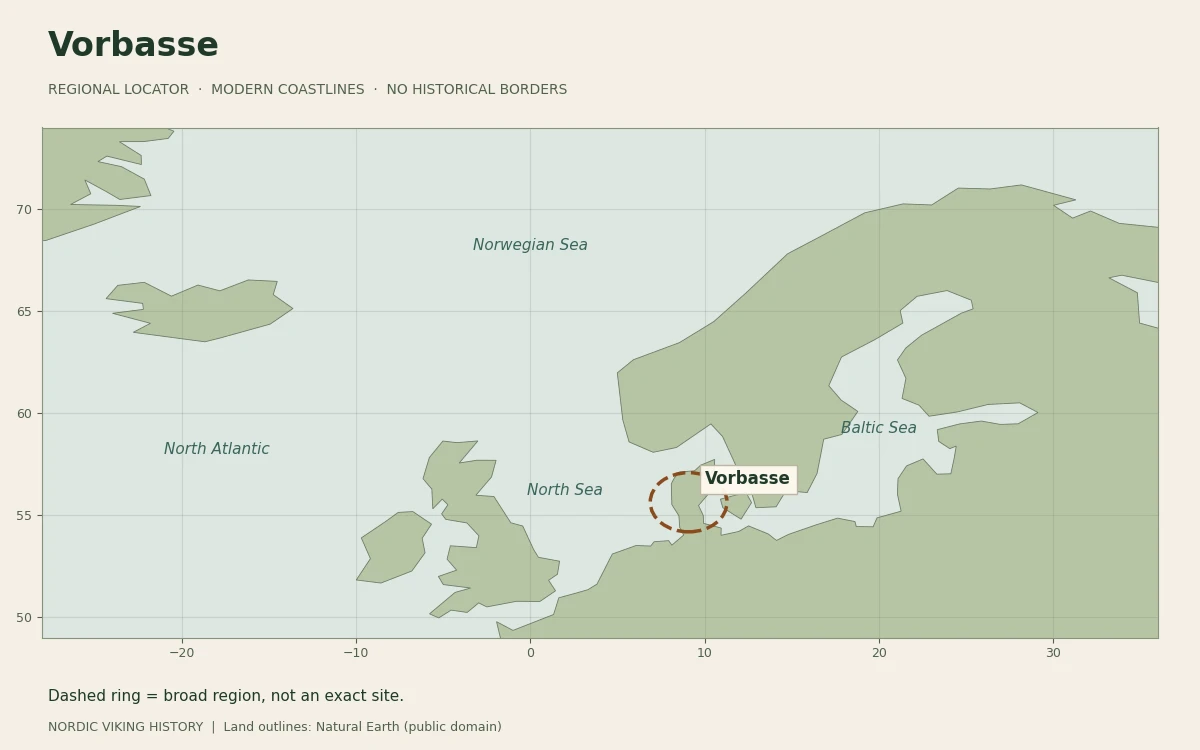
The historical setting
The archaeological village included households, agricultural buildings, boundaries, and working spaces. Changes in the arrangement and scale of farms reveal choices about labor and resources. A settlement plan is therefore more than an architectural drawing: it provides evidence for the relationship between households, livestock, cultivation, and production beyond immediate domestic needs.
What the evidence shows
National Museum interpretation highlights increasing cattle accommodation and the separation of dwelling and stable functions during the period. At Vorbasse, one farm could house about fifty animals. The wider argument is that agricultural production was becoming more substantial and could supply markets, although capacity alone cannot tell us exactly how every animal or product was used.
How to read this place
Imagine the work implied by a large herd rather than only counting buildings. Winter fodder, water, manure, repair, and supervision would shape household routines. The question then becomes how this production connected rural people with towns and exchange. Vorbasse helps explain that a ship’s provisions and a market’s food supply began with farms, even when the farmers themselves never joined an overseas voyage.
Explore more Viking-Age places →
The Evidence
The sources below support this article. Interpretations and limits are explained in the text; this is not an exhaustive research review.