
Viking crafts · An illustrated deep exploration
Rope & cordage.
From fibre to rigging.
A ship’s ropework begins with raw material. Bast, hair, hide and wool behave differently, and twisting small elements into larger ones turns fragile fibres into a working part of a rig.
01 · Material before technique
Different fibres make different ropes.
There was no single material called “Viking rope”. The Viking Ship Museum’s experimental work points to lime or linden bast as the main Viking-Age ropemaking material, supplemented by pine and other plant fibres, animal hair, wool and strips of hide.
Lime bast
Plant fibre from the inner bark of lime trees. Strong against abrasion and well suited to many rigging tasks.
Horsehair
Produces a rougher cordage. The museum uses it experimentally for sheet ropes and notes that it does not freeze as readily.
Hide & wool
Hide can be highly wear-resistant; wool is elastic. Both demonstrate that ropework was not limited to plant fibre.
Source: Viking Ship Museum, Ropemaker. Sources ↓
02 · Inside the bark
Lime bast starts as a tree resource, not loose string.
The useful fibres lie in the inner bark. In the Viking Ship Museum’s Gislinge experiment, lime was harvested in early summer, when bark could be removed more readily. Straight, relatively knot-free material was preferred.
Experimental production then separates and prepares the fibrous bast layer before it can be twisted. These modern projects reveal a plausible labour chain, but harvesting dates and preparation details recorded by the museum should be labelled as experimental practice rather than a complete preserved Viking-Age recipe.
Source: Viking Ship Museum, “Lime bast rope for the Gislinge Boat’s rig”. Sources ↓
03 · Make small elements continuous
Twist binds many fibres into a working yarn.
Short or flexible fibres become more useful when they are overlapped and twisted into a continuous element. The maker controls how fibres are added, how tightly they are twisted and how consistent the finished element becomes.
The direction of twist matters because the next stage can use counter-twist to stabilise the structure. A diagram can show this principle clearly, but archaeological rope should be described from the surviving cordage itself rather than assumed from a modern workshop convention.
04 · Build diameter in stages
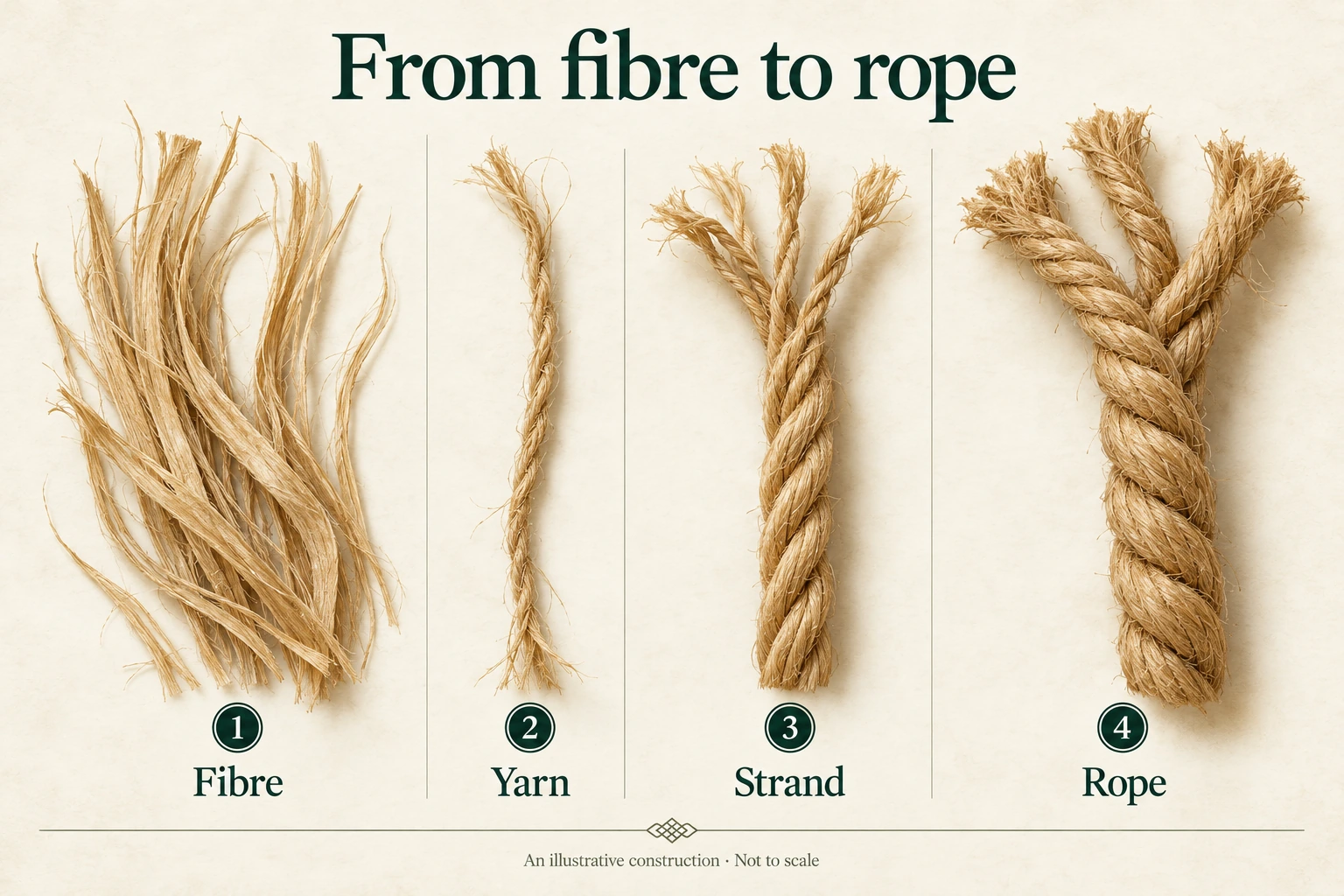
Yarns become strands; strands become rope.
Laying cordage means combining smaller twisted elements into larger ones. If the smaller elements are twisted one way and the next level is laid in the opposite direction, the opposing torsion helps the structure hold together.
A thick ship rope therefore contains a hierarchy. Cutting across a rope can reveal strands; separating a strand reveals smaller elements. Recording those levels is more useful than writing only “a piece of rope”.
05 · Follow the structure
Explore four levels of cordage.
Interactive teaching model
From loose fibre to rope
Choose one structural level. Follow the highlights from fibre to finished cordage.
All four structural levels are visible.
- Fibre. Prepared raw material overlaps with neighbouring fibres.
- Yarn or cord. Twist turns many fibres into one continuous element.
- Strand. Several smaller elements are laid together.
- Rope. Strands combine into the finished working cordage.
06 · A ship consumes enormous amounts of cordage
One rope is easy to overlook. A complete rig is not.
For the Sea Stallion reconstruction of Skuldelev 2, the Viking Ship Museum calculated about 1,400 metres of hand-made lime-bast rope plus roughly 600 metres of horsehair rope, with additional spare rope. The museum estimated about 5,450 hours of ropemaker labour for that experimental rig.
The project required hundreds of kilograms of prepared material. Those quantities describe the reconstruction, not a surviving Viking inventory, but they reveal why rigging should be treated as a major production system alongside the hull and sail.
Sources: Viking Ship Museum, “Rope” and Skuldelev 2 reconstruction. Sources ↓
07 · Give each rope a job
Standing and running rigging experience different forces.
Standing rigging braces structures such as the mast. Running rigging is adjusted during sailing and repeatedly moves through hands, fittings and contact points. The material that performs best in one place is not automatically best everywhere.
The museum’s reconstructions use different materials specifically to examine wear and behaviour. Kraka Fyr, for example, was rigged experimentally with linden-bast rope for mast support and bowline functions and horsehair rope for sheets and braces.
| Rigging question | Why material matters |
|---|---|
| Abrasion | Rope rubbing against wood or another rope may reward fibres that withstand friction. |
| Repeated knots | The museum notes that bast resists friction well but can be weakened by frequent knotting. |
| Cold and water | Horsehair has been tested for sheets partly because it does not freeze in the same way as some plant-fibre ropes. |
| Elasticity | Wool behaves differently from bast or hide and can absorb movement through stretch. |
Sources: Viking Ship Museum, Ropemaker; Kraka Fyr. Sources ↓
08 · Cordage beyond plants
Hair, hide and wool broaden the material toolkit.
The Viking Ship Museum includes ropes or rigging materials made from horsehair, cow-tail hair, pig bristle, wool and hides from animals such as seal, walrus, deer, elk or ox in its evidence-led overview.
These materials are not interchangeable. Hide can provide highly wear-resistant strips with relatively uniform thickness. Wool is elastic. Horsehair produces coarse rope with useful behaviour in cold conditions. A reconstruction should state where a material is archaeological, historical, ethnographic or experimental evidence.
09 · A familiar material with an evidence problem
Do not automatically turn Viking rope into hemp rope.
Hemp became a major ropemaking material in the medieval period, and modern visitors often recognise hemp rope immediately. That familiarity can create a misleading shortcut.
The Viking Ship Museum explicitly states that, to date, there is no definitive evidence for the production of hemp rope in the Viking Age. That does not prove that no Viking-Age person ever encountered or used hemp fibre; it means the stronger claim—routine Viking-Age hemp-rope production—is not supported securely enough to present as fact.
Source: Viking Ship Museum, Ropemaker. Sources ↓
10 · Reconstruction tests performance
Experimental ropes answer questions the wrecks cannot answer alone.
No Viking ship has been recovered with a complete, well-preserved rig. Reconstructors therefore combine ship traces, surviving cordage and tackle, period imagery, comparative traditions and practical trials.
The Viking Ship Museum’s long-term rope programme has used different reconstructed Skuldelev vessels to examine material choice, wear and sailing performance over years. These trials are evidence about how a reconstruction behaves. They do not transform missing original ropework into directly observed archaeological fact.
Sources: Viking Ship Museum, “The missing parts” and Work Reports. Sources ↓
11 · Rigging is maintained, not merely installed
Inspect, splice, replace and record wear.
Rope repeatedly bends, rubs, tightens and dries. Weakness can develop locally at contact points and knots long before the whole rope is unusable. The museum’s ropemakers therefore also maintain and repair rigging on working reconstructions.
A craft display should include worn rope beside new rope. Fraying, polishing, flattening and broken fibres make mechanical stress visible. A splice or replacement section can then show maintenance as part of the craft rather than an afterthought.
When comparing wear, record rope material, diameter, job in the rig, duration of use and weather exposure. “This rope lasted three years” means little without those conditions.
12 · Try the structure
Make three levels of cordage.
This is a modern learning activity, not a Viking rope recipe. Use safe soft fibres or yarn; children should be supervised if cutting tools are used.
- Prepare equal lengths. Use several short bundles of the same material so the comparison is controlled.
- Make a single twisted cord. Overlap material if necessary and keep the twist direction consistent.
- Make three matching cords. Measure their length after twisting. Compare it with the starting length.
- Lay the cords together. Combine them into one thicker strand or rope, turning in the opposite direction if your setup allows.
- Test gently. Compare flexibility, knotting and visible abrasion against an untwisted bundle. Do not perform high-load tests.
- Record the structure. Draw a cross-section and label fibre, smaller cord and final rope.
Follow the evidence
Sources & further reading
- Viking Ship Museum — Maritime Crafts: Ropemaker
Material evidence, lime bast, hair, hide, wool, hemp caution, and experimental performance.
- Viking Ship Museum — Lime bast rope for the Gislinge Boat’s rig
Modern lime-bast harvesting and preparation project.
- Viking Ship Museum — Rope
Sea Stallion / Skuldelev 2 reconstruction quantities and labour estimates.
- Viking Ship Museum — Sea Stallion from Glendalough
Scale of the full Skuldelev 2 reconstruction, including lime branches and horse tails for rope.
- Viking Ship Museum — Kraka Fyr
Long-term testing of linden bast and horsehair rope in different rigging functions.
- Viking Ship Museum — Work Reports
Ropes for five Skuldelev reconstructions and decades of craft experimentation.
- Viking Ship Museum — The missing parts
Why rigging reconstruction must combine multiple evidence types.
- Antiquity — Viking Age tar production and outland exploitation
Includes discussion of lime-bast preference in Danish Viking-Age boat cordage and the lack of archaeological tar-treatment traces on that rope.