
Journeys & Encounters · Deep dive
Birka’s Garrison: Buildings, Equipment, and Organized Protection


In Brief
A terraced complex beside Birka’s hillfort reveals how buildings, armor, archery equipment, dress, and storage contributed to a distinctive military setting.
On this page
A defensive neighborhood outside the hillfortBuildings changed while some spaces remained fixedArmor assembled from small platesArchery equipment in particular placesDress could communicate military standingFragments also point toward storageSourcesA defensive neighborhood outside the hillfort
The area called the Garrison lies immediately west of Birka's hillfort, across a series of terraces. Its modern name reflects interpretation rather than a surviving Viking Age designation. Hjalmar Stolpe investigated the area in 1877 and initially connected its charcoal-rich deposits and burned bones with cremation. Holger Arbman's excavations in 1934 recovered weapons and armor fittings that encouraged a different explanation: a place associated with the settlement's defense.
Larger Stockholm University investigations between 1997 and 2004 revealed buildings of different forms and possible functions, including accommodation, storage, and workshops. A tenth-century hall on Terrace I became known as the Warriors' House because of its weapon finds. Partial enclosing defenses and the concentration of martial equipment strengthen the defensive interpretation. Burned buildings and scattered arrowheads have also prompted an attack scenario, but the archaeological neighborhood needs to be understood through its successive occupations, not only through a proposed final battle.
Sources for this section: 1
Buildings changed while some spaces remained fixed
Liselotte Bergström's reanalysis identified at least eleven buildings on the three most closely investigated terraces, spanning the middle ninth through later tenth century. On Terrace I, two earlier framed buildings preceded the large hall. On Terrace II, successive buildings occupied the same position even though unused ground was available nearby; a stone-paved courtyard remained in place across several phases. This suggests persistent organization within the changing built environment.
The smithy on Terrace II had a raised hearth platform, a strengthened floor, possible anvil supports, and concentrations of smithing waste. A later building partly overlaid the smithy's stones without clearing them to create a level ground floor, suggesting an elevated wooden floor instead. Its precise date remained uncertain. These details show why a collection of weapons cannot stand for the entire history of the complex: maintaining equipment, rebuilding houses, and organizing working space formed part of its material life.
Sources for this section: 2

Armor assembled from small plates
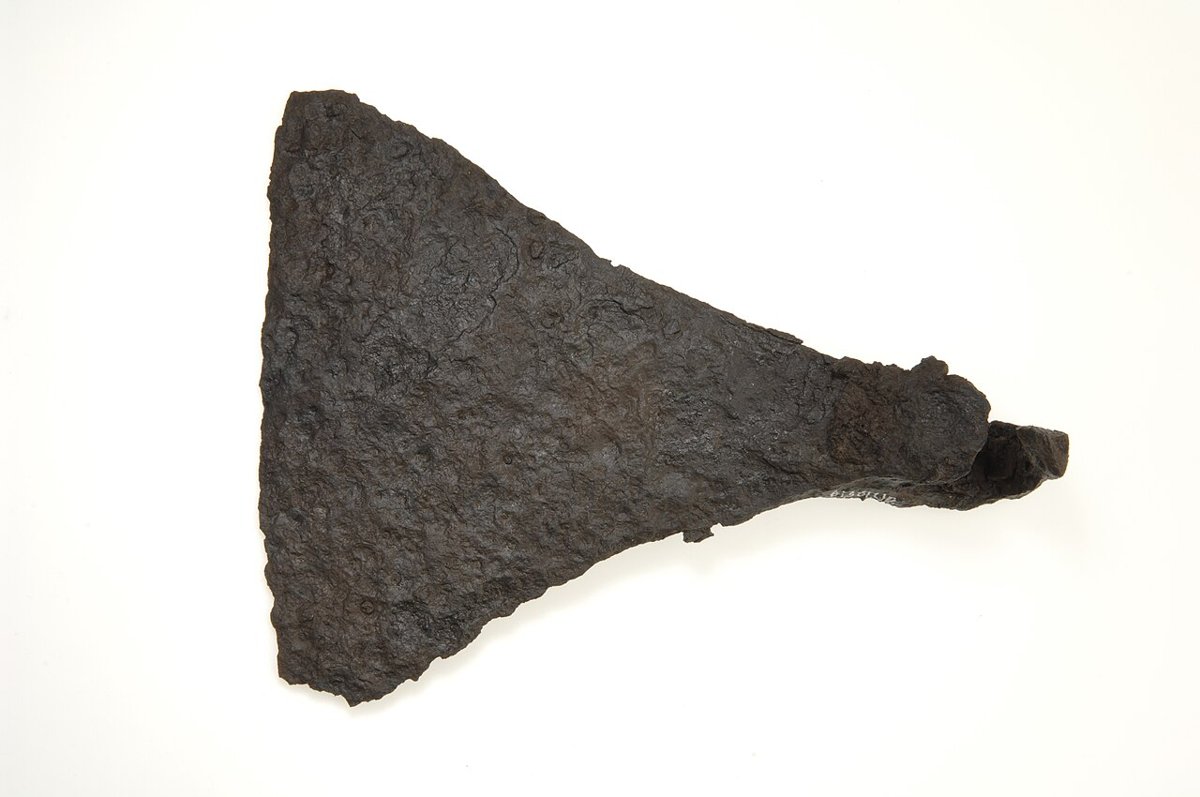
Niklas Stjerna's study examined lamellar armor fragments recovered in several excavation campaigns, including finds from 1877, 1934, and 1998–2000. Lamellar protection was assembled from individual plates rather than the interlinked rings of mail. Stjerna identified eight plate types and considered where they might originally have fitted within a suit. One particularly informative surviving portion consisted of twelve plates, giving evidence beyond the shape of an isolated fragment.
The comparison depended on several features together: the profile of the edges, rounded projections, hole positions, thickness, and variation in plate form. Parallels in Central Asia and central Siberia led Stjerna to propose an Old Turkic connection and a tentative date around 900–950. He did not establish a certain place of manufacture. The armor consequently supports a specific technological comparison while leaving open how it reached Birka, how many people used such equipment, and what proportion of the defensive group wore it.
Sources for this section: 3
Archery equipment in particular places
The study Eastern Archery in Birka's Garrison examined metal fittings associated with equipment whose organic components rarely survive. Quiver loops, arrowheads, and a possible thumb ring supplied evidence for connections with Eurasian archery traditions. Three quiver loops and the proposed ring occurred beside the western end wall of the hall, while another loop lay near a northeastern roof-supporting post. Additional loops came from locations south of the hall and near the smithy.
This distribution allows researchers to ask how equipment was kept and used, rather than merely listing foreign-looking objects. The identification of closed quivers depends on fittings and comparisons, because their leather, bark, wood, and other organic components have largely disappeared. The authors also compared grave Bj.1125b, which contained quiver and bow-case fittings, arrowheads, and an accompanying horse burial. The comparison connects settlement and burial evidence, though the presence of equipment alone cannot measure an individual's proficiency or reconstruct a particular engagement.
Sources for this section: 4
Dress could communicate military standing
Charlotte Hedenstierna-Jonson and Lena Holmquist Olausson studied a different part of the equipment: decorative mounts associated with clothing, belts, and belt pouches. Their work drew attention to a complete belt set with steppe-nomadic connections among the Garrison finds. These items belonged to an ensemble of appearance as well as utility. A belt could carry equipment while its fittings made its wearer recognizable within a particular visual tradition.
The authors argued that Birka's warriors adopted aspects of the meanings attached to eastern mounted-warrior dress, including expressions of rank and status. That is a social interpretation built from the objects and their comparisons, rather than an inscription explaining the wearer's intentions. Its value is to widen the discussion of military organization beyond the shape of weapons. Shared dress and equipment could help people present themselves as members of a group, while conspicuous differences might communicate distinctions within it.
Sources for this section: 5
Fragments also point toward storage
Anna Bäckheden's study of flat iron fragments from the hall asked which objects those pieces had originally formed. Some could not be securely classified from their shape and position. Among the identifiable material, she interpreted many fragments as components of chest fittings or shields. Their distribution suggested that a large chest might once have stood in the southwest corner of the building. The proposal remained a reconstruction from fragmentary evidence, not the excavation of an intact furnished room.
Storage belongs in the history of armed protection because equipment and other possessions had to be accommodated as well as carried. A chest interpretation raises practical questions about access, contents, and custody that the fragments cannot fully answer. Read alongside the terraces, smithy, armor, archery fittings, and decorated belts, the iron scraps give the Garrison a more substantial human setting: a changing place of work, assembly, equipment, and possessions, with defense among its defining activities.
Sources for this section: 6
For the introductory context, read Birka and Hovgården: Trade, Power, and Burials.
The Evidence
The sources below support this article. Interpretations and limits are explained in the text; this is not an exhaustive research review.
- Swedish History Museum: the Garrison at Birka ↗
- Liselotte Bergström: buildings in Birka’s Garrison, 2015 ↗
- Niklas Stjerna: steppe-nomadic armor from Birka, 2004 ↗
- Lundström, Hedenstierna-Jonson, and Holmquist Olausson: Eastern Archery in Birka’s Garrison ↗
- Royal Academy: The Oriental Mounts from Birka’s Garrison ↗
- Anna Bäckheden: study of flat iron fragments, thesis abstract ↗