
Journeys & Encounters · Deep dive
Clontarf: Alliances, Dynastic Memory, and a Powerful National Story
In Brief
The battle of 1014 became a story of liberation, but its participants and its medieval retellings resist a simple division into two peoples.
On this page
The battle and the question being askedCoalitions crossed the supposed national dividing lineAn emperor in a manuscriptA story written for descendantsStyle helps construct the heroWhat a network analysis can measureThe debate has more than two positionsObjects and narratives answer different questionsSourcesThe battle and the question being asked
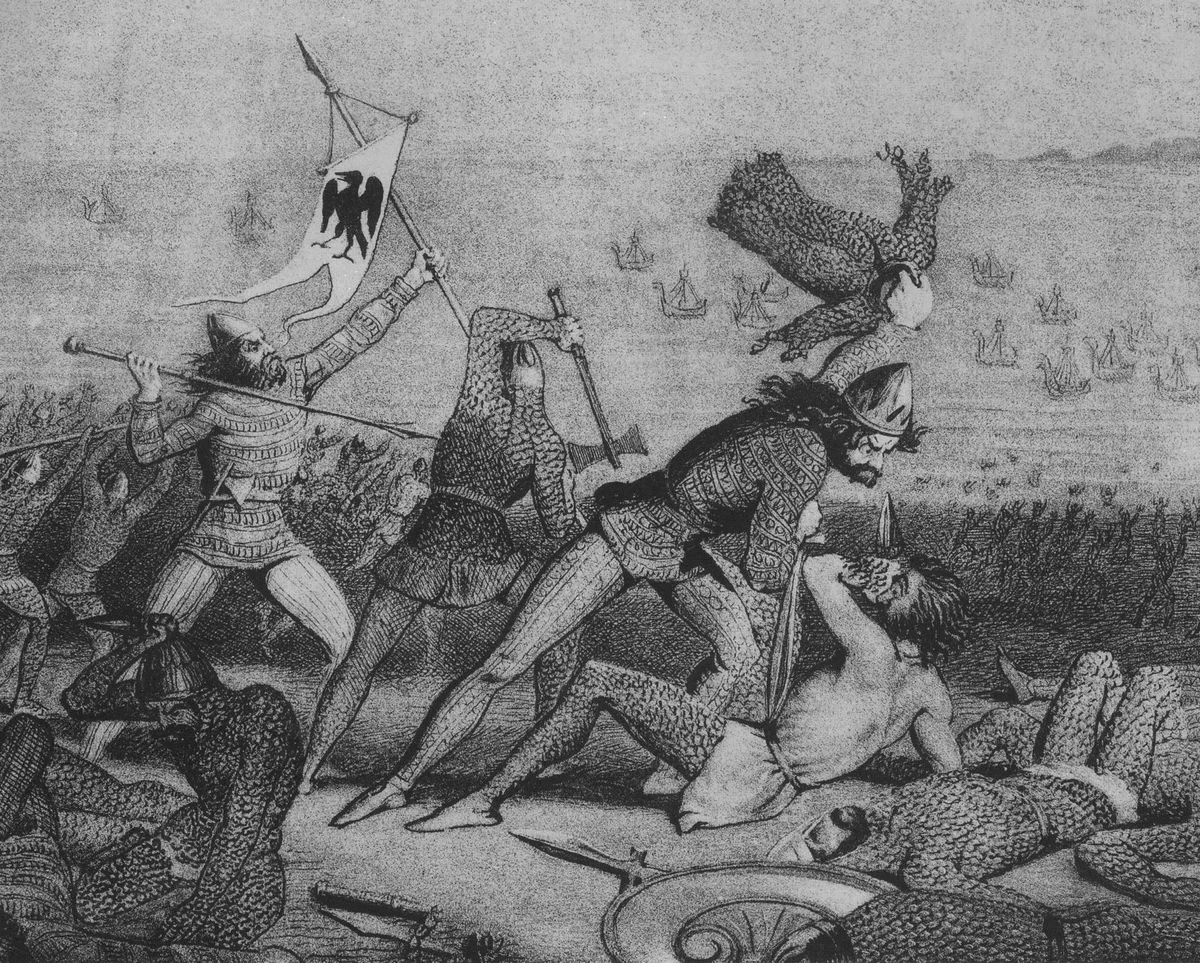
Brian Boru died in the conflict at Clontarf in 1014, while his side won the battle. That combination of victory and personal loss gave later writers unusually powerful material. The National Museum of Ireland’s exhibition explicitly challenges the familiar picture of a Christian king expelling pagan Vikings from Ireland. Its framing asks visitors to separate what led to the battle, what happened, and what followed. These are different problems. A victory can change the balance between rulers without removing a population, ending maritime trade, or producing a unified nation. The first step is to identify which of those outcomes a particular account actually claims.
Sources for this section: 1
Coalitions crossed the supposed national dividing line
Research on the medieval narrative describes Brian and his allies fighting the forces of Dublin, Leinster, and their overseas associates. Irish participants therefore appeared on opposing sides. This matters because a modern map of national identities cannot explain the coalition by itself. Rulers sought advantage within a competitive political landscape, and local opposition to an overking could intersect with interests reaching beyond Ireland. The conflict did have a Scandinavian dimension; acknowledging alliances does not erase it. Instead, the composition of the sides requires us to ask how local rivalries and external participation reinforced one another. Neither a purely domestic feud nor a uniform ethnic confrontation captures the whole problem.
Sources for this section: 2

An emperor in a manuscript
Trinity College’s exhibition places Brian’s public authority alongside the Book of Armagh. An inscription associated with his visit in 1005 describes him as emperor of the Gaels. This is unusually valuable evidence because it belongs to his lifetime, unlike much of the elaborate narrative about his final battle. The title displays an ambitious claim to supremacy. It does not automatically demonstrate that every community accepted his authority in the same way. Comparing a contemporary honorific with a later account of victory helps distinguish political aspiration from retrospective celebration. The manuscript preserves a particular act of recognition, with a setting and audience, rather than a modern constitutional definition of Ireland.
Sources for this section: 3
A story written for descendants
Cogadh Gáedhel re Gallaibh became one of the principal vehicles for Brian’s heroic reputation. Trinity’s manuscript exhibition explains its connection with the interests of his descendants, including those who adopted the surname Ó Briain. The text casts his death in a Christian sacrificial pattern and presents resistance to foreign enemies as the defining achievement of his life. Such a purpose does not make every event in the narrative fictitious. It does make selection, emphasis, and moral contrast part of the historical evidence. A reader should ask whose ancestry becomes legitimate through the story and which rivals become less visible when Brian occupies its center.
Sources for this section: 4
Style helps construct the hero
A study in Irish Historical Studies examines the contrast between the narrative’s compressed treatment of earlier events and its expansive account of Brian’s reign. Rather than treating these styles simply as evidence for two unrelated works joined together, the study argues that they serve a unified purpose: magnifying the culminating victory. This is a useful lesson in reading chronicles and sagas. Length, rhythm, and descriptive intensity distribute importance. A long battle scene can make an event feel like the inevitable conclusion of generations of conflict. Examining that design allows readers to appreciate the work’s literary power without letting its architecture silently determine their own historical explanation.
Sources for this section: 2
What a network analysis can measure
A published network study turns the narrative’s named characters and their interactions into a quantitative comparison. Its results occupy a middle position between sharply opposed interpretations: many hostile interactions connect Irish and Scandinavian characters, but conflict within those categories is also substantial. Crucially, the researchers state that they are analyzing the social world portrayed by the text. They do not possess a complete record of actual eleventh-century relationships. A network diagram therefore tests the structure of this source’s representation. It cannot remove the source’s selective survival, dynastic purpose, or retrospective viewpoint. Numerical methods become most informative when their object of measurement is stated precisely.
Sources for this section: 5
The debate has more than two positions
Trinity’s account of its 2014 conference records a strong disagreement with the idea that Clontarf was merely a provincial grudge match. Seán Duffy emphasized the seriousness of the overseas threat and the significance of Brian’s followers understanding the outcome as victory despite his death. This interpretation deserves to stand beside the evidence for mixed alliances, rather than being reduced to a discarded national legend. Historians can reject a simple expulsion story while disagreeing about the scale and objectives of external intervention. The important distinction is between demonstrating that an old formula is inadequate and proving one replacement explanation in every detail.
Sources for this section: 6
Objects and narratives answer different questions
The museum exhibition juxtaposes weapons, silver, religious objects, and much later commemorative material. This range encourages a history larger than the battlefield alone. Weapons illuminate equipment; hoards illuminate the movement and protection of wealth; later objects reveal the continuing usefulness of Brian’s memory. None by itself supplies a complete list of combatants or a reliable transcript of their motives. Together with manuscripts, however, they show why Clontarf remained available for reinterpretation. The strongest account retains the battle’s importance while specifying its evidence: a decisive conflict, complex coalitions, an ambitious king, and a literary afterlife that gave later generations an unusually compelling political story.
Sources for this section: 1, 3, 4, 5, 6
The Evidence
The sources below support this article. Interpretations and limits are explained in the text; this is not an exhaustive research review.
- National Museum of Ireland: Clontarf 1014 exhibition ↗
- Irish Historical Studies: stylistic contrast and narrative function ↗
- Trinity College Dublin: Clontarf conference and manuscript leaflet ↗
- Trinity College Dublin: Brian Boru’s world ↗
- Royal Society Open Science: network analysis of the Cogadh ↗
- Trinity College Dublin: interpretations at the Clontarf conference ↗