
Journeys & Encounters · Deep dive
Gnezdovo: Waterfront Life and Networks on the Upper Dnieper
In Brief
River landscapes, imported silver, glass technologies, and rare inscriptions reveal a community connecting several worlds through everyday activity.
On this page
A settlement in a changing river landscapeWhen did the settlement begin?Boats, waterfront activity, and a final fireSilver that changed its functionThousands of beads, several technologiesAn inscription is not a literacy rateSourcesA settlement in a changing river landscape
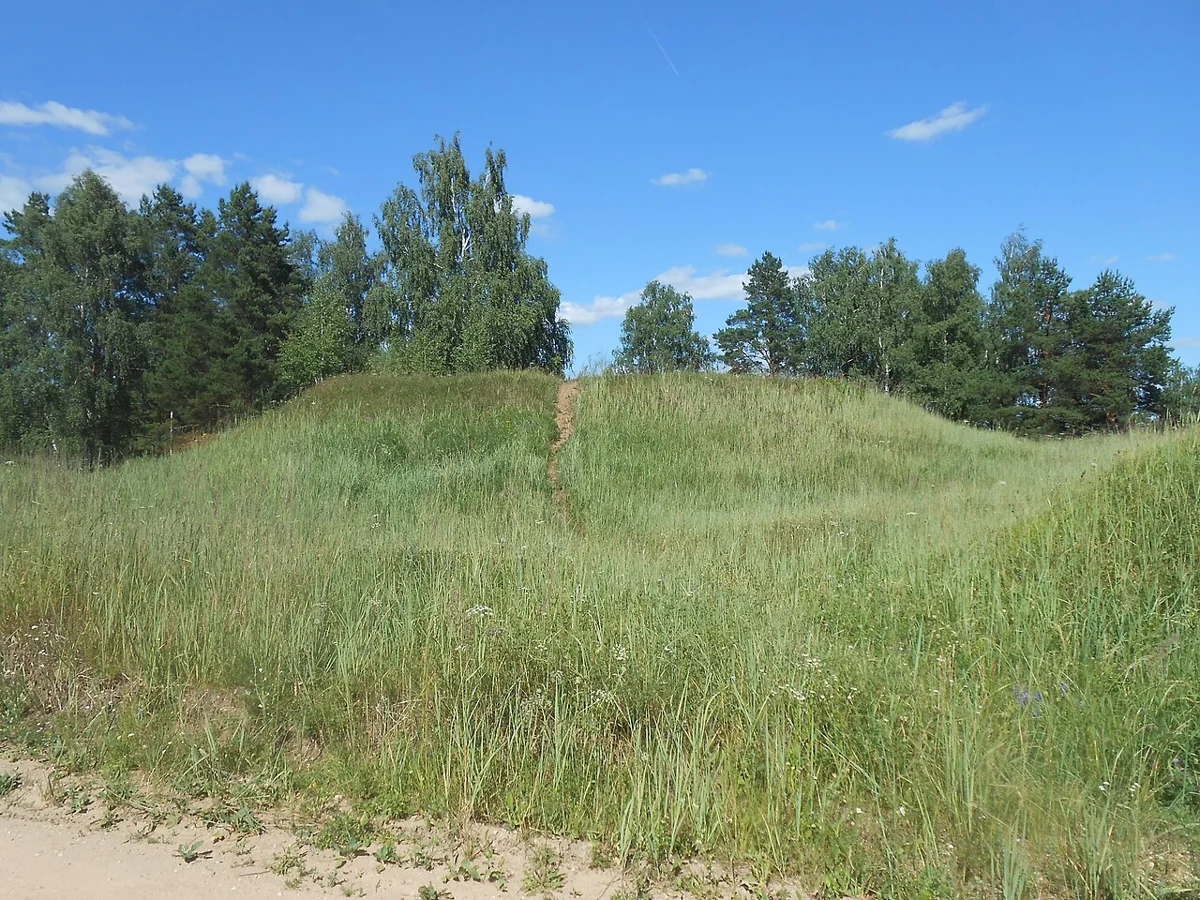
Gnezdovo near Smolensk occupied a landscape of the upper Dnieper and smaller tributaries, rather than a timeless line drawn between the Baltic and Black seas. Research published in 2025 combines archaeology, radiocarbon dates, and pollen evidence from its western area. The authors reconstruct changing river positions and identify settlement and economic activity along the floodplain and the Olsha and Lubnya valleys.
They propose intensive agricultural use of lower valley surfaces beginning as early as the fifth century. That is evidence for a longer inhabited landscape, not a claim that the famous Viking-age trading center already existed then. Continued land use also disturbed older settlements. A dense distribution of burial mounds can therefore be more visible than the occupation sites that accompanied it. Reconstructing Gnezdovo's connections requires both the navigable landscape and the communities using it, while recognizing that later cultivation has altered their archaeological visibility.
Sources for this section: 1
When did the settlement begin?
Gnezdovo's foundation chronology has been debated between relatively early and late models, conventionally emphasizing the ninth or tenth century. A 2020 study introduced radiocarbon wiggle matching because many artifact dates were broad and an adequate local tree-ring chronology was unavailable. The researchers examined four tree trunks, three associated with the earliest group of occupation deposits.
Their results placed the settlement's emergence no later than the final quarter of the eighth century. This is a published scientific interpretation of sampled deposits, not a universal date for every mound and neighborhood. The importance of the study lies in moving the discussion beyond circular reliance on artifacts already assigned to an assumed historical period. An early construction phase can predate the richest surviving burials. Equally, establishing earlier occupation does not tell us when the settlement reached its greatest extent or acquired every function associated with its later prominence.
Sources for this section: 2


Boats, waterfront activity, and a final fire
Excavations around Lake Bezdonka, below the central fortified area, have identified structures associated with waterfront activity and wooden ship components. The State Historical Museum's 2024 field report describes deposits reaching about 1.5 meters thick, divided into earlier and later phases. That season concentrated on upper levels.
A final occupation horizon contained traces of burning, thirteen arrowheads, and a broken spearhead. The excavators proposed an assault as a possible explanation for the settlement's destruction. The combination warrants attention, but the report presents an interpretation requiring further work, not a fully reconstructed battle. Domestic objects, spindle whorls, ornaments, horse equipment, and glass gaming pieces also occurred in the same broad horizon. The waterfront was thus an inhabited working environment, not merely a point where travelers changed boats. Its deposits combine transport, household activity, material wealth, and evidence relevant to the settlement's ending.
Sources for this section: 3
Silver that changed its function
A hoard excavated in 1993 in the eastern unfortified settlement contained 395 objects. The museum dates it to the second half of the tenth century and records its discovery in a shallow pit within an area of residential and associated structures. Its contents include silver ornaments, weighing equipment, and Arabic dirhams.
Some coins had suspension fittings soldered onto them, converting money into wearable ornaments. This is direct evidence that an imported object could acquire a new use after leaving its mint. Earrings, pendants, beads, and other jewelry make the deposit more than a sack of interchangeable currency. It joined objects with different histories and bodily associations. The hoard's context gives a place of concealment, but not the identity of its owner or a complete explanation for deposition. Its strongest contribution is showing how exchange, adornment, and stored wealth overlapped within one settlement household environment.
Sources for this section: 4
Thousands of beads, several technologies
Olga Dobrova's technological study examined a burial corpus of more than 12,000 glass beads. Most could be assigned to nine manufacturing groups comparable with material from Staraya Ladoga, but unusual specimens complicate any single account of supply. Some were formed from molten lumps, some apparently used molds, and others combined multiple pieces or layers.
A particularly rare technique involved a copper tube. Such details matter because beads that look broadly similar can embody different manufacturing sequences. Conversely, a widely shared technique does not establish a single workshop or the birthplace of its user. Dobrova questions a universal explanation that internal cores merely saved expensive glass: shaping and other practical considerations also need attention. For a site connected with distant exchange, technological analysis helps separate the appearance of an ornament from how it was produced. The burial assemblage records consumption and funerary selection as well as the circulation of crafted goods.
Sources for this section: 5
An inscription is not a literacy rate
An amphora found in moundL-13 in 1949 carries a much-discussed Cyrillic inscription. Alexandr Fetisov's 2024 review traces competing readings that identify its contents, an owner's name, or other meanings. The burial's date has also been revised, and the inscription may have been applied outside Gnezdovo before the vessel traveled there.
Other objects include scissors with Arabic lettering and later writing implements. These finds show contact with written cultures, but their significance differs. An imported inscription can arrive with an object even if its recipient cannot read it; a stylus more directly raises the possibility of local writing practice. Fetisov emphasizes the limited evidence rather than assuming widespread literacy from a celebrated artifact. Gnezdovo's networks brought together objects, technologies, and scripts from different directions. Understanding that interaction requires asking what each object actually documents, rather than converting every imported feature into a fixed ethnic or linguistic identity.
Sources for this section: 6
For the introductory context, read The Eastern River Routes: Waterways and Portages.
The Evidence
The sources below support this article. Interpretations and limits are explained in the text; this is not an exhaustive research review.
- Krenke and colleagues2025: western Gnezdovo landscape research ↗
- Murasheva and colleagues2020: radiocarbon chronology ↗
- State Historical Museum:2024Gnezdovo expedition report ↗
- State Historical Museum:1993Gnezdovo hoard ↗
- O.P.Dobrova2018: glass bead manufacturing technologies ↗
- Alexandr Fetisov2024: writing practices at Gnezdovo ↗