
Journeys & Encounters · Deep dive
Lejre: Great Halls, Remembered Kings, and a Changing Landscape
In Brief
Successive halls establish Lejre as a major center of power. Small objects, burial monuments, and research beyond the palisade show why its history extends beyond the legendary kings.
On this page
What a great hall establishesMoving the residence while preserving the institutionThe small figure and the large interpretationMonuments altered by later generationsGrydehøj and a revised burial landscapeFollowing evidence beyond the enclosureSourcesWhat a great hall establishes
The great halls at Lejre changed a historical debate without resolving every part of it. Medieval traditions placed the Scylding kings here, but excavated building plans now independently establish a major center of power. A particularly large hall discovered in 2009 exceeded 60 meters in length and measured about 12 meters across. The museum dates its construction to the late eighth or early ninth century.
Such a building required timber, labor, planning, and sustained access to resources. Its scale supports interpretation as an elite or royal residence. It does not supply the personal name of its occupant. Lejre Museum itself discusses how Saxo's account served later political interests and how descriptions of seating and hospitality depend partly on younger written sources. The archaeological hall and the literary court can therefore illuminate related questions without becoming interchangeable evidence. A monumental building is secure; identifying its ruler as a particular saga king remains another claim.
Sources for this section: 1
Moving the residence while preserving the institution
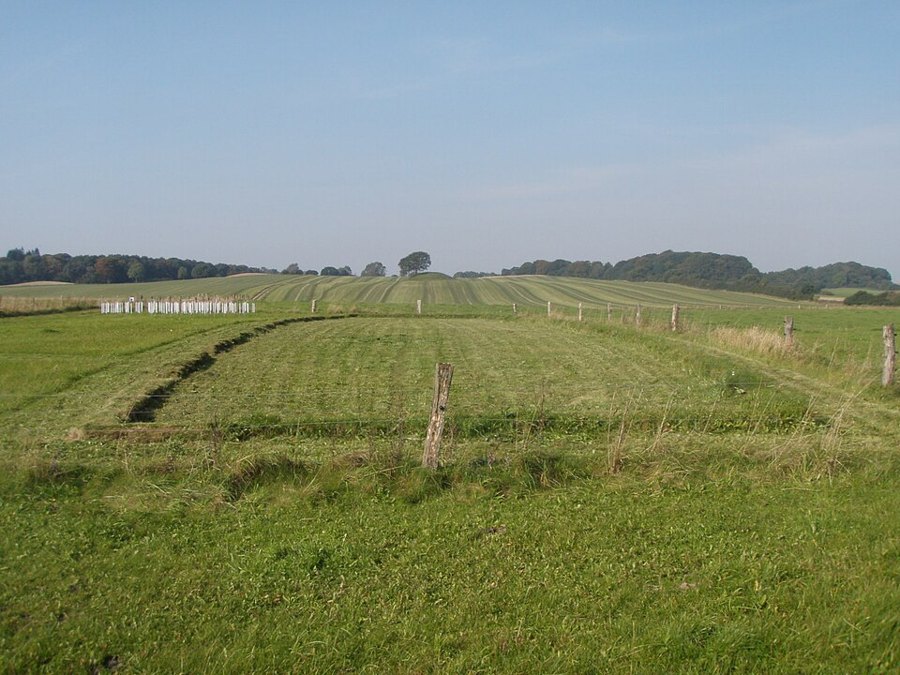
Lejre's elite center did not remain fixed on one building footprint. At Fredshøj, a residence established around 500 included a hall approximately 47 meters long. Around 600 the focus moved roughly 500 meters south to Mysselhøjgård. There, two neighboring enclosed areas eventually formed a more complex residence landscape.
The northern enclosure contained successive large halls, including the exceptionally long building. Around 900 the principal hall shifted into the southern enclosure, where further rebuilding maintained a central hall with associated structures. This sequence is more informative than treating every outline visible on a site plan as contemporary. Several monumental buildings represent replacement and relocation, not necessarily a crowd of rival rulers living side by side. The repeated investment suggests continuity in the place's political importance, while changes in arrangement show that continuity did not require architectural immobility. Archaeology documents a durable institution more readily than an unbroken family genealogy.
Sources for this section: 2

The small figure and the large interpretation
A hollow silver figure discovered during the 2009 excavations depicts a seated person accompanied by two birds. It weighs about 9 grams and is less than two centimeters high. Lejre Museum interprets the combination of throne, ruler, and birds as Odin with his ravens, and dates the figure stylistically to approximately 900–950.
The identification is debated, as the museum acknowledges. Clothing and bodily details have prompted alternative readings, while the hollow construction leaves its original attachment and use unresolved. It may have functioned as an amulet or as part of another object, but neither possibility is established by its survival alone. The figure nevertheless demonstrates skilled metalworking and elaborate imagery within the elite landscape. Its interpretive value lies in the conjunction of features. Calling any seated person Odin would be too simple; calling this particular figure securely identified would also conceal the actual debate.
Sources for this section: 3
Monuments altered by later generations
The stone ships east of the residence are archaeological monuments and products of a long preservation history. In 1758 the antiquarian L.A.Gebhardi recorded more than 150 stones, although he interpreted them as remains associated with a legendary royal building. His identification was wrong, but his observations retained evidence for monuments subsequently damaged.
Large stones became useful building material, and many disappeared into later construction. In 1921 remaining stones were threatened with blasting before local preservation efforts secured the site. National Museum restoration in 1926 raised surviving stones again. Consequently, the visible arrangement should not be treated as an untouched Viking-age scene. Old drawings, excavations, and restoration records help explain its present form. Old drawings can retain observations that later archaeology interprets differently.
Sources for this section: 4
Grydehøj and a revised burial landscape
Grydehøj contains the remains of an exceptionally elaborate cremation. The museum's account describes a large burning deposit beneath the mound, animal remains, and tiny gold threads consistent with richly decorated clothing. The burial belongs to the seventh century, well before the end of Lejre's residence sequence. Its occupant remains anonymous.
The relationship between the mound and the neighboring stone ships has been reconsidered. A 2020 museum article treated their precise chronological relationship as unresolved, while a more recent exhibition account reports research proposing that Grydehøj and at least four ship settings formed a combined seventh-century monument. This is a developing interpretation, not permission to identify the deceased with a named legendary king. It also changes the historical question: the stone ships may belong to the earlier creation of an elite commemorative landscape rather than simply being additions beside an ancestral mound centuries later.
Sources for this section: 4, 5
Following evidence beyond the enclosure
Recent research has widened attention beyond the halls. Excavation in 2019 identified a gateway through the palisade, while a 2021 pilot project used ground-penetrating radar around both the residence and burial monuments. Comparisons with previously excavated features allowed researchers to assess what the instrument could recognize locally.
Some known postholes produced clear signals because their fills contained contrasting materials, including stone and clay. Other possible posts were less visible. The lesson is practical: an apparently empty radar image need not mean an empty ancient landscape. Researchers combine geophysics with metal finds, historical mapping, and excavation records to choose where further work is worthwhile. The larger aim is to recover the activities supporting the monumental center. Halls reveal where power was displayed; workshops, crossings, and surrounding occupation may explain how people supplied, approached, and sustained it.
Sources for this section: 6
The Evidence
The sources below support this article. Interpretations and limits are explained in the text; this is not an exhaustive research review.
- Lejre Museum: halls, kingship, and written tradition ↗
- Lejre Museum: successive residence areas ↗
- Lejre Museum: interpreting the Odin figure ↗
- Lejre Museum: monuments and their preservation history ↗
- Lejre Museum: new interpretation of Grydehøj and ship settings ↗
- Kastholm, Nielsen, and Stamnes: Lejre radar pilot project ↗