
Journeys & Encounters · Deep dive
Gamla Uppsala Before and During the Viking Age

In Brief
Monumental mounds, timber halls, ordinary farms, and a misleading place-name reveal a center that changed over many centuries.
On this page
The monuments were already oldOpening the mounds did not reveal named kingsThe timber architecture changed the landscapeBeyond the royal estateLong lines of postsTesting the so-called sacrificial groveContinuity did not mean an unchanged centerSourcesThe monuments were already old
The great mounds at Gamla Uppsala belong to a history beginning well before the conventional Viking Age. Treating them as monuments built by the people described in eleventh-century accounts collapses several centuries into one scene. Archaeological research instead distinguishes the monumental estate of the sixth through eighth centuries from its later transformations. John Ljungkvist and Per Frölund’s synthesis examines halls, workshops, courtyards, fences, mounds, and resource use as parts of a connected complex. This changes the central question. Rather than asking which famous king occupied a mound, researchers investigate how buildings and earthworks created an exceptional place, how that arrangement was maintained, and which elements survived when the organization of the center changed.
Sources for this section: 1
Opening the mounds did not reveal named kings
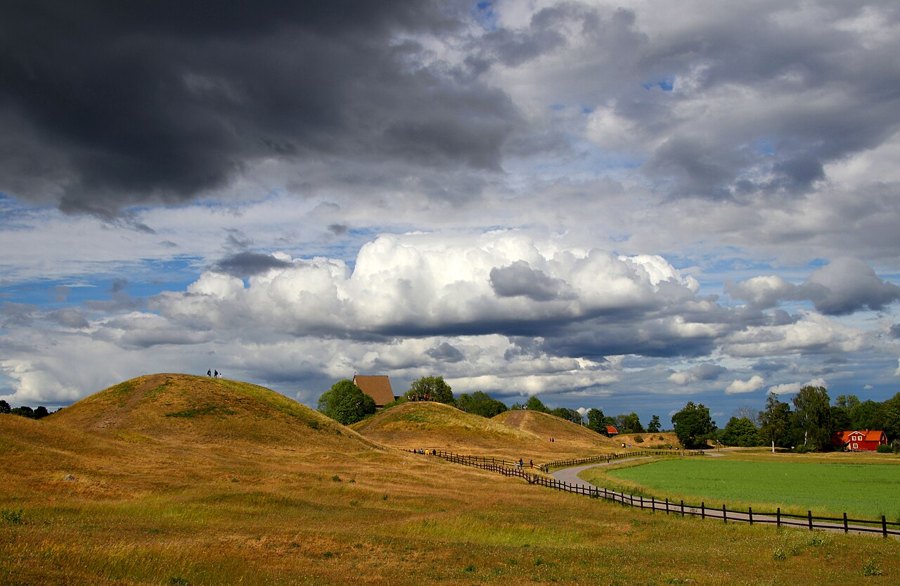
Nineteenth-century excavators tested whether the great hills were artificial burial monuments. Work in the eastern mound in 1846 reached a stone cairn and cremated remains; excavation of the western mound in 1874 also identified a cremation burial. Among the fragmented objects were helmet remains and gold from the eastern mound, and goshawk remains in the western one. The museum associates the latter with elite hunting. These finds support high status, but they do not identify named individuals. Older names linking the mounds with gods belong to their later interpretation. The scale of construction and the selection of grave goods are evidence for exceptional funerary investment; genealogy requires another kind of evidence that the excavations did not supply.
Sources for this section: 2
The timber architecture changed the landscape
Research at the estate has linked previously isolated features into a broader spatial sequence. Monumental building platforms, a great hall, working areas, and boundaries made the central zone physically distinct. The Uppsala University reconstruction project deliberately represented a period roughly a century before the Viking Age, when major monuments were already present. That chosen date is an important discipline: a reconstruction needs a particular moment, rather than every impressive feature ever found on a site. A hall in an elevated position could dominate views and organize approaches, but its full superstructure remains reconstructed from the surviving evidence. The digital image should therefore be read as a research-based proposal for a dated landscape, not as an ancient picture recovered intact.
Sources for this section: 1, 3
Beyond the royal estate
Railway investigations opened approximately 70,000 square meters near the monumental core. Farms from the Vendel period, Viking Age, and Middle Ages were studied, along with more than a hundred graves. Finds included dress ornaments and a sword bent around an urn. The expanded excavation area matters as much as the striking discoveries: it exposed people and activities outside the most celebrated monuments. Craft work, cooking, farming, and burial now contribute to the history of the center. A great hall required a supporting landscape, yet those who lived around it were not simply background figures. Their buildings and graves allow researchers to compare changing local practices with the conspicuous statements made by the estate.
Sources for this section: 4
Long lines of posts
The railway project also revealed two extensive alignments of substantial timber posts. Their discovery altered the known scale of organized construction. The excavators discuss a possible processional function, but a surviving post foundation does not preserve the words or actions that once occurred beside it. The published project separates catalogs of foundations, activity areas, fences, roads, and graves, enabling relationships to be tested rather than inferred from an evocative name. Animal remains, construction traces, and the positions of adjoining routes become relevant when evaluating what the lines did. Their physical existence is secure; the exact ceremonies, rules of movement, and meanings associated with them remain interpretive questions. The difference is particularly important at a place already surrounded by powerful literary traditions.
Sources for this section: 5
Testing the so-called sacrificial grove
An investigation in the area called Offerlunden, or the sacrificial grove, offers a useful counterweight to dramatic expectations. Excavators found that a depression had been deepened in the nineteenth century, removing older deposits. A hearth at its base showed that it was not always waterlogged in the way its later appearance suggested. The report did not identify ritual remains in the investigated trenches. It instead discussed material extraction and settlement activity, while acknowledging that other parts of the area remained untested. A suggestive name had generated a question, not supplied its answer. The case demonstrates why the modern landscape cannot be used without checking drainage, excavation, and other changes that occurred after the period under study.
Sources for this section: 6
Continuity did not mean an unchanged center
The regional museum’s recent research overview describes a substantial settlement around the estate, with many farms and an extensive burial landscape. Only part of that landscape remains visible. The combination of ordinary settlement and monumental architecture makes Gamla Uppsala more than a group of mounds. It also prevents a simple narrative of abrupt disappearance at the start of the Viking Age. Features were retained, rebuilt, removed, or given different settings, while later Christian construction changed the central area again. The strongest historical account follows these transformations individually. Monumental scale, sustained occupation, and later religious importance are connected observations, but they do not establish that one dynasty, one building plan, or one set of rituals endured without interruption.
Sources for this section: 1, 7
The Evidence
The sources below support this article. Interpretations and limits are explained in the text; this is not an exhaustive research review.
- Ljungkvist and Frölund: emergence of the magnate complex ↗
- Upplandsmuseet: the archaeological landscape ↗
- Uppsala University: a dated landscape reconstruction ↗
- Arkeologerna: railway excavation and settlement ↗
- Arkeologerna: excavation publications and feature catalogs ↗
- Upplandsmuseet: Offerlunden excavation report ↗
- Upplandsmuseet: recent research synthesis ↗