
Journeys & Encounters · Deep dive
Sigtuna and the Reorganization of the Mälaren World
In Brief
A planned street, royal minting, early cemeteries, and mobile inhabitants reveal several different processes behind the emergence of Sigtuna.
On this page
A new town is more than a new marketThe evidence of the narrow propertiesMinting as a visible claimChristian burial before the surviving churchesMobility measured in peopleContinuities around the edge of the townSourcesA new town is more than a new market
Sigtuna’s late tenth-century beginnings are often compressed into a story of one town replacing another. A closer examination asks what changed in the organization of land, political representation, worship, and residence. These changes need not have happened simultaneously. The archaeological question is not merely whether people bought goods there, but how the settlement differed from surrounding farms and earlier centers. A regular plan can make access and ownership visible; a coin can announce a ruler; a cemetery can establish a community’s repeated attachment to a place. None of these, by itself, defines every function of a town. Their relationships provide the stronger explanation. Sigtuna’s evidence is especially valuable because the modern town overlies a sequence of buildings and deposits, allowing change to be followed within individual properties rather than inferred only from scattered valuable objects.
Sources for this section: 1, 3, 4
The evidence of the narrow properties
Anders Wikström’s archaeological synthesis explains the importance of the excavation at Trädgårdsmästaren in 1988–1990. Four properties and the passages between them were examined using detailed stratigraphic methods. The results supported a foundation around 980, with an early tree-ring date of 981. Properties approximately seven to eight meters wide stood perpendicular to a street running along the shoreline. Their lengths changed over time, and several buildings occupied each plot. The evidence describes a framework that could persist while individual structures were replaced. Wikström also discusses how the plan, luxury objects, and absence of stables altered scholarly interpretation: Sigtuna came to be understood increasingly as an ideological and political center, rather than simply a commercial one. This is an interpretation of combined evidence, not a surviving statement of the founder’s intentions.
Sources for this section: 1

Minting as a visible claim
A silver penny in the Swedish History Museum, dated around 995, names Olof and the moneyer Godwine. It follows an English model and was recovered in a hoard at Digeråkra on Gotland. That biography joins several places: production in Sigtuna, a design tradition associated with England, and eventual deposition elsewhere. The museum’s broader display also notes archaeological traces of the Sigtuna mint, excavated in 1989, including lead pieces impressed with coin dies. Those are manufacturing evidence, not merely coins that happened to circulate through the town. Royal names and titles made political claims reproducible in small objects. Yet a minted penny does not demonstrate that every transaction used royal currency. Its importance includes the public assertion of authority as well as its potential role in exchange.
Sources for this section: 2, 3
Christian burial before the surviving churches
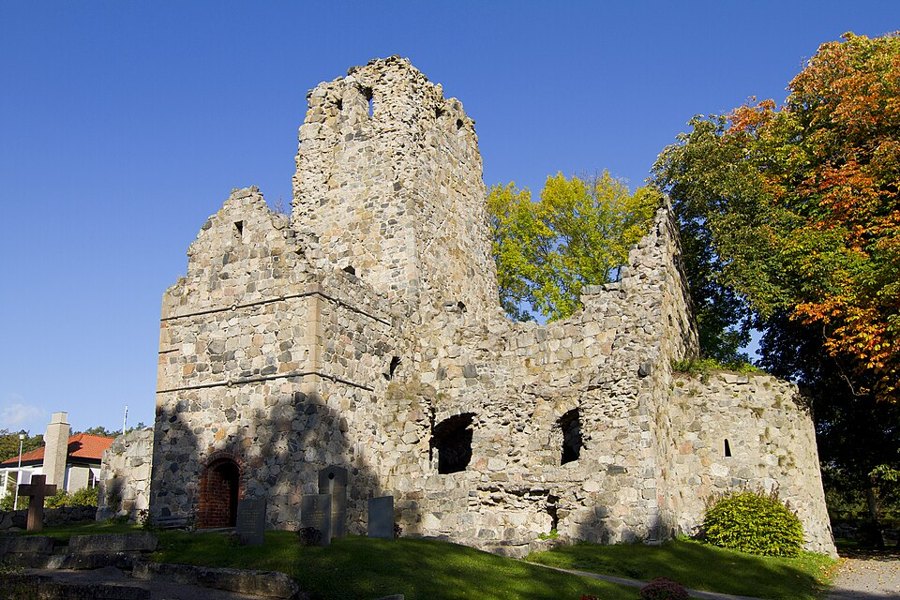
The report on excavations at St. Olof’s church distinguishes an early burial phase, approximately 980–1050, from subsequent stone buildings. Four graves preceded the stone churches investigated. This sequence matters because the standing ruin is not the beginning of Christian activity at the site. Excavators identified older foundations and different floor levels beneath the later building. The relationship between those layers allowed them to distinguish construction episodes that architecture visible above ground could obscure. More broadly, Sigtuna’s early Christian cemeteries have not always yielded evidence of contemporary church buildings. One proposed explanation places worship in halls on urban properties; another considers structures whose traces have not survived or have not yet been recognized. Christian burial is therefore more securely demonstrated than a complete reconstruction of the earliest worship spaces.
Sources for this section: 4
Mobility measured in people
A multidisciplinary study published in 2018 combined archaeology, skeletal investigation, genetics, and strontium isotope analysis. It generated genomic information from 23 individuals of the tenth through twelfth centuries and identified substantial diversity among early residents. Isotope results also indicated a mixture of local and nonlocal childhood environments. These methods answer related but different questions. Genetic affinity concerns relationships and ancestry; tooth chemistry concerns environments encountered while tissues formed. Neither is a direct label for language or legal identity. The research found mobility among both males and females, complicating a model centered only on traveling male merchants or warriors. Its sample also spans the boundary conventionally placed between Viking and medieval periods. The results illuminate urban population formation across that transition, rather than presenting one frozen moment in the year 980.
Sources for this section: 5
Continuities around the edge of the town
Sigtuna Museum points to a spatial comparison with Birka: burial grounds surrounded the inhabited area on the landward side while settlement faced the water. Later churches and their burial grounds developed along related routes. A road beneath the later stone-paved predecessor of Prästgatan has been dated to at least the 990s, while the paving belongs to the late eleventh century. The resulting townscape combined inherited alignments with new construction. Such continuities do not prove that a whole population moved together from Birka. They show that urban formation could reuse familiar relationships between the living, the dead, and the waterfront. Read together, the plots, mint, graves, and population evidence suggest an organized center sustained through movement and repeated investment. They do not require a single cause or one perfectly coordinated foundation event.
Sources for this section: 6
The Evidence
The sources below support this article. Interpretations and limits are explained in the text; this is not an exhaustive research review.