
Journeys & Encounters · Deep dive
Lund: From Viking-Age Settlement to Cathedral City
In Brief
Coffins, a buried church, timber paving, and neighborhood cemeteries reveal how Lund developed through successive changes in land use.
On this page
A foundation date that movedThe church beneath the cathedralBuilding a public squareA cemetery beyond the monumental centerObjects complicate a simple conversion storyLater property boundaries and earlier occupationSourcesA foundation date that moved
Lund illustrates why a town's birthday is an archaeological argument rather than a single secure event. Dates once placed near 1020 moved toward 990 as excavations exposed early churches and graves. Tree-ring dating of oak log coffins north of the cathedral subsequently pushed the discussion farther into the late tenth century. Several coffins date within approximately 979–1002, while occupation deposits beneath them show that activity preceded those burials.
The evidence separates three questions: when people used this location, when Christian burial began, and when a settlement acquired urban institutions. They need not have the same answer. A wooden church serving the early cemetery is inferred, but its actual building remains have not been identified. Connecting this development with Harald Bluetooth's kingdom is a historical interpretation of the archaeological chronology, not a royal foundation document discovered beneath a coffin.
Sources for this section: 1
The church beneath the cathedral
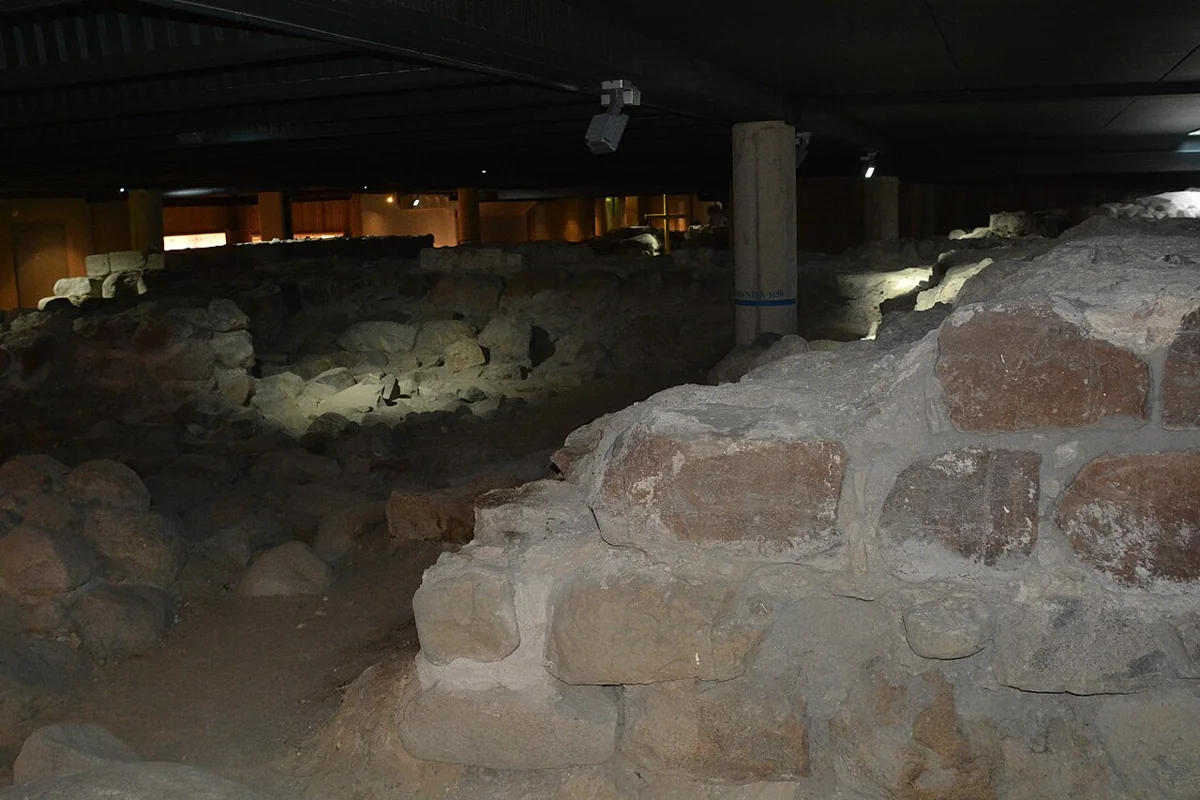
During accessibility work in the northern crypt in 2015–16, Kulturen’s archaeologists traced three successive uses of the ground. They found a wattle-lined well. After people filled it, they cut a pit into that fill, probably for storage. A later builder laid part of a stone foundation over the filled pit.
Excavation leader Gertie Ericsson suggests that the well and the storage pit may predate 979. She considers the foundation probably eleventh-century. She compared it with walls from earlier excavations and proposed that the building may have been a predecessor of the standing cathedral. The surviving fragments leave its plan and identification open.

Building a public square
Lund's development also required work outside churches. Excavations at Stortorget revealed a substantial timber-paved public area above an engineered foundation of brushwood, stones, and leveling earth. Heavy planks supported the walking surface, with driven stakes helping stabilize the structure. This was an organized construction project requiring transported materials and collective labor.
Claes Wahlöö estimated that the paving extended across roughly 6,000 square meters. Drainage helps explain the effort: raising and stabilizing the surface made a wet space usable. Tree-ring evidence places an early phase around the beginning of the twelfth century. Wahlöö proposed a connection with the new archbishopric, but that association is interpretive. Some timbers provide only an earliest possible date because their outer rings are missing, and reuse further complicates the sequence. The square's physical engineering is clearer than the identity of the official who commissioned it.
Sources for this section: 3
A cemetery beyond the monumental center
The archaeological town was larger than its best-known monuments. Preparations for Lund's tramway brought investigation back to the cemetery of Sankt Olof, near the present Allhelgonakyrkan. The medieval church itself had not been located when Kulturen described the preliminary excavation in 2016. Burials, however, had appeared during construction in 1891 and again in later interventions.
The written record first names Sankt Olof's church in 1350. That date establishes surviving documentary visibility, not necessarily its foundation. Archaeologists therefore asked questions that a written mention could not answer: where the church stood, how far its cemetery extended, and how densely people were buried. These are practical measures of a neighborhood institution. Mapping graves can reconstruct parts of an otherwise vanished urban landscape, while avoiding the assumption that every church shown on a late medieval plan already existed in Viking-age Lund.
Sources for this section: 4
Objects complicate a simple conversion story
During the 2017 cemetery excavation, four large rock-crystal beads appeared beside a buried person at Sankt Olof. Their recorded position suggested that they had rested on the chest. Archaeologist Mattias Karlsson proposed that they might have belonged to prayer beads. The report was explicitly provisional: excavation of the grave was not yet complete.
This find belongs to Lund's medieval Christian burial landscape, and the report does not establish a Viking-age date. Its value here is comparative. A town's religious development cannot be described simply as a switch from graves with objects to graves without them. Even within a Christian cemetery, selected belongings could accompany the dead. Equally, an attractive interpretation should remain tied to its evidence: four beads and their position support a question about devotional practice, but do not by themselves establish the person's name, occupation, or complete religious experience.
Sources for this section: 5
Later property boundaries and earlier occupation
Lund's oldest settlement is often investigated beneath property organized much later. In the Sankt Mikael block, excavation planned in 2019 concerned ground close to the cathedral, in an area occupied by ecclesiastical institutions. By the Reformation the block was church property. A Dominican convent founded in 1222 occupied its southern portion, on land provided by Archbishop Andreas Sunesson.
That medieval ownership does not settle what happened there centuries earlier. Excavation director Stefan Larsson specifically identified the period before the Dominican donation as a research question, alongside the earliest settlement. A later institution could inherit, combine, or reorganize older ground. Read together, Lund's coffins, buried walls, engineered square, and neighborhood cemeteries reveal overlapping developments rather than one instantaneous transformation. The Viking-age settlement and the medieval cathedral city are connected through successive uses of land, whose order must be reconstructed independently in each excavated area.
Sources for this section: 6, 1, 2, 3
The Evidence
The sources below support this article. Interpretations and limits are explained in the text; this is not an exhaustive research review.
- Kulturportal Lund: Lund as a medieval church center ↗
- Gertie Ericsson, Kv Domkyrkan 1. Domkyrkans krypta, Kulturmiljörapport 2020:75, pp. 1, 17–18 (publisher’s publications page) ↗
- Claes Wahlöö, Kulturen yearbook1998: Forum in Lund ↗
- Kulturen: preliminary investigation at Sankt Olof ↗
- Kulturen: rock-crystal beads at Sankt Olof ↗
- Stefan Larsson, Kulturen: Sankt Mikael excavation questions ↗
- Gertie Ericsson, Vid foten av jätten Finn, Ale 2017:2, pp. 17–26 (full text) ↗