
Research & Sources · Deep dive
Marine Reservoir Effects: Why a Fish-Eating Person Can Look Too Old
In Brief
Repton and Norse Greenland reveal why human radiocarbon dates depend on diet, regional waters, and the event a researcher wants to date.
On this page
Carbon reaches people through foodThe ocean is not one uniform reservoirRepton presented a real contradictionSelecting a correction for a mixed dietGreenland offers a different comparisonA dietary estimate is not a menuUncertainty belongs inside the correctionWhat the revised date can establishSourcesCarbon reaches people through food
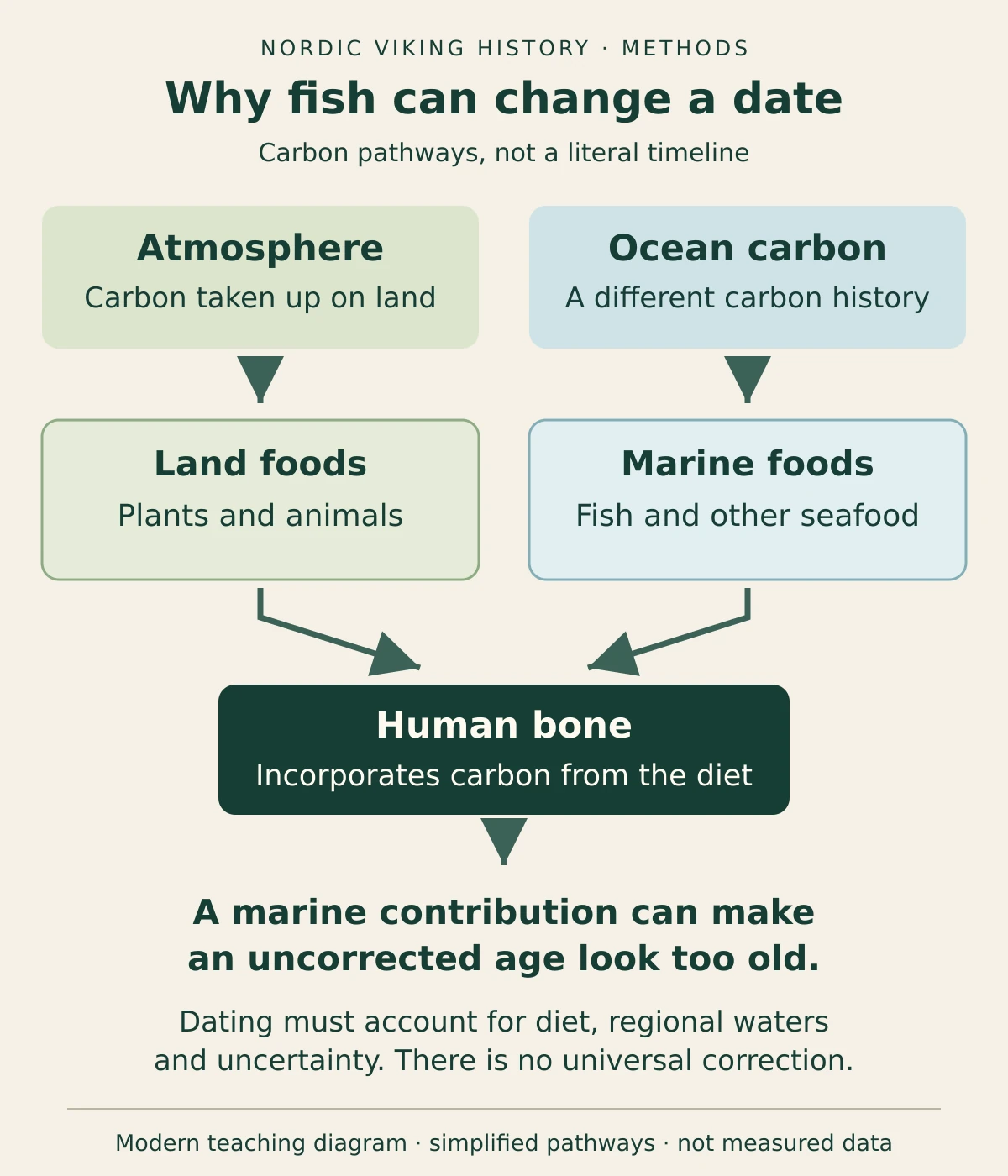
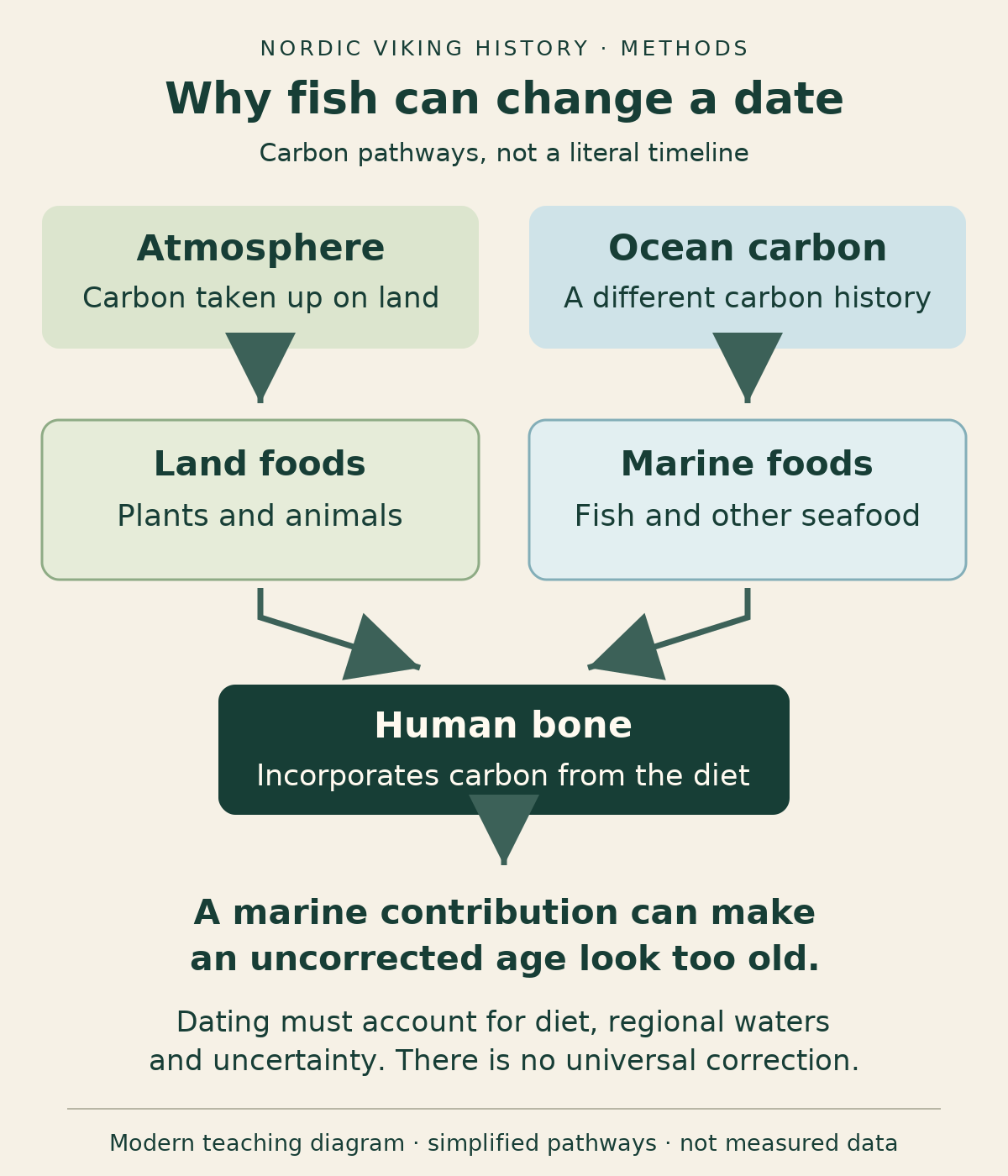
Radiocarbon dating of human bone concerns carbon incorporated into tissue during life. The source of that carbon matters. Marine food webs contain carbon with a radiocarbon history different from the contemporary atmosphere. Someone who ate marine foods can therefore yield a conventional age older than expected if the analysis treats all dietary carbon as terrestrial. This is a systematic effect that requires a model of the carbon source, not an explanation that the skeleton has mysteriously aged. Bristol’s account of Repton presents the problem particularly clearly because the earlier dates seemed to conflict with archaeological evidence.
Sources for this section: 2
The ocean is not one uniform reservoir
Marine20 provides a marine calibration framework rather than assuming that a fish or shell exchanged carbon directly with the atmosphere. Ocean circulation, exchange with air, and contributions from deeper water affect radiocarbon concentrations. Regional departures from the modeled marine average also require attention. The published Marine20 study explicitly limits its application and discusses the difficulty of polar regions. This matters for northern histories: a generic global correction cannot be applied confidently to every Scandinavian or North Atlantic person without considering the waters from which their food may have come.
Sources for this section: 3

Repton presented a real contradiction
At Repton, archaeological evidence connected burials and a deposit of commingled remains with the late ninth-century Great Army. Some earlier radiocarbon results appeared to place bones substantially earlier, creating the impression that remains from different periods had been assembled. The 2018 research reassessed the dates with marine dietary effects in view. The dated remains became consistent with a single late ninth-century event. That conclusion resolves a chronological difficulty; it does not establish that every buried person had the same role, background, or cause of death.
Sources for this section: 1, 2
Selecting a correction for a mixed diet
Cook and colleagues’ methodological guidance treats marine contribution and the regional reservoir adjustment as separate inputs, each requiring realistic uncertainty. Consider an illustrative traveler who ate food from several coastal regions: choosing the burial location alone would not necessarily identify the appropriate dietary carbon source. Nor would a simple statement that the person ate seafood establish its proportion in the dated tissue. The procedure needs an explicit account of how that proportion was estimated and why the chosen regional value is suitable. Those decisions belong in the published method, where alternative assumptions can be tested rather than concealed.
Sources for this section: 5
Greenland offers a different comparison
A study published in 1999 examined 27 Norse individuals from Greenland churchyards spanning the late tenth to mid-fifteenth centuries. Stable carbon measurements were used to estimate dietary differences and calculate individual reservoir corrections. The researchers also compared three strongly marine individuals with terrestrial grave clothing to help evaluate the corrections. That comparison matters because the two materials had different routes into the carbon cycle while sharing a burial context. It offered an external check on an interpretation that would otherwise rest more heavily on assumptions about diet.
Sources for this section: 4
A dietary estimate is not a menu
The Greenland results indicated a shift toward greater marine dietary contribution over the settlement period. Such measurements address broad carbon sources rather than listing meals, species, or recipes. The method also concerns the carbon incorporated into the sampled tissue, which is not interchangeable with the total weight or calories of all foods consumed. Those are different quantities and require different assumptions. A historical account must avoid converting a marine proportion into an exact quantity of fish eaten each day. Nor should a trend among sampled churchyard burials become a complete census of every household. The study’s value lies in connecting human tissue, chronology, and changing subsistence, while making individual corrections explicit. The later medieval portion also needs to remain distinct from the initial Viking-age settlement.
Sources for this section: 4
Uncertainty belongs inside the correction
A regional reservoir adjustment has an uncertainty of its own. Marine20’s authors explain that uncertainty must be propagated rather than treated as a perfectly known number subtracted from a laboratory age. A human sample introduces the additional problem of mixing dietary sources. The result should therefore communicate both the measurement and the assumptions used to translate it into calendar time. A narrower answer obtained by ignoring uncertain dietary or environmental inputs is not automatically a better date. Precision that disappears when reasonable alternative assumptions are tested needs to be described honestly.
Sources for this section: 3
What the revised date can establish
The strongest interpretation asks whether corrected dates agree with independently observed evidence, while leaving room for disagreement. At Repton, the change supports the proposed late ninth-century association. In Greenland, the comparisons link dietary histories to a longer settlement chronology. Neither case licenses correcting every inconvenient date until it matches a preferred story. The dietary argument must come from evidence, the chosen reservoir model must be explained, and the remaining interval must be retained. These examples show why apparent chronological conflicts deserve investigation before they are used to discard either archaeological context or laboratory analysis.
Sources for this section: 2, 4, 5
For the introductory context, read Radiocarbon Dating: Ranges, Diet, and an Exceptional Year.
The Evidence
The sources below support this article. Interpretations and limits are explained in the text; this is not an exhaustive research review.
- Jarman and colleagues: new dates from the Repton charnel ↗
- University of Bristol: radiocarbon dating of the Repton grave ↗
- Heaton and colleagues: Marine20 calibration curve ↗
- Arneborg and colleagues: diet and radiocarbon dates in Norse Greenland ↗
- Cook and colleagues: calibration of marine and mixed samples ↗