
Journeys & Encounters · Deep dive
Manx Crosses: Names, Stories, and Cultural Encounters
In Brief
Carved memorials combine Christian forms, Scandinavian narratives, personal inscriptions, and the traces of later reuse.
On this page
A Christian landscape with Scandinavian connectionsGaut names the makerSigurd’s story on a cross slabThorwald’s contrasting imagesA monument reused as building materialRecording the surfaces before they changeSourcesA Christian landscape with Scandinavian connections
The Isle of Man's carved stones belong to a long history of Christian commemoration, extending beyond the Viking Age in both directions. Manx National Heritage describes early crosses and ogham inscriptions alongside monuments whose makers combined Christian imagery with Scandinavian stories. Maughold churchyard, with the remains of four small chapels or keeills, preserves evidence for an early monastic community and a particularly large concentration of sculpture.
This setting changes how the later carvings should be approached. Scandinavian settlement encountered an existing religious landscape rather than empty ground waiting for monuments. Crosses also survive across numerous other parishes, including Andreas, Bride, Jurby, and Kirk Michael. Their distribution makes the collection an island-wide source for commemoration and artistic exchange. Present locations require care, however: church shelters and museum displays bring together stones recovered from different settings. The collection's unity today should not obscure the individual histories of the monuments or the variety of communities that commissioned them.
Sources for this section: 1
Gaut names the maker
Manx Cross 101 at Kirk Michael is especially valuable because its runes identify a carver. In Manx National Heritage's translation, Gaut states that he carved this monument and all in Man. The sweeping claim has encouraged scholars to associate him with other stones, but the museum appropriately treats the extent of his personal output and workshop as a question rather than an established catalog.
The decoration includes a ring-chain pattern on the shaft, a four-strand plait, and a tendril design. These recurring forms allow stylistic comparison without requiring every similar carving to be the work of one pair of hands. An inscription along the edge possibly names Mael Brigde, son of Athakan the smith, as the commissioner and relates the memorial to his soul and his brother's wife. Text and ornament therefore illuminate different participants: a person commissioning a religious monument and an artisan asserting responsibility for making it.
Sources for this section: 2

Sigurd’s story on a cross slab
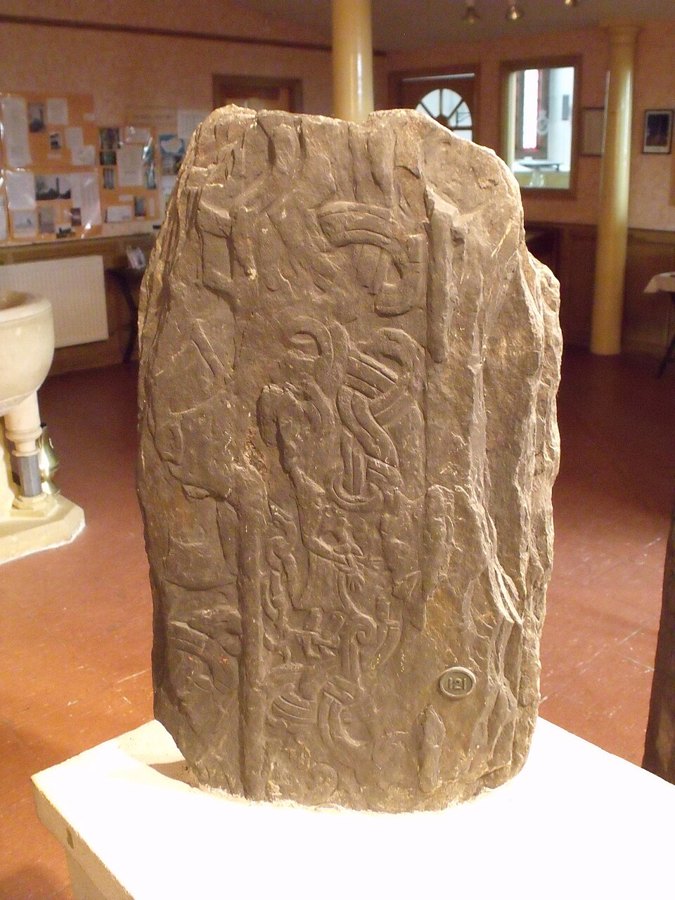
The Andreas stone numbered Manx Cross 121 carries episodes identified with the Sigurd legend. One scene shows the hero attacking the dragon Fafnir with a sword. Above, he roasts the dragon's heart and puts his burned fingers into his mouth. A bird and the head of his horse accompany the scene. The museum explains these details through the story in which tasting the dragon's blood allows Sigurd to understand the birds and learn of Regin's intended betrayal.
On the opposite face, a bound figure among serpents is identified as Gunnar, who later possesses the treasure and is tortured by Atli. Several episodes are thus selected and compressed into a carved surface. Recognizing the sequence depends on comparing visual details with the wider narrative tradition. The monument demonstrates that a cross could accommodate heroic storytelling, but it does not reveal whether every viewer understood the scenes in the same way or heard precisely the same version of the tale.
Sources for this section: 3
Thorwald’s contrasting images
Manx Cross 128, known as Thorwald's Cross, juxtaposes two striking groups of figures. One is interpreted as Odin with a raven on his shoulder, using a spear against the wolf Fenrir while the animal grips him in its jaws. On the other face, a figure holds a cross and an object understood as a book. A fish and knotted serpents accompany him, including a serpent beneath his feet.
Manx National Heritage reads the second group as Christian imagery: a priest-like figure and the triumph of Christ over evil. A surviving runic fragment names Thorwald as the person who raised the cross. These identifications make the stone important for studying religious encounters, but the carving is not a diary of its patron's conversion. The juxtaposition establishes that different bodies of imagery could share a monument. The intentions behind that combination, and the meanings assigned by different viewers, require interpretation beyond the surviving inscription.
Sources for this section: 4
A monument reused as building material
The broken Maughold slab numbered Manx Cross 80 illustrates a different kind of encounter: the changing treatment of old monuments. Recovered during church renovations in 1900, it had served as a lintel. The surviving piece originally belonged to the shaft of a larger cross. One face preserves a key pattern and a panel of looped ornament, while the other combines interlace, a human figure, and animals.
A staff beside the figure suggests a bishop or abbot, and the carried object may be a closed book. A stag survives lower down, with part of another animal above it. The cautious wording matters because breakage removes the wider visual setting that might resolve an identification. Reuse also explains why a stone's discovery place is not necessarily its original display position. The monument was valued enough as usable stone to survive physically, even though its earlier commemorative arrangement had been dismantled.
Sources for this section: 5
Recording the surfaces before they change
In 2018, Manx National Heritage undertook a three-week campaign to scan and photograph the crosses, followed by months of processing. The project created detailed digital records as a baseline for detecting future deterioration. This purpose is different from simply producing attractive illustrations: repeated observations can be compared with an earlier measured surface when weathering or damage threatens faint carving.
The survey also made three-dimensional models publicly accessible, widening opportunities to examine decoration and inscriptions across geographically separated stones. Museums, churches, shelters, and outdoor locations preserve different viewing conditions, so digital comparison is particularly useful. The project joined heritage specialists with technical and academic partners, including Lancaster University. Yet the models remain records of surviving surfaces, not reconstructions of missing scenes or lost wording. Their strongest contribution is to preserve and expose the evidence from which interpretations are made, allowing the stones' material details to remain central to discussion.
Sources for this section: 6
The Evidence
The sources below support this article. Interpretations and limits are explained in the text; this is not an exhaustive research review.
- Manx National Heritage: carved stone cross collection ↗
- Manx National Heritage: Gaut’s Cross, Manx Cross 101 ↗
- Manx National Heritage: Sigurd Cross, Manx Cross 121 ↗
- Manx National Heritage: Thorwald’s Cross, Manx Cross 128 ↗
- Manx National Heritage: Maughold Cross, Manx Cross 80 ↗
- Manx National Heritage: Manx Crosses Go Digital ↗