
Journeys & Encounters · Deep dive
The Kvalsund Boats: Rowing, Possible Sailing, and a Revised Chronology
In Brief
Two dismantled vessels from a western Norwegian bog complicate simple stories about the invention of the Viking ship. Their date and incomplete sailing evidence must be considered together.
On this page
Two vessels emerged from peatThe newer date changes the comparisonRowing evidence is clearer than a complete rigBroken boats and the interpretation of depositionA fragmentary sample shapes the bigger storyWhy Kvalsund belongs in Viking historySourcesTwo vessels emerged from peat
The University Museum of Bergen’s account records the discovery of boat remains at Kvalsund in 1920 during peat cutting. Haakon Shetelig investigated the site and recovered material from a smaller vessel and a larger one, the latter commonly called the Kvalsund ship. The find therefore should not be imagined as one intact boat resting neatly in the ground.
The association of two vessels raises questions about how they reached the deposit and how their parts were distinguished. A reconstructed outline is the outcome of that analysis, not the condition in which the pieces were found. The discovery history also places Kvalsund within a different archaeological setting from the famous ship burials of the Oslo Fjord. Similar-looking maritime components can have entered the archaeological record through very different events.
Sources for this section: 1
The newer date changes the comparison
The dating study published in Journal of Archaeological Science: Reports places the Kvalsund vessels much closer to Oseberg in time than older broad comparisons suggested. The university museum summarizes their date as approximately 780–800. The study discusses a gap of only a few decades before Oseberg’s construction, rather than a long, loosely defined developmental interval.
This matters because chronology controls a technological argument. If two forms are close in time, their differences need not represent successive universal stages. They may reflect different functions, regional practices, or choices among available techniques. A sequence from simple rowing boat to advanced sailing ship can become misleading when dates are revised. The correct response is to reconsider the model, not retain the old evolutionary story while merely changing the date printed beside the object.
Sources for this section: 1, 2

Rowing evidence is clearer than a complete rig
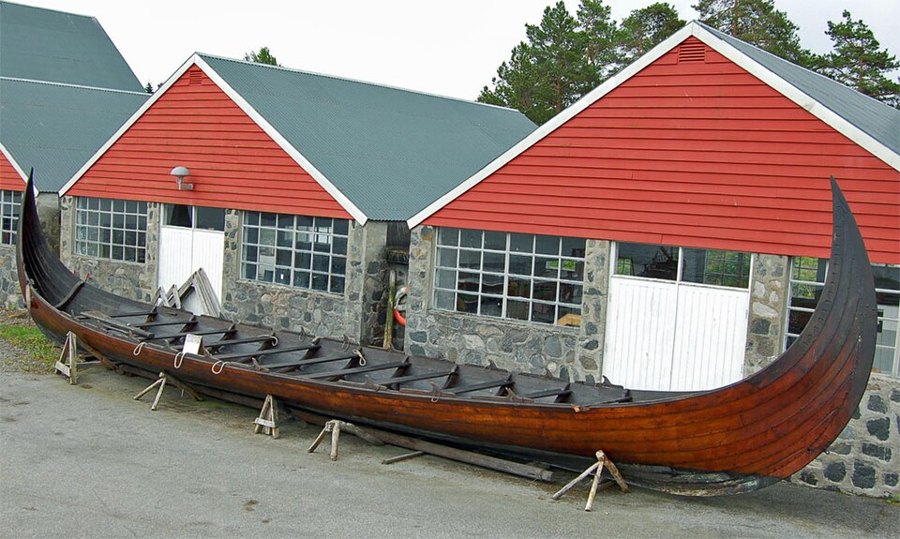
The university museum describes the larger vessel as having ten pairs of oars and discusses its hull and steering arrangement. It also records the long-standing debate over sailing. A possible mast-like timber and other features encouraged the proposal, but secure evidence for the complete mast-supporting arrangement and sail was lacking.
The dating paper similarly treats the absence of a mast fish or keelson cautiously, noting the possible consequences of incomplete deposition. This prevents two opposite overstatements. Missing components do not conclusively prove that the vessel never sailed; a possible mast does not establish the full rig with certainty. The question has to be answered through the combination of surviving structure, depositional history, and appropriate comparisons. Kvalsund is useful precisely because those lines of evidence do not produce a simplistic yes-or-no picture.
Sources for this section: 1, 2
Broken boats and the interpretation of deposition
The university museum interprets the deliberately damaged and mixed boat parts as an offering deposit rather than an ordinary ship burial. That interpretation connects the observed treatment of the pieces to a proposed ritual action. It does not reveal the exact words, participants, or beliefs involved.
The distinction between damage and motive is important. Researchers can examine breakage, arrangement, and associated material more directly than intention. A ritual interpretation may be persuasive while its detailed narrative remains unknown. It should also remain separate from the vessel’s earlier technical history. A boat deposited ceremonially may previously have been a practical working craft. Its final treatment does not automatically define the purpose for which it was originally constructed or every activity in which it participated.
Sources for this section: 1
A fragmentary sample shapes the bigger story
The Viking Ship Museum’s description of research on western Norwegian shipbuilding highlights how heavily the field has depended on a small group of major finds. It also calls attention to isolated nautical timbers that have received less study. This is a significant warning against treating Kvalsund, Oseberg, and Gokstad as a complete series representing all vessels once in use.
A rare surviving form may have been common historically, while a familiar museum ship may represent an exceptional context. We cannot resolve that imbalance simply by arranging the best-known finds in chronological order. More complete documentation and comparison of smaller fragments can broaden the sample. The research program identifies questions and a method; it should not be cited as though all of its proposed conclusions were already established results.
Sources for this section: 3
Why Kvalsund belongs in Viking history
Bergen Maritime Museum’s exhibition places Kvalsund among early Viking-period maritime evidence and presents ships as both practical objects and expressions of power or belief. The revised chronology makes the find especially relevant to discussions of the period’s beginnings, even while the exact sailing arrangement remains uncertain.
Kvalsund’s importance does not depend on winning a contest for the first true Viking ship. Such a label conceals the overlapping changes in propulsion, hull design, regional use, and archaeological survival. The more productive question is what each component and context adds to our understanding. Here we have two vessels, an unusual deposition, a more precise chronological relationship to later famous ships, and a continuing debate about sail use. Together they show technological history as variation and investigation rather than a single inevitable progression.
Sources for this section: 2, 3, 4
The Evidence
The sources below support this article. Interpretations and limits are explained in the text; this is not an exhaustive research review.