
Journeys & Encounters · Deep dive
Roskilde 6: The Engineering and Interpretation of an Exceptional Longship
In Brief
A surviving keel almost thirty-two meters long anchors the reconstruction of Roskilde 6. Its scale invites questions about structural design, organized labor, and the difference between original remains and a complete museum outline.
On this page
A harbor discovery with an unusually long keelMaking separate timbers act as one long memberQuality survives in surfaces and repairsA large crew implies a larger organization ashoreConservation depended on deciding the shapeWhat the traveling exhibition actually displayedSourcesA harbor discovery with an unusually long keel
Roskilde 6 emerged during construction of the Viking Ship Museum's harbor in 1996–97, among several shipwrecks from different periods. It had been brought into shallow water and partly broken up, leaving substantial lower-hull evidence rather than an intact vessel. The Viking Ship Museum's Danish technical account reconstructs an overall length approaching 37.4 meters from the surviving keel and the proposed ends.
The distinction between those measurements matters. The nearly complete keel is an archaeological component; the overall length includes reconstruction of the original form. Earlier summaries used shorter estimates, illustrating how a find's published dimensions can change as research develops. The importance of Roskilde 6 does not depend on treating every decimal as equally secure. Even with uncertainty in the missing upper structure, the surviving longitudinal evidence establishes a vessel of exceptional scale within the known Viking Age material.
Sources for this section: 1
Making separate timbers act as one long member
The keel was assembled from three pieces. The central section joined extensions through unusually long, carefully shaped scarfs, approaching two meters at the connections. According to the museum's technical interpretation, their geometry resisted movement in both vertical and horizontal planes. The aim was to make the assembled keel behave as nearly as possible like a continuous piece.
This is a more useful engineering observation than the simple statement that bigger ships needed bigger trees. Joining members changes how forces pass through them. A long hull encountering uneven support from waves must transmit loads across its connections, so the joint becomes part of the structure's performance rather than merely a way to reach the required length. Roskilde 6 shows builders addressing that problem through form and fit. It does not supply a written calculation, but the surviving solution reveals a practical understanding of the problem.
Sources for this section: 1

Quality survives in surfaces and repairs
The National Museum of Denmark emphasizes the quality of the oak, the long planks, the careful finishing, and the repairs. It also describes tool marks preserved in the wet harbor environment. A flaw in an axe edge left a recognizable trace, allowing researchers to follow work performed with that particular tool across different surfaces.
Such evidence brings analysis below the level of the ship's dramatic silhouette. A distinctive mark can link tasks, while a repair records intervention after initial construction. Neither automatically identifies a named craftsperson, workshop owner, or patron. The evidence instead helps reconstruct decisions and sequences of work. This makes the ship a record of skilled labor as well as an instrument for transporting people. The unusually large hull required organization, but its success also depended on many small, accurately executed connections whose workmanship is still visible.
Sources for this section: 2
A large crew implies a larger organization ashore
Museum reconstructions suggest about seventy-eight rowing positions and a total complement around one hundred. Those are estimates based on the vessel's reconstructed arrangement, not a preserved muster roll. The National Museum dates its timber to around 1025 and relates the ship to the political world of Cnut's North Sea empire, while treating ownership by his fleet as a possibility.
A vessel of this scale required more than the people who occupied its benches. As a practical inference, assembling a crew also meant supplying food, equipment, repairs, and a place in a wider system of command. But scale alone cannot identify the individual who paid for it or establish a particular campaign. The careful distinction is between exceptional resource requirements, which the vessel strongly demonstrates, and a named historical owner, which remains an interpretation. A ship can illuminate the capacity of elite maritime organization without carrying a verifiable royal signature.
Sources for this section: 5, 2
Conservation depended on deciding the shape
The Viking Ship Museum's reconstruction account explains why establishing the form of individual planks mattered before conservation. Once the timbers had undergone the planned drying treatment, their shape would be difficult to alter. Reconstructing the hull was therefore not simply a final decorative step for exhibition; it affected how the original material would be preserved.
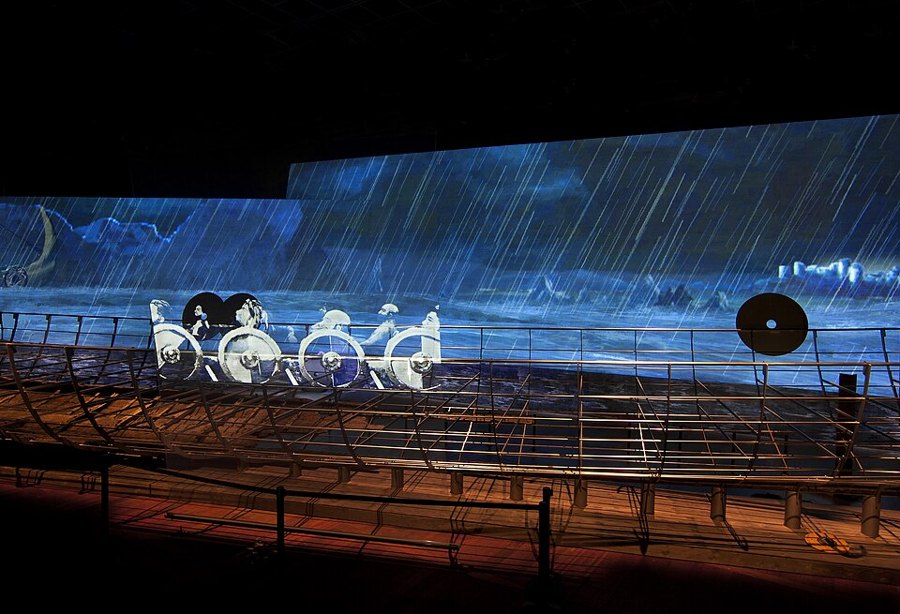
This creates a demanding relationship between interpretation and conservation. The proposed hull must accommodate the surviving pieces without forcing them into a convenient but unsupported outline. Records of each decision remain important because later researchers may reassess the reconstruction. The modern support is also not equivalent to missing ancient structure: it carries conserved fragments in an arrangement designed to make them understandable. Good presentation helps viewers see where original timber ends and the explanatory framework begins. It should make the reconstruction legible rather than disguise the amount of wood that is absent.
Sources for this section: 3
What the traveling exhibition actually displayed
The Berlin exhibition in 2014 placed the surviving keel and floor timbers within a modern steel outline. Its presentation also used the sail from the modern Sea Stallion reconstruction to suggest the visual impact of a rigged longship. That sail was an exhibition aid from another vessel, not the recovered sail of Roskilde 6.
This is a particularly clear example of different evidence being combined in one powerful image. Original wood, reconstructed dimensions, a supporting frame, and borrowed modern equipment can occupy the same gallery while carrying different historical status. Understanding the display requires separating those layers mentally, even as the exhibition brings them together spatially. Roskilde 6 remains extraordinary after that separation. Its genuine surviving structure supports important conclusions about late Viking Age shipbuilding, while the missing elements provide a defined area for further research rather than an invitation to assume that every visible feature is ancient.
Sources for this section: 4
The Evidence
The sources below support this article. Interpretations and limits are explained in the text; this is not an exhaustive research review.
- Viking Ship Museum: Roskilde 6, technical account in Danish ↗
- National Museum of Denmark: The largest Viking ship ↗
- Viking Ship Museum: Reconstructing the hull before conservation, 2009 ↗
- Berlin State Museums: Roskilde 6 installation, 2014 ↗
- National Museum of Denmark: Exhibition and Roskilde 6 facts, 2013 ↗