
Research & Sources · Deep dive
ZooMS: Identifying Worked Antler Without Mistaking Species for Origin
In Brief
Collagen fingerprints can identify materials whose original shape has been carved away. Their historical meaning still depends on chronology, distribution, and the limits of reference data.
On this page
Carving removes familiar identification cluesA peptide fingerprint is a comparisonLess destructive does not mean method-freeHedeby’s combs connect several kinds of evidenceA Scottish case changed an earlier argumentThe spectrum still requires interpretationSpecies distribution is not a workshop addressReport uncertainty where it enters the chainSourcesCarving removes familiar identification clues
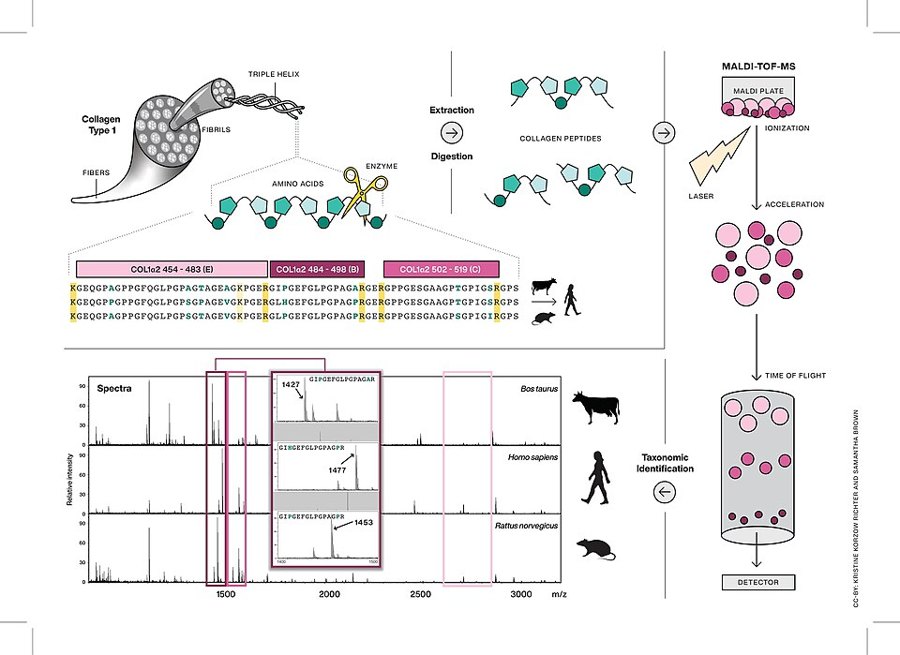
A finished comb may no longer preserve the anatomical features that distinguish the antler from which it was made. Traditional identification becomes harder when craftworkers select, cut, polish, and assemble small pieces. Zooarchaeology by Mass Spectrometry, or ZooMS, offers another route by examining surviving proteins. The method is particularly useful for worked animal materials because it does not require the original skeletal outline to remain recognizable. This makes it possible to revisit objects already held in collections, provided their documentation and preservation remain suitable for the proposed study. Its goal is a taxonomic identification at the resolution the protein evidence supports, which may be a species or a broader group rather than a completely precise biological label.
Sources for this section: 1
A peptide fingerprint is a comparison
Collagen is broken into smaller components called peptides, whose measured masses create a pattern that can be compared with reference markers. The ZooMS primer explains both the practical advantages and the limitations of this approach. Closely related animals can share relevant features, and the available reference data are uneven across biological groups. A successful measurement therefore does not guarantee species-level resolution for every specimen. The result should state the identification actually supported, rather than translating a broad family-level match into a particular animal because that species would make a more interesting story.
Sources for this section: 1

Less destructive does not mean method-free
Research on ammonium-bicarbonate extraction explored recovering enough collagen without the conventional demineralization step. The study compared this approach with more established preparation and emphasized its potential for worked artifacts. This is valuable for museum objects because preserving the object and retaining material for future analysis are part of the research problem. Nevertheless, suitability must be evaluated for the actual specimen. A method described as minimally or nondestructive should be understood through its documented procedure and effects, not treated as permission to sample every artifact without considering surface condition, conservation history, or the research question.
Sources for this section: 2
Hedeby’s combs connect several kinds of evidence
The early Hedeby comb study combined typological dating with ZooMS. Reindeer antler dominated the sampled ninth-century combs, while the broader craft-waste record at the site was mainly red deer. The authors argued that the contrast favored manufacture elsewhere and subsequent movement of finished combs. Species identification alone would not establish that conclusion: raw antler could also travel. The manufacturing-waste comparison is the additional step that makes the historical argument more specific. The result concerns the studied early assemblage, not every comb made or used at Hedeby throughout its history.
Sources for this section: 3
A Scottish case changed an earlier argument
A study of twenty early medieval combs from Orkney tested claims that reindeer antler in locally styled objects indicated a long period of early Scandinavian contact. The molecular identifications placed the sampled native-style combs in red deer and Norse-style examples in reindeer. Ancient DNA was also applied to a subset and supported the successful molecular identifications. The findings challenged the earlier material attributions underlying the contact model. This is an example of method changing historical reasoning at its foundation: revising what an object was made from can alter the significance assigned to its style and date.
Sources for this section: 4
The spectrum still requires interpretation
A double-blind comparison of morphological and collagen-fingerprint identification found encouraging agreement but also errors and difficult cases. Poorly resolved markers, interfering peaks, and human decisions could affect the result. The study concerned Paleolithic assemblages, so it does not directly validate or invalidate the Viking comb analyses. It provides a methodological warning against treating instrument output as self-interpreting. Complementary morphological evidence remains useful, particularly when collagen preservation is poor or the relevant taxa are difficult to distinguish through the available markers.
Sources for this section: 5
Species distribution is not a workshop address
Identifying reindeer antler narrows the biological source in a way that can be historically important, but it does not independently locate the person who made the comb. Material, unfinished blanks, finished goods, and craftspeople can move through different networks. Hedeby’s argument gains strength from comparison with production debris, while the Orkney study gains strength from testing the material assumption behind a chronology of contact. In both cases, the historical claim is constructed from several observations. The protein fingerprint supplies a crucial piece without containing the entire route of exchange.
Sources for this section: 3, 4
Report uncertainty where it enters the chain
A useful ZooMS account separates sample selection, protein preservation, marker interpretation, taxonomic resolution, and archaeological inference. It identifies unclassified specimens rather than silently omitting them from percentages. It also distinguishes direct identification from proposals about trade or migration. The primer’s emphasis on reference standards and the double-blind study’s attention to error show why transparent reporting matters. A reader should be able to see whether uncertainty lies in the molecular identification, the object’s date, or the explanation of its movement. This makes a comb’s small fragment of surviving collagen a reproducible source of history rather than a technological label attached to a preferred narrative.
Sources for this section: 1, 2, 5
The Evidence
The sources below support this article. Interpretations and limits are explained in the text; this is not an exhaustive research review.