
Gods & companions
Nanna
Grief, a funeral ship and gifts from beyond death
Nanna is Baldr’s wife and Forseti’s mother in Snorri’s account. Her most important surviving scene belongs to the funeral after Baldr’s death.
Explore the stories ↓
A family linked by loss
Gylfaginning identifies Nanna as the daughter of Nep and gives Forseti as her son with Baldr. It provides little detail about her earlier life or courtship. Modern descriptions sometimes assign her a precise universal role such as goddess of joy or of the moon, but these passages do not establish those claims.
At the funeral
When Baldr’s body is brought to the ship Hringhorni, Snorri says Nanna dies from grief. She is laid on the pyre beside him. This is a narrative event, not an instruction about how bereaved people ought to behave. The scene communicates the depth of the catastrophe within Baldr’s household and the divine community.
A small act of connection
Later, when Hermod visits Hel, Nanna sends gifts back for Frigg and Fulla. That detail gives her an action beyond the moment of her death. The transfer of clothing and a ring maintains relationships between the living community and those it has lost. The sources do not supply a full conversation in her voice; a retelling can acknowledge the emotional force of the gifts without inventing one.
Nanna refuses Balder in Saxo
Saxo gives Nanna a markedly different role in Book III of Gesta Danorum. She is Gewar’s daughter and is drawn to Hother’s accomplishments. When Balder asks for her, Gewar directs him to learn her own wishes. Nanna refuses, arguing that a relationship between a divine being and a mortal would be unequal and unstable. In this telling she is not Balder’s grieving wife: she chooses Hother, and their relationship becomes one of the causes of the rivalry. Her speech gives a clear statement of resistance rather than presenting her only as the object of two men’s competition.
A marriage inside a changing war
After Hother’s early success against Balder’s forces, he returns to Gewar and marries Nanna. Victory does not settle the wider conflict. Balder later defeats Hother, yet continues to suffer because military success has not won Nanna. The sequence makes marriage, desire and kingship intersect without reproducing Snorri’s funeral story. The contrast is useful precisely because it cannot be harmonized: a retelling should not make Nanna marry Hother and then quietly proceed as though she had always been Baldr’s wife. These are different medieval arrangements of the material, each with its own chain of events and emotional emphasis.
Read behind the retelling
Sources & limits
The cited account does not establish Nanna as a moon goddess. Her major surviving role here concerns Baldr, Forseti and the funeral.
Retold in contemporary English. Dialogue is summarized, not presented as a translation. How to read our sources and versions.
Follow the thread
Stories & related reading: Nanna

2 min read
The death of Baldr
Frigg tries to protect Baldr from every danger, but Loki finds the one promise she did not obtain.
Read the story ↗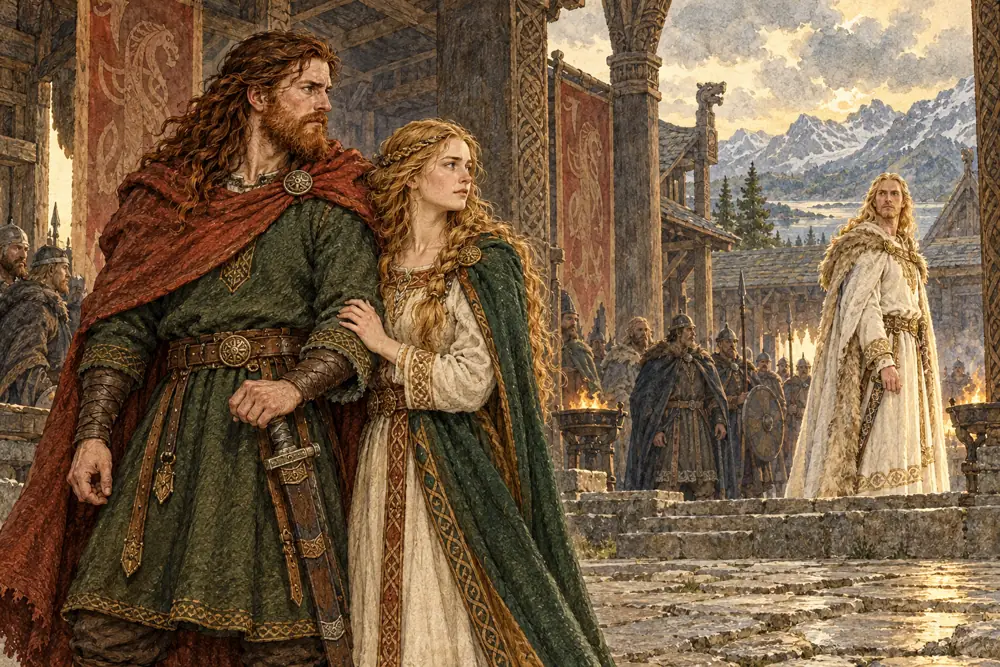
2 min read
Balder, Hother and Nanna in Saxo
Saxo’s Danish history places familiar names in a very different struggle, with a human hero confronting a divine rival.
Read the story ↗