
Other powers
Sol
The sun’s journey under pursuit
Sol is the female personification of the sun. Her movement through the sky is presented as a journey under threat, with consequences that reach into Ragnarök.
Explore the stories ↓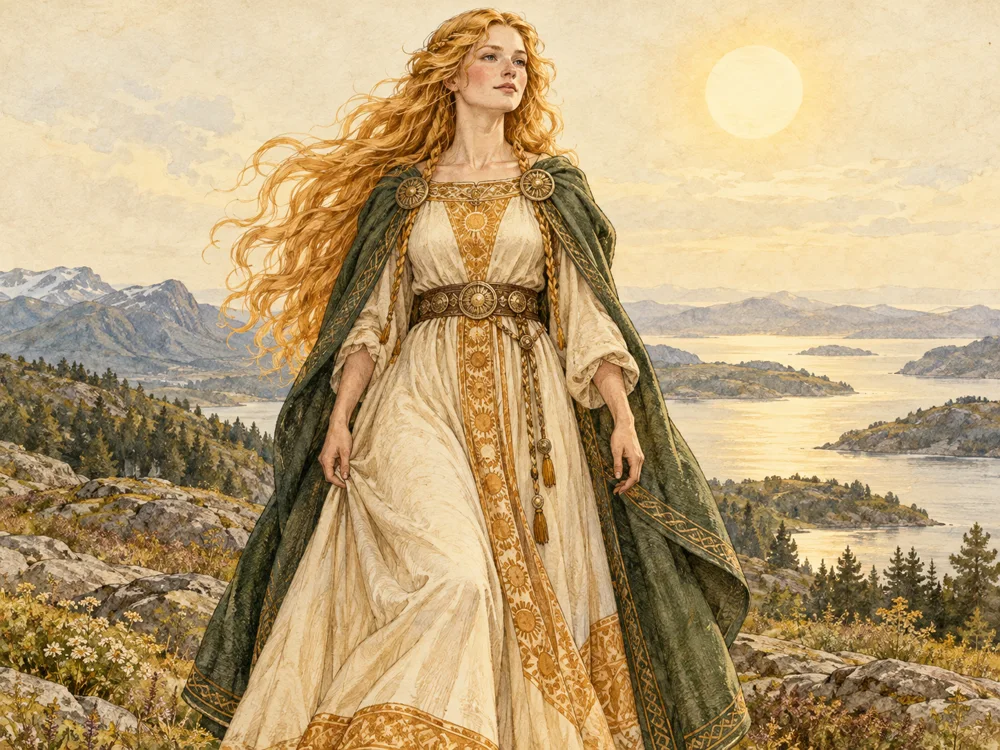
The celestial chariot
Gylfaginning tells of Mundilfari’s children, Sol and Mani. The gods place them in the sky; Sol drives the horses associated with the sun’s chariot. The story distinguishes the named driver from some of the arrangements that produce the sun’s light. Its details belong to mythic cosmology rather than an early scientific model that should be forced into modern terminology.
A pursuer and a successor
A wolf pursues the sun, and the final catastrophe includes her destruction. Vafþrúðnismál says she will have a daughter who follows her path after the powers fall. The continuation of sunlight is thus part of renewal. Different cosmic wolf references are not entirely easy to harmonise, so a retelling should identify the version it follows instead of claiming a single unambiguous diagram of every pursuit.
The horses must be protected from the heat
Snorri describes the sun’s vehicle as made from glowing material associated with Muspell. Sol is appointed to drive its horses, Árvakr and Alsviðr. Beneath their shoulders the gods place cooling devices, described differently in translation as wind-bags or iron-coolness. Grímnismál adds Svalinn, a shield before the sun: without that protection, mountains and sea would burn. These details give the daily journey more complexity than a bright disk crossing the sky. The world needs sunlight, but the light’s heat must be controlled if living places are to endure beneath it.
A daughter follows the old road
The wisdom contest in Vafþrúðnismál asks how the sun can survive when Fenrir has destroyed it. The answer is not that the old order escapes untouched. Sol will bear a daughter before the catastrophe, and that daughter will travel her mother’s path after the gods fall. Snorri repeats this image in his account of renewal. It is a small but decisive continuation: the route remains meaningful even when its former traveler is gone. The passage does not name the daughter or tell a childhood story for her. Its point is the return of light after the destruction, expressed through succession rather than simple reversal.
Read behind the retelling
Sources & limits
Sol is female and Mani male in these sources. Do not impose a sun-god/moon-goddess scheme borrowed from another tradition.
- Gylfaginning, chapters 11–12 and 53
- Vafþrúðnismál, stanzas 46–47
- Grímnismál, stanzas 37–38
- Vafþrúðnismál, stanzas 46–47
Retold in contemporary English. Dialogue is summarized, not presented as a translation. How to read our sources and versions.
Follow the thread
Stories & related reading: Sol
2 min read
How the world was made
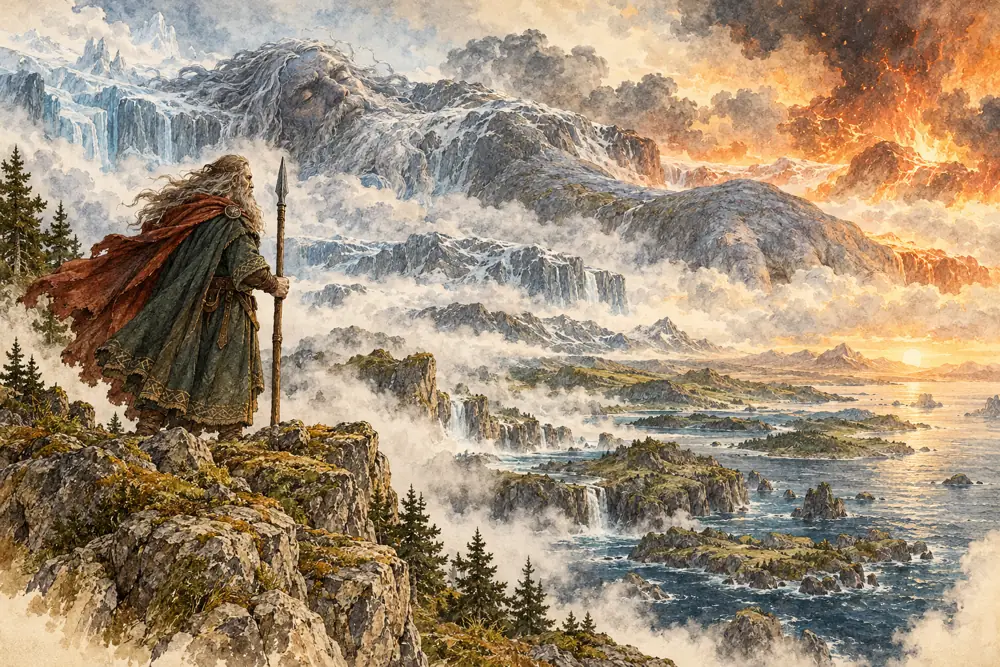
Several Eddic passages explain beginnings. Snorri combines them into an account in which the world is fashioned from Ymir’s body.
Read the story ↗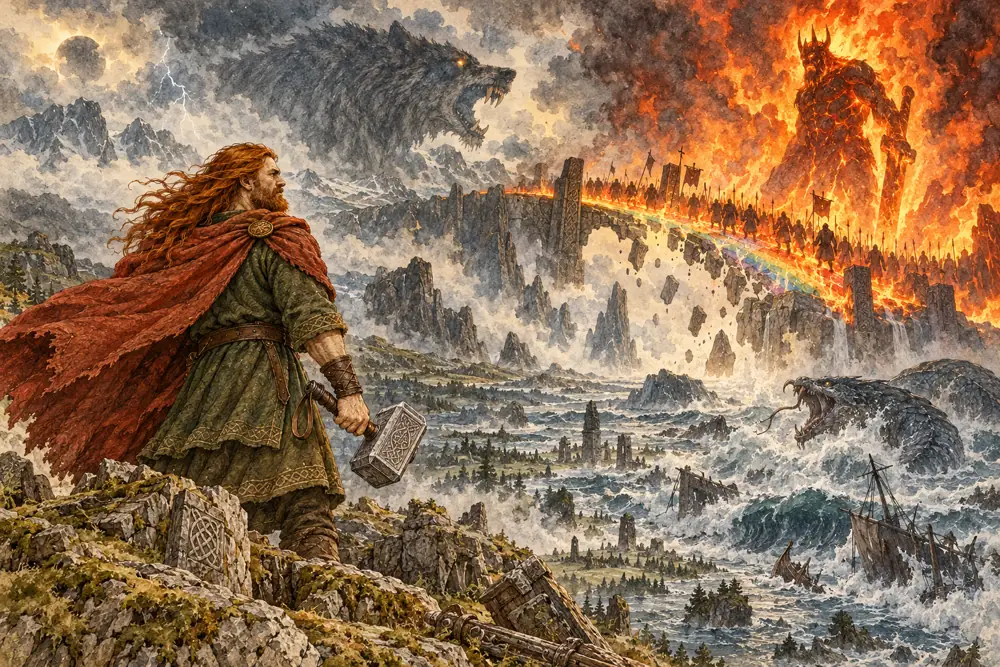
3 min read
Ragnarok: the breaking of the world
The end approaches through broken human bonds and broken cosmic restraints. The surviving texts also imagine a world that rises after the disaster.
Read the story ↗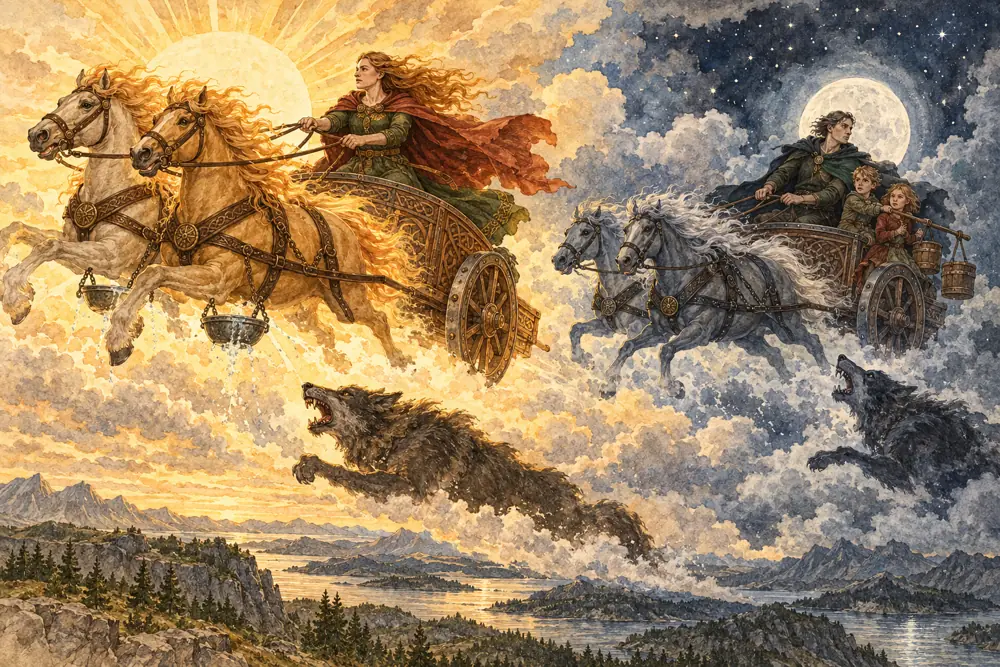
2 min read
Sun and Moon on their appointed paths
The lights of the sky become travellers with names, companions and enemies.
Read the story ↗