
A Norse story · 2 min read
Sun and Moon on their appointed paths
Sól, Máni and the pursuit across the sky
The lights of the sky become travellers with names, companions and enemies.
Names that reach too high
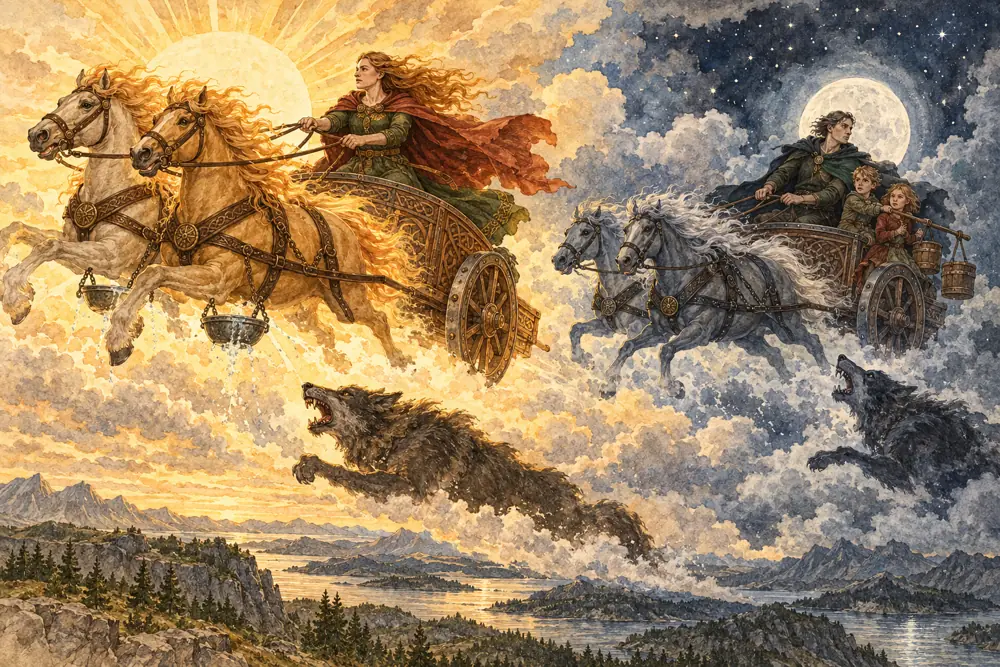
Gylfaginning tells of Mundilfari and his two beautiful children. He names his daughter Sól, Sun, and his son Máni, Moon. The gods resent the presumption and place the children in the heavens to guide the lights whose names they bear. Sól drives the horses drawing the sun’s chariot. The text distinguishes the driver from the luminous object fashioned for the world: it is more precise than simply saying that a woman is the physical sun.
The travellers and their companions
Sól’s horses are Árvakr and Alsviðr, and the account includes a cooling device beneath their shoulders. Máni directs the moon’s course and its waxing and waning. He takes two children from earth, Bil and Hjúki, while they are carrying water from a well with a vessel suspended from a pole. They follow him and can be seen from earth. The image offers a story for markings in the moon, but it is not necessary to identify it confidently with a later nursery rhyme.
The wolves do not rest
When the questioner asks why the sun moves so quickly, the answer is pursuit. Sköll runs after her, while Hati seeks the moon. The account connects such wolves with the threatening beings of Ironwood and with the destruction approaching at Ragnarök. Regular motion therefore has an anxious edge: the daily ordering of the world continues because its travellers keep ahead of danger. The final catastrophe is also a failure of that ordinary order.
A sky made of several stories
The same work separately describes Night and Day travelling in their own chariots. These accounts belong to a rich imaginative sky rather than a single modern astronomical mechanism. Different poems and prose passages also vary in the identities and roles of the devouring wolves. This retelling follows Gylfaginning’s early chapters and does not smooth every witness into one diagram. The memorable elements are the appointed task, the water-carrying children, the horses and the chase: individual images that turn the visible heavens into a world of relationships.
Read behind the retelling
Sources & limits
This is a retelling of Gylfaginning, not an ancient poem titled “Song of the Sun and Moon.” Wolf identities and descriptions vary across sources.
Retold in contemporary English. Dialogue is summarized, not presented as a translation. How to read our sources and versions.
Another thread to follow

3 min read
Ragnarok: the breaking of the world
The end approaches through broken human bonds and broken cosmic restraints. The surviving texts also imagine a world that rises after the disaster.
Read the story ↗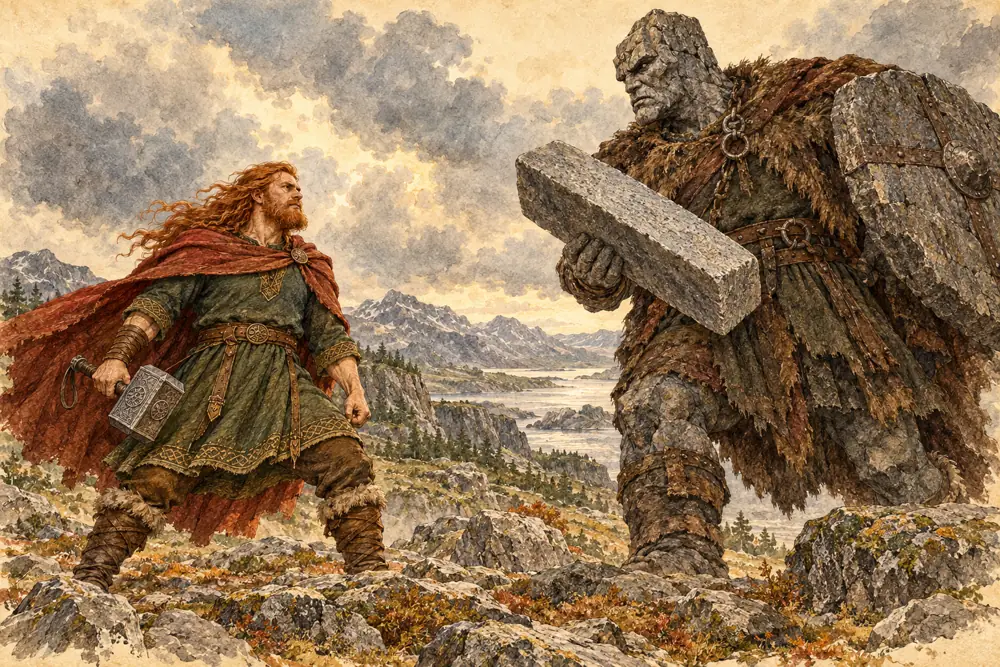
2 min read
Thor and the stone-hearted Hrungnir
Hrungnir pursues Odin into Asgard, boasts beyond hospitality, and challenges Thor to meet him armed.
Read the story ↗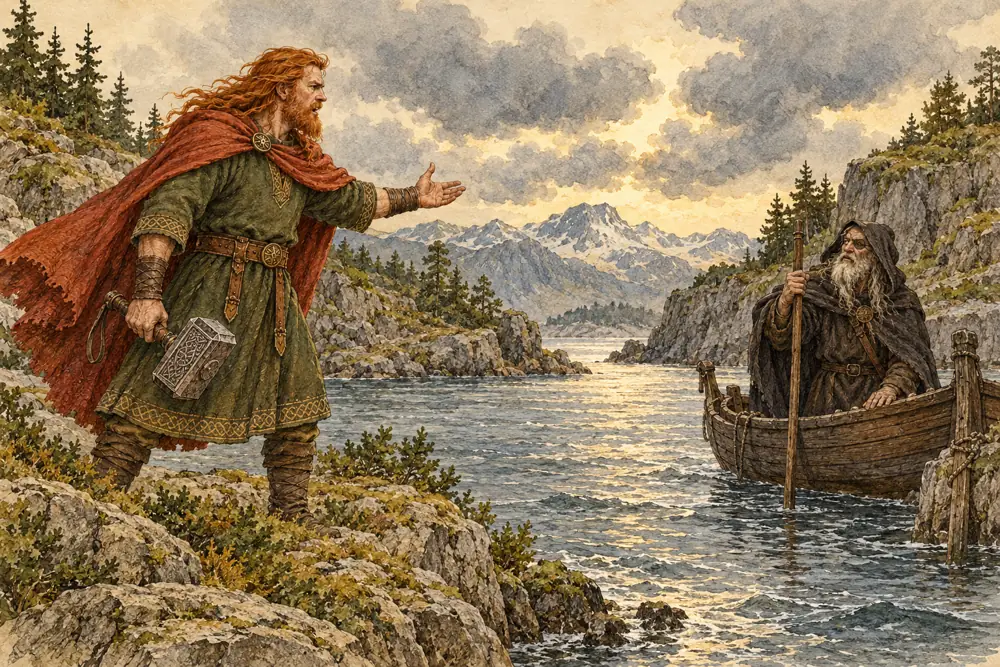
2 min read
Thor and the ferryman
Thor needs a ferry. Hárbarðr offers insults instead, and a verbal contest replaces the expected passage.
Read the story ↗