
A Norse story · 2 min read
Thor and the ferryman
A crossing blocked by words.
Thor needs a ferry. Hárbarðr offers insults instead, and a verbal contest replaces the expected passage.
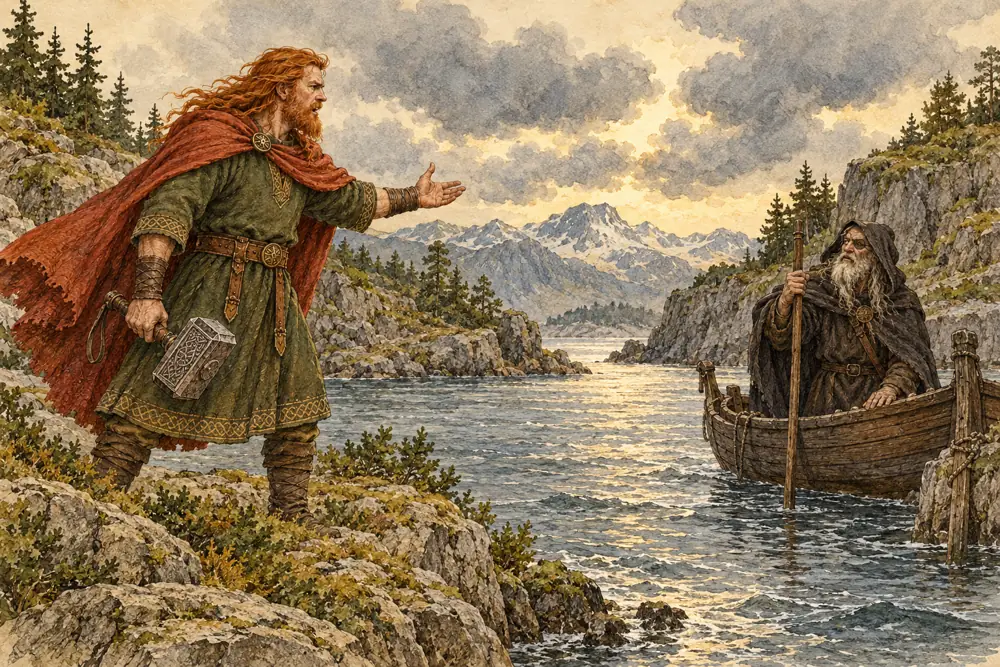
Stranded on the shore
Hárbarðsljóð begins with Thor returning from the east and reaching a stretch of water. A ferryman stands on the far side. Thor asks for passage and offers food, but the man responds with mockery rather than service. He calls himself Hárbarðr, Greybeard. The poem becomes an exchange of challenges, boasts and insults across the water. Unlike a hammer fight, the distance prevents Thor from simply closing with his opponent. The ferryman controls the situation precisely because he controls the means of crossing.
Two competing kinds of achievement
Thor boasts of fighting giants and defending the world from their attacks. Hárbarðr counters with his own activities: stirring conflict, pursuing women and acting among warriors. Each dismisses the other’s accomplishments. Some references point to stories also known elsewhere; others remain difficult because the fuller narratives have not survived. The exchange is not a tidy inventory of events we can reconstruct with certainty. It is a performance in which each speaker selects whatever will embarrass the other. Claims made to win an argument need to be treated as claims, not automatically as neutral biography.
Is the ferryman Odin?
Hárbarðr is generally identified as Odin, and Hárbarðr occurs among Odin’s names in Grímnismál. The contrast between the speakers also fits that identification: Thor foregrounds direct protection and giant-killing, while the ferryman presents himself through war, cunning and sexual boasting. The poem does not end with a dramatic unveiling in which the ferryman announces that the disguise is removed. That familiar image belongs more to explanatory retellings than to the surviving conclusion. Readers should know both the strong basis for the identification and the way the actual poem presents it.
A journey still unfinished
Thor threatens the ferryman, but the water keeps the threat from becoming a blow. Hárbarðr refuses passage and directs him toward a longer land route. Thor must leave without winning the crossing. The scene is funny, abrasive and uncomfortable: the defender of the human world cannot command a boat when he needs one. It can be read as a contrast between different forms of divine power, although turning it into a simple struggle between social classes goes beyond what the poem securely proves. Its most immediate achievement is literary: it gives each god a distinctive voice and makes an impassable stretch of water the stage for their rivalry.
Read behind the retelling
Sources & limits
Hárbarðr is conventionally identified with Odin. Several boasts refer to otherwise obscure material; missing stories should not be invented to fill the gaps.
Retold in contemporary English. Dialogue is summarized, not presented as a translation. How to read our sources and versions.
Another thread to follow
2 min read
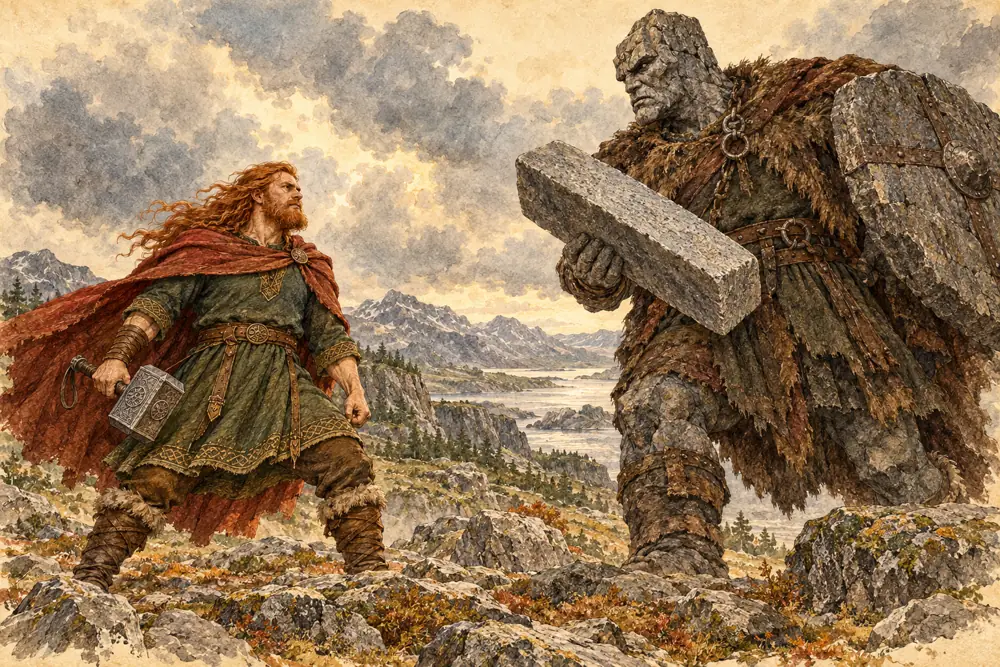
Thor and the stone-hearted Hrungnir
Hrungnir pursues Odin into Asgard, boasts beyond hospitality, and challenges Thor to meet him armed.
Read the story ↗
2 min read
The death of Baldr
Frigg tries to protect Baldr from every danger, but Loki finds the one promise she did not obtain.
Read the story ↗
2 min read
Loki’s quarrel at Ægir’s feast
Loki enters the gods’ feast and attacks one guest after another in a formal exchange of insults.
Read the story ↗