
A Norse story · 2 min read
Freyr, Gerd, and Skirnir’s threats
A journey that should not be retold as a simple romance
Freyr’s desire sends Skirnir to Gerd, whose refusals are met first with gifts and then with violence and magical coercion.
Desire seen from afar
Freyr sits in the high seat Hlidskjalf and looks into the worlds. He sees Gerd, daughter of Gymir, and is overwhelmed by desire. In Skírnismál he withdraws from ordinary company until Skirnir, his servant and messenger, asks what is wrong. Freyr describes the woman he has seen and believes their union impossible. Skirnir offers to make the journey. He needs a horse to cross the dangerous barrier and a sword that fights by itself. Freyr gives him these things. The expedition begins as an effort to fulfil Freyr’s longing, but the poem soon shifts its attention to the person being approached.
Gerd says no
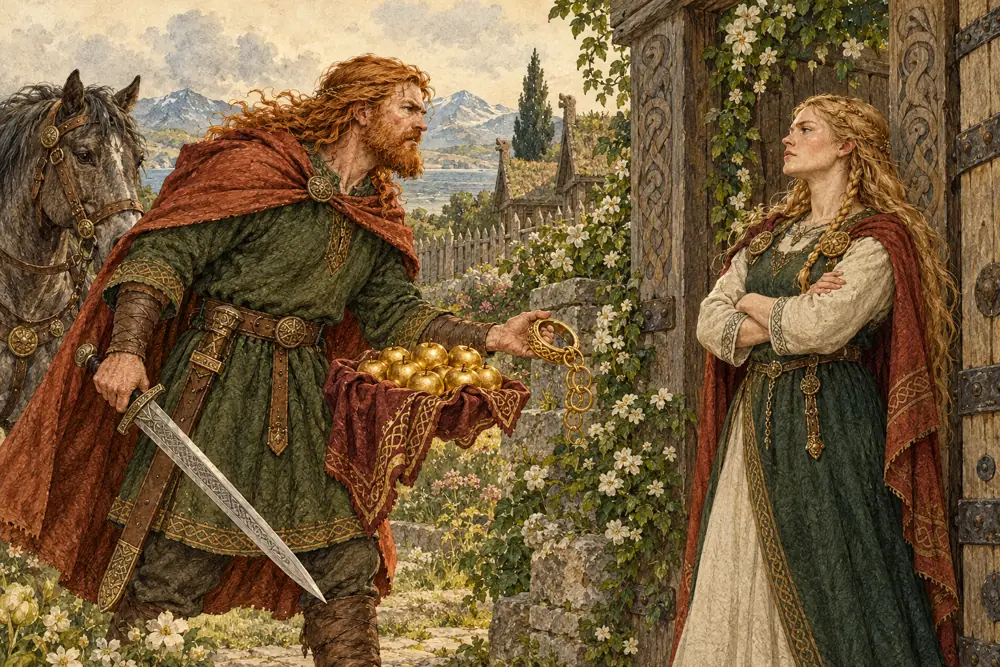
Skirnir reaches Gymir’s enclosure and speaks with Gerd. He offers eleven golden apples in exchange for her favour towards Freyr. She refuses. He then offers the extraordinary ring that produces more rings; she refuses that too, explaining that there is already plenty of gold in her father’s home. These are clear answers, not coy invitations to bargain harder. Skirnir turns from gifts to threats. He brandishes his sword and threatens Gerd’s life and her father’s. She still resists. The speaker who came carrying presents now uses the weapons and authority that accompanied them.
The curse and the meeting
Skirnir then threatens a lengthy magical curse: isolation, humiliation, distress, and an intolerable existence if she will not yield. The poem gives the curse far more space than a cheerful summary usually allows. At last Gerd offers hospitality and agrees to meet Freyr in the grove Barri after nine nights. Skirnir returns with this answer. Freyr finds even that delay almost impossible to bear. The poem ends with his impatience, not with a narrated wedding or a scene proving that Gerd freely falls in love. Adding either would change the surviving story.
What the ending does and does not say
The meeting is promised after explicit intimidation. Calling this an uncomplicated love story hides its central conflict. Some interpretations connect the pair with fertility or the union of different powers, but those interpretations do not erase Gerd’s refusals in the text. Snorri’s shorter account also connects Freyr’s gift of the sword with his later vulnerability. The poem’s main power lies in the contrast between Freyr’s anguish and the pressure brought to bear on someone else to relieve it. A reader can recognise the importance of the myth without treating the behaviour of its characters as admirable.
Read behind the retelling
Sources & limits
Contains threats and coercion. The meeting is not evidence of freely given consent; the surviving poem does not narrate a happy marriage.
- Skírnismál, especially stanzas 19–39 and the final exchange; Bellows translation
- Snorri, Gylfaginning XXXVII: Freyr sends Skirnir
Retold in contemporary English. Dialogue is summarized, not presented as a translation. How to read our sources and versions.
Another thread to follow

2 min read
Loki’s quarrel at Ægir’s feast
Loki enters the gods’ feast and attacks one guest after another in a formal exchange of insults.
Read the story ↗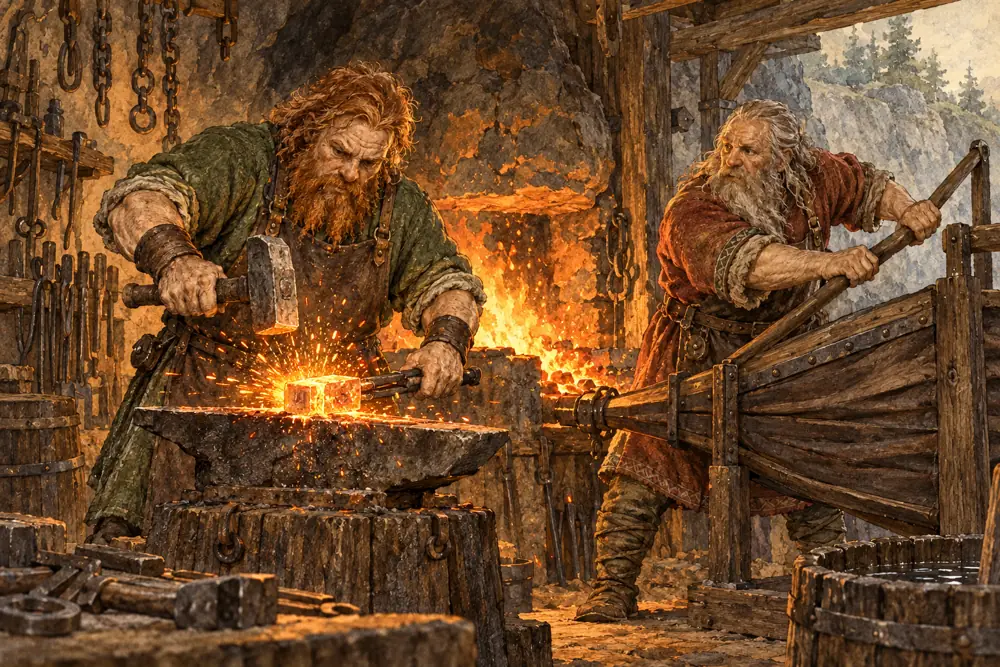
2 min read
The treasures of the gods
Loki’s attack on Sif’s hair sets two groups of dwarf craftsmen to work, bringing some of the gods’ most famous possessions into the story.
Read the story ↗
3 min read
Ragnarok: the breaking of the world
The end approaches through broken human bonds and broken cosmic restraints. The surviving texts also imagine a world that rises after the disaster.
Read the story ↗