
A Norse story · 2 min read
The treasures of the gods
Sif’s hair, a dangerous wager, and the making of Mjölnir
Loki’s attack on Sif’s hair sets two groups of dwarf craftsmen to work, bringing some of the gods’ most famous possessions into the story.
An injury that demands repair
Loki cuts off Sif’s hair. Snorri does not supply a sympathetic reason: it is an act of mischief with a real victim, and Thor threatens to break Loki’s bones unless he makes amends. Loki promises replacement hair made of gold that will grow like living hair. That promise sends him to the dwarves, whose craftsmanship repeatedly gives the gods powers they cannot provide for themselves. The sons of Ivaldi make the golden hair, Odin’s spear Gungnir, and Freyr’s ship Skidbladnir. The ship can carry its passengers with a favourable wind, yet fold away when it is no longer needed.
A wager in the smithy
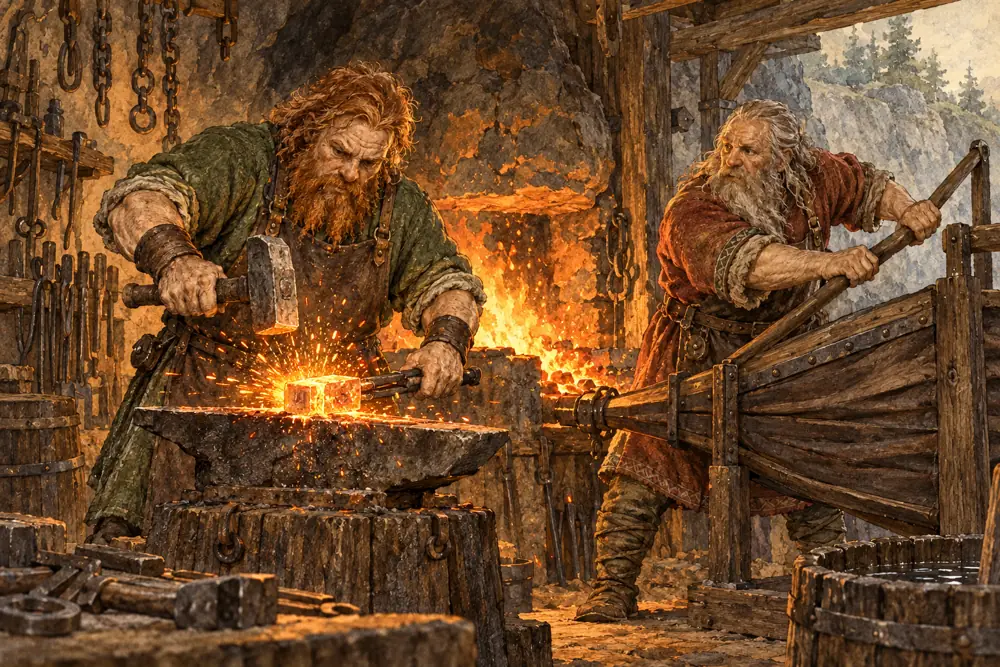
Rather than stop after repairing the damage, Loki bets his head that the brothers Brokk and Sindri cannot match these three objects. One works the forge while the other keeps the bellows moving. A biting fly interferes with the work, attacking hand, neck, and finally eyelid. Brokk holds out through the first two attacks. In the last, blood runs into his eyes and he briefly interrupts the blast. From the forge come a boar with shining golden bristles, the ring Draupnir, and a hammer. The interruption leaves the hammer with an unusually short handle, but does not destroy its power.
The gods choose
Odin, Thor, and Freyr judge the gifts. Odin receives the ring, which produces eight rings of equal weight every ninth night. Freyr receives the golden boar. Thor receives Mjölnir: a weapon that strikes with extraordinary force and returns when thrown. Despite its short handle, the hammer wins because it offers the greatest protection against the gods’ enemies. Loki tries to escape the wager. Thor catches him, but Loki argues that he promised his head, not his neck. Brokk cannot collect one without touching the other. Instead he stitches Loki’s lips together. The story ends with an uncomfortable consequence for a character whose speech has created both the crisis and the solution.
Why the craftsmanship matters
This is more than a list of magical equipment. Sif suffers the initial injury, the craftsmen do the skilled work, and the gods gain objects they will use in other stories. Loki helps produce a stronger divine community while behaving destructively within it. The account also explains poetic references to golden hair, treasure, and the gods’ weapons. Names and spellings of the smiths vary between editions; this retelling follows the Sindri form used in Brodeur’s translation.
Read behind the retelling
Sources & limits
The fly’s identity is often made explicit as Loki in modern retellings; the narrative does not need added dialogue or motives to explain the contest.
Retold in contemporary English. Dialogue is summarized, not presented as a translation. How to read our sources and versions.
Another thread to follow

2 min read
Loki’s quarrel at Ægir’s feast
Loki enters the gods’ feast and attacks one guest after another in a formal exchange of insults.
Read the story ↗
3 min read
Ragnarok: the breaking of the world
The end approaches through broken human bonds and broken cosmic restraints. The surviving texts also imagine a world that rises after the disaster.
Read the story ↗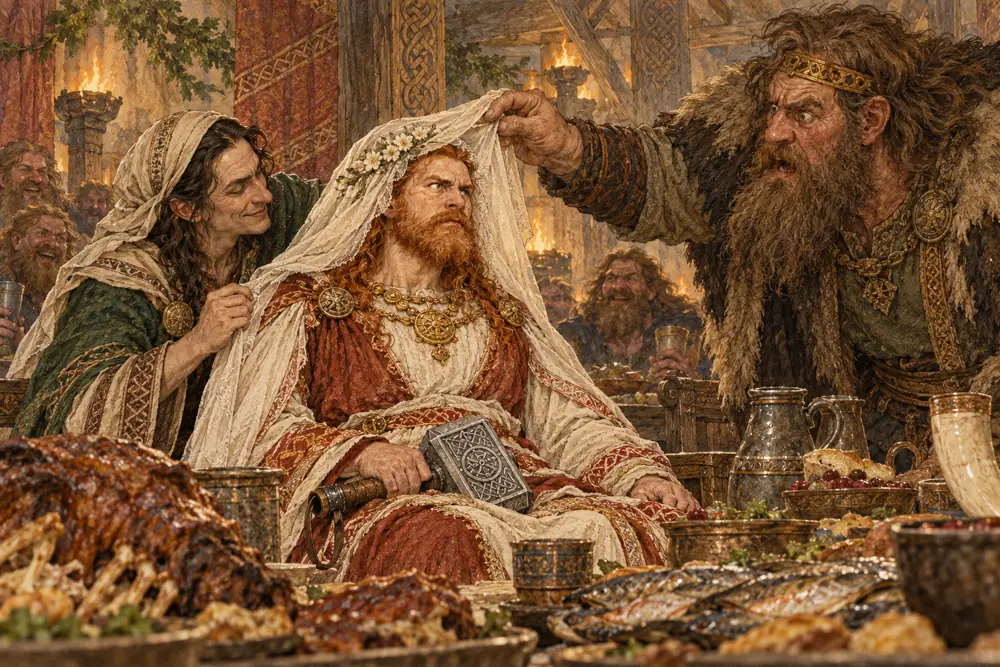
2 min read
Thor’s extraordinary wedding
When Thrym demands Freyja in exchange for Mjölnir, the gods send a very different bride.
Read the story ↗