
A Norse story · 2 min read
Rig and the origins of social ranks
A divine traveller in an unequal human world
A mysterious guest visits three households. The poem makes differences in status part of a mythic ancestry, then moves towards kingship.
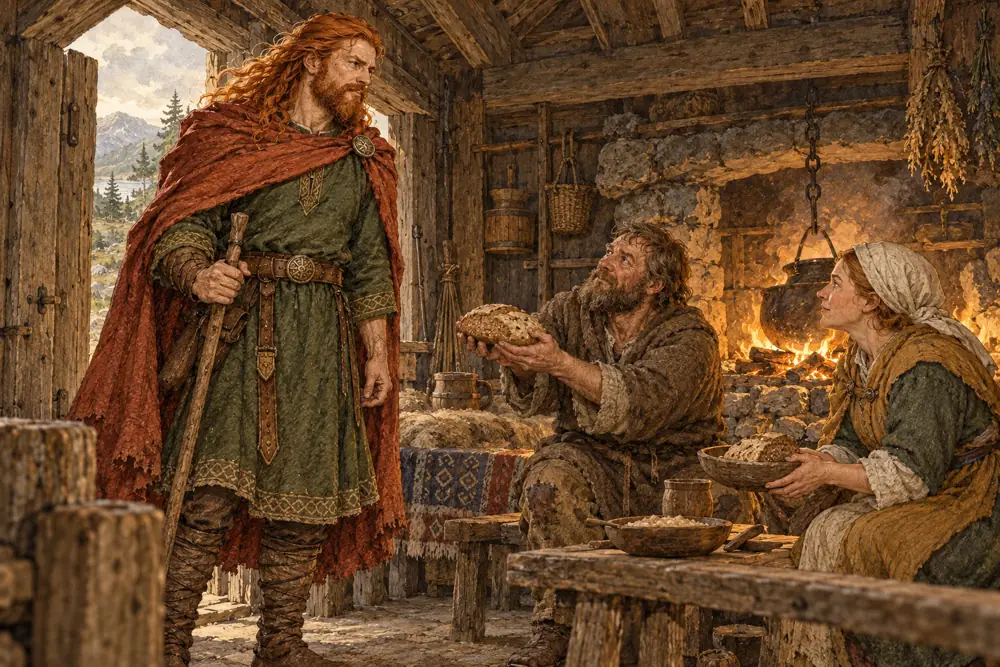
Three households
Rígsþula introduces a traveller called Rig. A prose introduction identifies him with Heimdall, although the poem itself uses the name Rig. He visits three households in turn, and the narrative repeats a pattern of food, conversation, sleeping arrangements, and departure. After each visit a child is born. The pattern connects the guest with the origins of three social groups. It is not a census or a neutral description of society. It is a poem that makes an unequal social order appear rooted in the distant, supernatural past.
Thrall, Karl, and Jarl
The first household has coarse food and a life of hard work. Its child is Thrall, the ancestor of enslaved people within the poem’s scheme. The second household is more prosperous and produces Karl, associated with free farming households and practical labour. The third offers fine food, decorated surroundings, and leisure. Its child is Jarl, who learns weapons, riding, and other accomplishments valued by an elite. The poem contrasts bodies, clothing, names, meals, and occupations. These comparisons reveal the poet’s ranking of people; they should not be reproduced as natural or biological facts about human worth.
From ancestry to power
Rig returns to Jarl, teaches him runes, recognises him as his son, and encourages him to claim territory. Jarl wins land and distributes wealth. He marries Erna, and their descendants continue the story. The youngest, Kon, possesses exceptional knowledge and magical abilities. His name in the phrase Konr ungr, ‘young Kon’, invites a connection with konungr, ‘king’. A bird urges him away from bird-catching towards greater exploits. Then the surviving text breaks off. We cannot supply the missing conclusion as though it were preserved, even if the direction towards a royal story is apparent.
Reading hierarchy as ideology
The poem is valuable precisely because it is not impartial. It shows an imagined explanation of rank, property, labour, and royal authority. Its descriptions can illuminate the concerns of the society that transmitted it, but cannot establish that all Scandinavian communities had exactly three uniform classes or accepted this account. The identification of Rig with Heimdall comes from the prose frame and has been discussed by scholars. Keeping that distinction visible avoids turning an editorial connection into repeated dialogue by the god. This is a social-origin myth bordering on royal legend, and it deserves to be read critically as well as imaginatively.
Read behind the retelling
Sources & limits
The surviving poem is incomplete. Its demeaning portrayal of enslaved people expresses social hierarchy, not objective differences between groups.
Retold in contemporary English. Dialogue is summarized, not presented as a translation. How to read our sources and versions.
Another thread to follow
2 min read
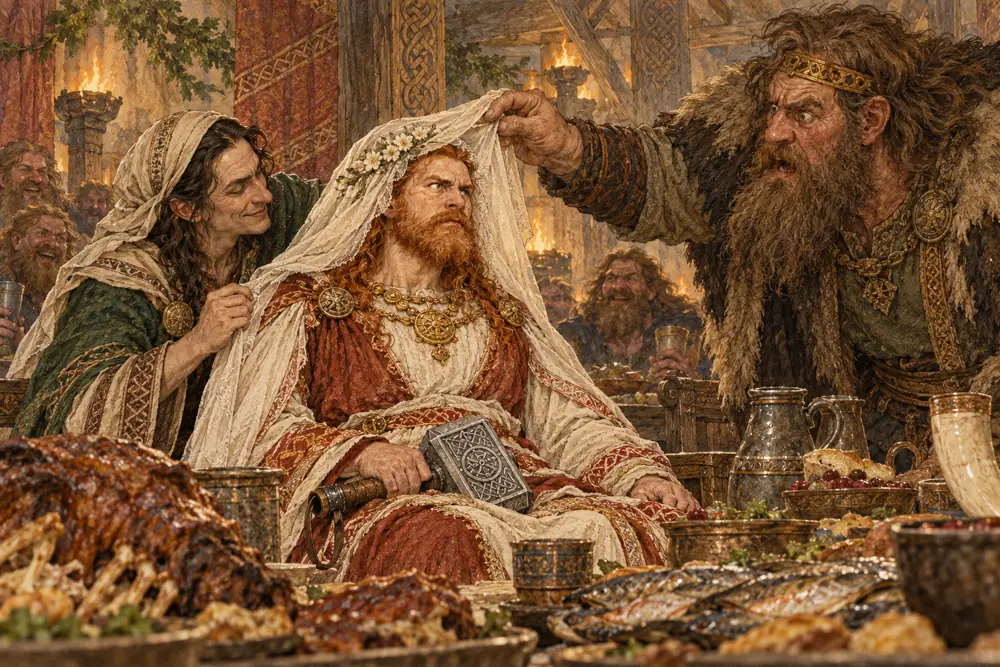
Thor’s extraordinary wedding
When Thrym demands Freyja in exchange for Mjölnir, the gods send a very different bride.
Read the story ↗
2 min read
Loki’s quarrel at Ægir’s feast
Loki enters the gods’ feast and attacks one guest after another in a formal exchange of insults.
Read the story ↗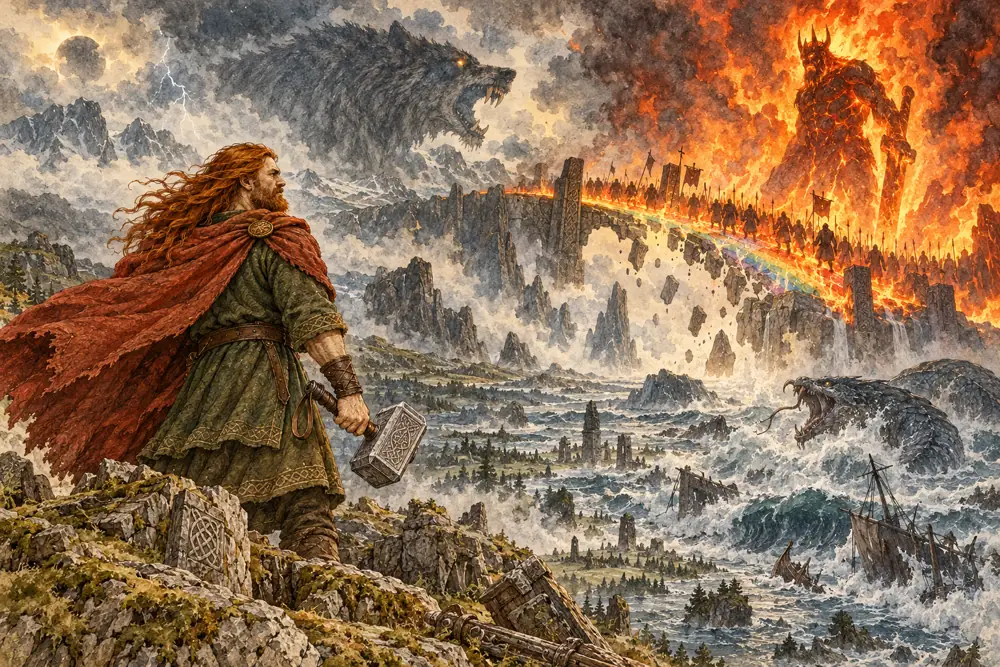
3 min read
Ragnarok: the breaking of the world
The end approaches through broken human bonds and broken cosmic restraints. The surviving texts also imagine a world that rises after the disaster.
Read the story ↗