
Gods & companions
Heimdall
The watcher at the edge of the gods’ world
Heimdall guards the approach to the gods and sounds the alarm at Ragnarök. Extraordinary senses make him the figure who should notice danger before everyone else.
Explore the stories ↓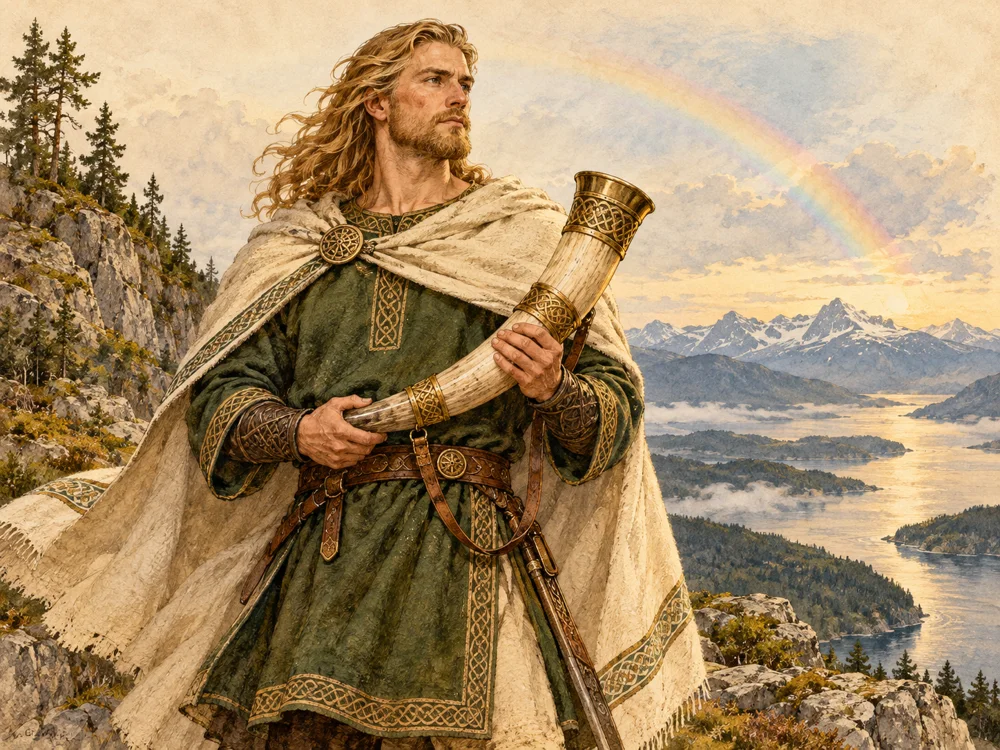
The vigilant guardian
Gylfaginning places Heimdall at Himinbjörg beside Bifröst. He needs very little sleep, sees immense distances by night as well as day, and hears things as slight as growing grass and wool. His horn Gjallarhorn can be heard across the worlds. These deliberately impossible details make vigilance tangible: the security of the divine community is imagined through a watchman whose senses reach beyond human limits.
Nine mothers and an enigmatic past
Heimdall is said to have nine mothers, described as sisters. The surviving references do not explain every detail of that birth. Rígsþula’s prose introduction identifies the traveller Ríg with Heimdall; the poem narrates the origins of social groups through his visits to human households. That framing is important, but it should not turn every uncertain allusion to Heimdall into a single reconstructed biography.
Counsel, rivalry and the ending
In Þrymskviða, Heimdall proposes dressing Thor as a bride to recover Mjöllnir. Skáldskaparmál also alludes to a struggle between Heimdall and Loki over Brísingamen. At Ragnarök his horn announces disaster, and Snorri makes the two rivals kill one another. His job is to warn and defend, not to guarantee that the boundary can hold forever.
Ríg visits three very different households
The prose heading of Rígsþula identifies Ríg with Heimdall. Traveling on foot, he enters three households in succession, eats the food offered and stays with each couple. The resulting children stand at the beginnings of three social groups: thralls, free farmers and an aristocratic household. The contrasts are deliberately concrete. Food, appearance, work and possessions change from one home to the next. Ríg later returns to instruct Jarl in runes and recognizes him as his son; the narrative proceeds toward the abilities of the younger Kon. This is a poem giving social hierarchy a divine origin, not a neutral census of actual Viking families. Its unequal portraits reveal the values of the story while extending Heimdall's narrative role far beyond watching a bridge.
Two rivals in the shapes of seals
Skáldskaparmál preserves a strange glimpse of Heimdall far from his familiar watchtower. In its explanation of poetic names, it connects him with a struggle against Loki at Singasteinn over Freyja's necklace, Brísingamen. Snorri says that the rivals were in the forms of seals and points to Úlf Uggason's Húsdrápa for the story. The surviving passage is an allusion, not a fully narrated chase with every cause and consequence supplied. Its importance is the transformation itself: the watchman can participate in a struggle across forms and environments rather than remain fixed at Bifröst. The episode also gives their final mutual destruction at Ragnarök a background of earlier rivalry, without allowing us to reconstruct a complete lost adventure from those few lines.
Read behind the retelling
Sources & limits
Ríg’s identification with Heimdall comes from the poem’s prose introduction. Several other Heimdall traditions survive only as brief allusions.
- Gylfaginning, chapters 27 and 51
- Þrymskviða, the gods’ council
- Skáldskaparmál, kennings for Heimdall
- Rígsþula, prose introduction and poem
Retold in contemporary English. Dialogue is summarized, not presented as a translation. How to read our sources and versions.
Follow the thread
Stories & related reading: Heimdall
2 min read
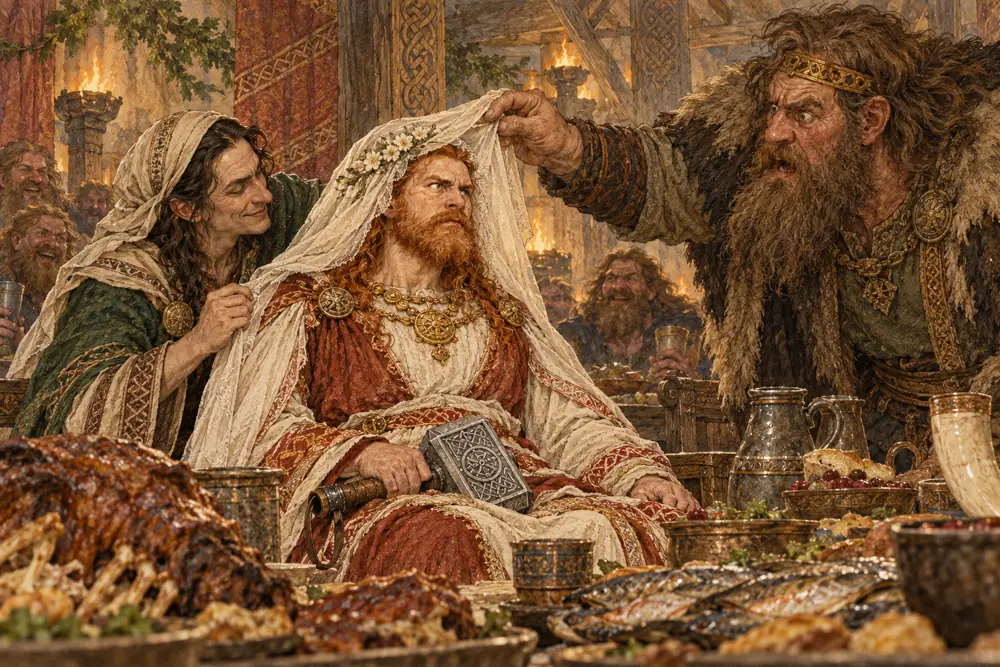
Thor’s extraordinary wedding
When Thrym demands Freyja in exchange for Mjölnir, the gods send a very different bride.
Read the story ↗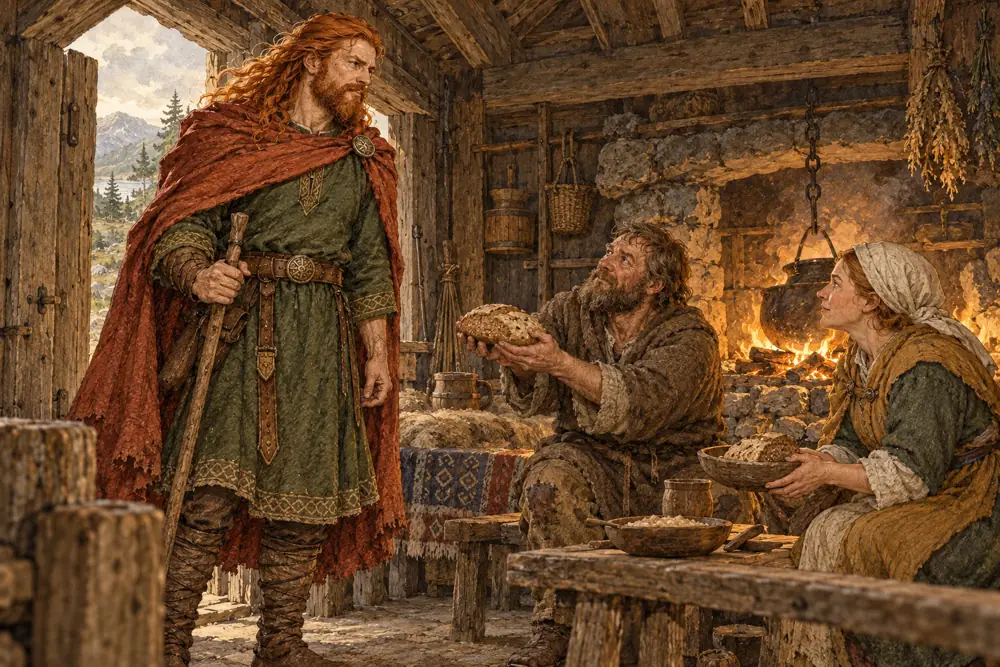
2 min read
Rig and the origins of social ranks
A mysterious guest visits three households. The poem makes differences in status part of a mythic ancestry, then moves towards kingship.
Read the story ↗
3 min read
Ragnarok: the breaking of the world
The end approaches through broken human bonds and broken cosmic restraints. The surviving texts also imagine a world that rises after the disaster.
Read the story ↗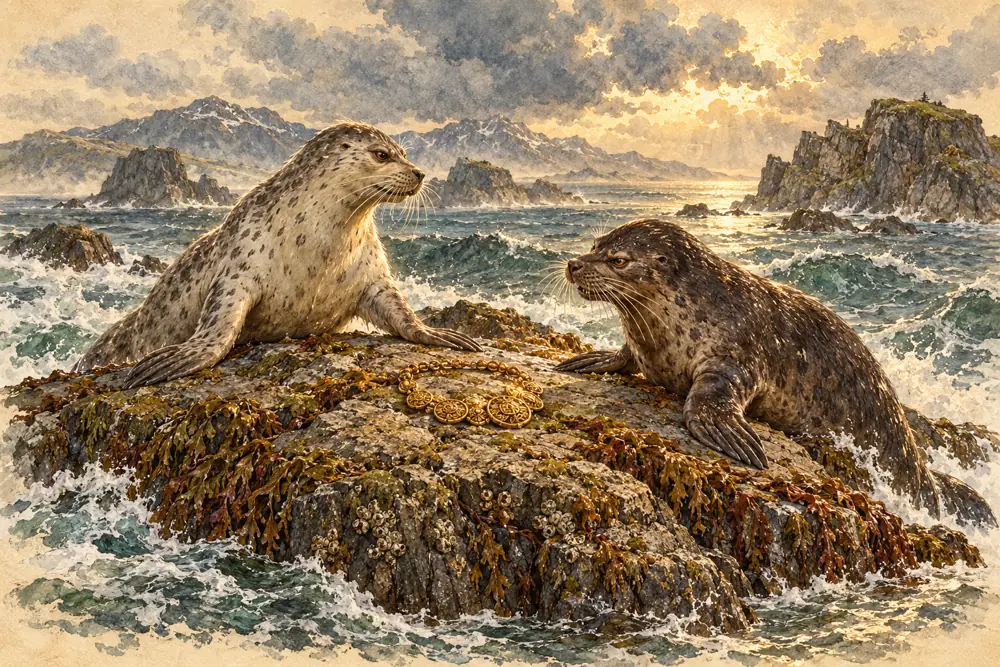
2 min read
Heimdall and Loki at Singasteinn
Two divine enemies fight over Freyja’s necklace, but the fuller story that once surrounded the scene has not survived.
Read the story ↗
2 min read
Loki’s quarrel at Ægir’s feast
Loki enters the gods’ feast and attacks one guest after another in a formal exchange of insults.
Read the story ↗