
Viking crafts · Follow the making
Pottery Making: Clay, Form and Fire
Follow a vessel from clay selection to use, while comparing hand forming, wheel work, experimental firing and the archaeological traces that separate possibility from proof.
Explore the craft ↓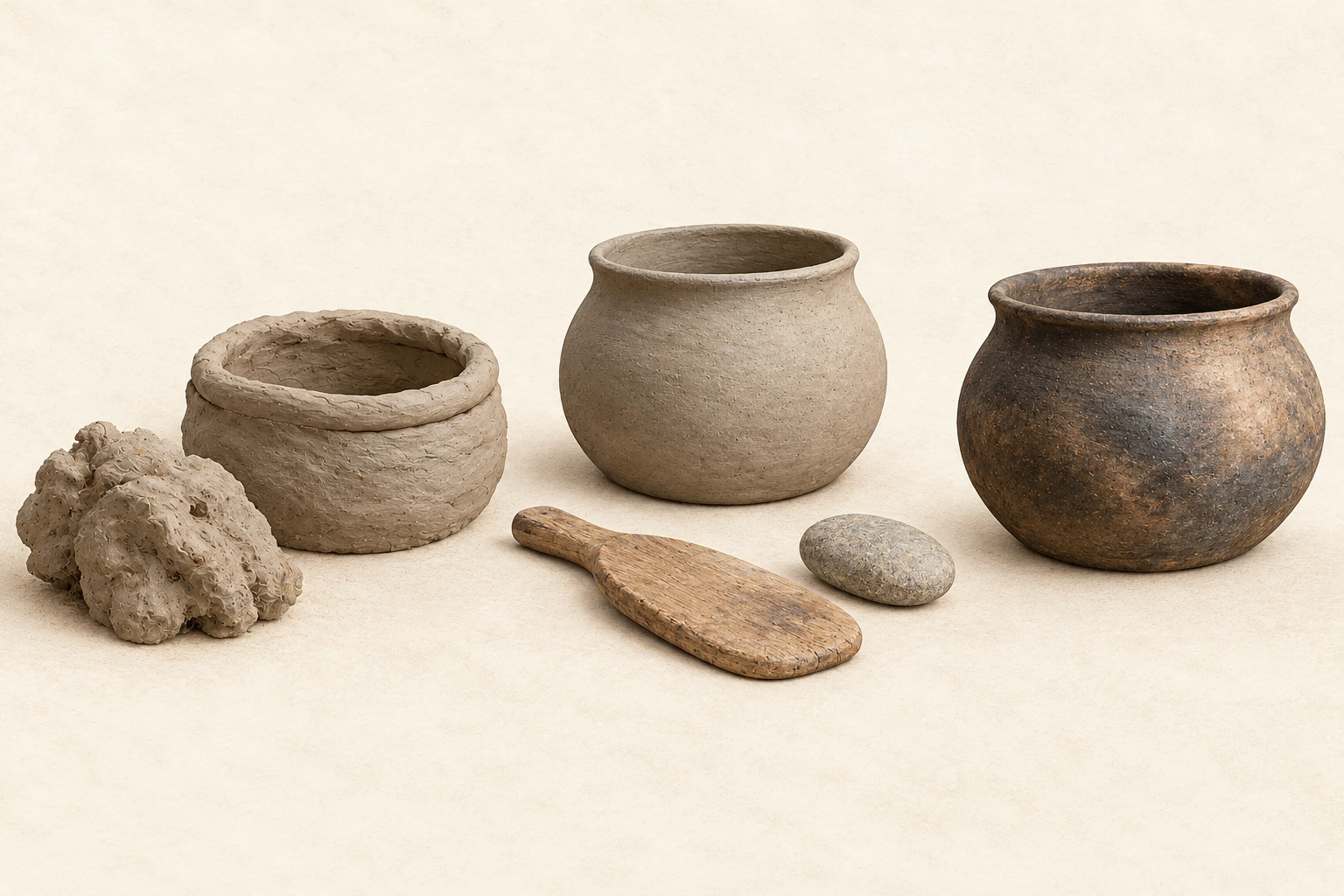
01 · Pottery making
Read the vessel as a sequence of choices
Start with a pot’s opening, wall and base. What had to happen before it could stand, hold its shape and become useful? This guide follows the questions behind making, rather than presenting a single recipe for a whole period. The companion article, Pottery: Cooking, Craft, and Cultural Change, introduces the wider historical evidence.
At Hedeby, imported ceramics arrived among other traded goods; soapstone vessels also travelled into the market. A pot found in a Scandinavian settlement therefore need not be locally made, and ceramic vessels did not occupy every role alone. Place and material must be established before technique is assigned. National Museum of Denmark: Import
02 · Pottery making
Choose a clay body, not just a colour
Perry’s analysis of Torksey pottery identified naturally sandy clay as the potters’ raw material. The sand was not simply an ingredient that every maker had added. Selection matters: a useful clay source can be chosen for its existing properties. The study links a manufacturing tradition to a particular landscape rather than to an imagined universal Viking clay mixture. Gareth J. Perry (2016), Pottery Production in Anglo-Scandinavian Torksey
For an object study, describe visible grains separately from the clay around them. Write “inclusions present” before deciding “temper added.” That small difference in wording keeps the observation distinct from a proposed action by the potter. A coarse-looking surface is a question to investigate, not a complete recipe.
03 · Pottery making
Test the explanation for small holes
Neal’s Ribe experiment compared pots made with different clays and added materials against archaeological examples from Ribe and Okholm. Its test series included natural clays and a cleaned clay control, so differences could be compared systematically. Pinprick holes did not automatically demonstrate deliberate organic temper. The comparisons favoured naturally occurring organic inclusions as an explanation for the studied pottery, while some alternatives remained difficult to exclude. This is why a tiny feature deserves a carefully framed question. Jessica Neal, with Anders Olesen: Experiments in Viking Pottery
On a photograph of a broken edge, circle grains, voids and changes in texture with different colours. Then list at least two possible explanations for a feature before choosing one. Do not break a collection object or call every dark speck charcoal; the exercise is about recording what the image actually shows.
04 · Pottery making
Build and smooth the wall
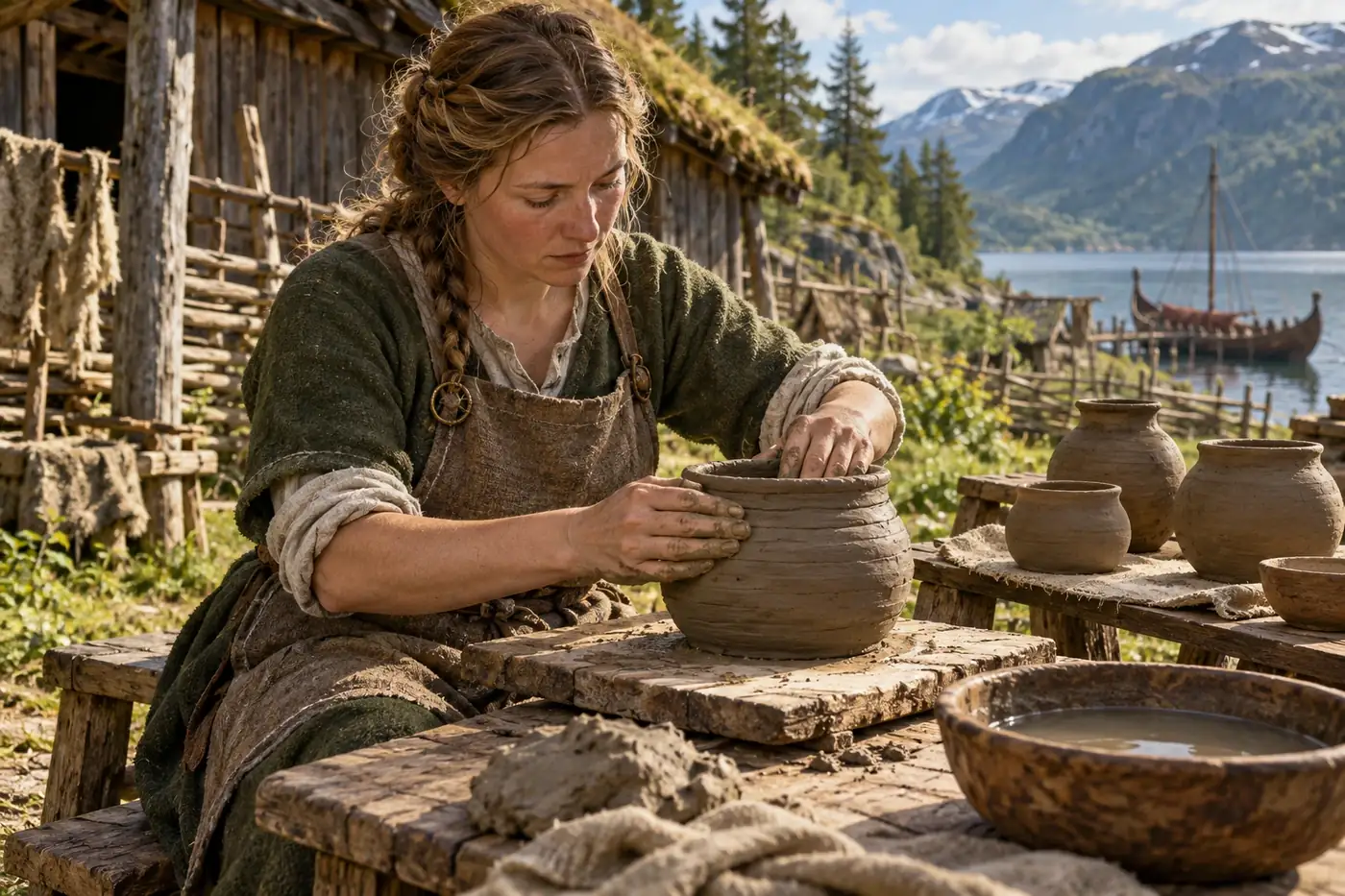
Ribe VikingeCenter’s modern potter demonstration shows clay shaped by hand and surfaces worked with simple implements such as wood, stone and antler. The useful lesson is the relationship between shaping and finishing: the wall has to acquire a form before its surface can be refined. This is a modern demonstration of plausible actions, not a recording of an ancient workshop. Ribe VikingeCenter: The potter, documentary
Study the transition from base to wall and from wall to rim. Where would a hand support the vessel while another worked? The coiled unfinished vessel in the illustration shows one hand-forming method. It does not stand for every pot: the guide also follows regional evidence for wheel-produced pottery.
05 · Pottery making
Make room for regional wheel traditions
The familiar contrast between local handmade pottery and imported wheel-thrown ware is too simple. Ribe VikingeCenter identifies early local wheel-turned production as a distinctive feature of Ribe, earlier than its wider use elsewhere in Denmark. A wheel-made vessel does not automatically become an import because it was found in Scandinavia. Local evidence has to decide the question. Ribe VikingeCenter: The potter
When comparing two pots, separate three questions: where they were found, how they were formed, and where they were manufactured. Those answers may require different evidence. “Round and regular” is a visual description; a named production tradition is a stronger claim. Do not let a smooth outline do the work of an archaeological argument.
06 · Pottery making
Look beneath the finished surface
Perry’s Torksey study considered the orientation of particles and voids as well as visible forming traces. Such observations help evaluate wheel throwing against other possibilities, including hand construction followed by wheel finishing. A horizontal line is therefore not a complete manufacturing history. The strongest interpretation brings different observations into agreement. Gareth J. Perry (2016), Pottery Production in Anglo-Scandinavian Torksey
Try sketching the same pot twice: once as an outer silhouette and once as an imagined section through its wall. Leave the second drawing blank wherever the photograph supplies no evidence. This exposes the difference between a convincing outline and knowledge of how the wall was actually assembled.
07 · Pottery making
Give drying its own place in the sequence
The Ribe demonstration allows several days of drying before firing. Its sequence is useful because shaping and firing are separated by an interval that is easily omitted from attractive illustrations. A newly formed vessel, a dried vessel and a fired vessel represent different stages, even when their outlines look similar. The demonstration’s timetable should not be imposed on every ancient clay, season or vessel. Ribe VikingeCenter: The potter, documentary
For a cold-clay classroom study, make two small sample shapes and record them over several days. Photograph the same view and note visible changes without claiming to reproduce a Viking workshop. The point is to learn why a process needs observation between dramatic moments, not only at the beginning and end.
08 · Pottery making
Distinguish a firing experiment from a kiln find
The Ribe report used a reconstructed kiln based on the much earlier Hasseris example, dated around AD 500, because no local Viking-Age pottery kiln was available from excavation when the project was designed. Its firing results are experimental evidence. A photograph of that kiln must not be captioned as the recovered kiln of a Viking potter at Ribe. Jessica Neal, with Anders Olesen: Experiments in Viking Pottery
Firing conditions can also vary within a named tradition. Perry found evidence for differing firing atmospheres at Torksey. A dark exterior alone cannot supply the entire firing history. Read colour together with the ceramic fabric and archaeological setting. Gareth J. Perry (2016), Pottery Production in Anglo-Scandinavian Torksey
09 · Pottery making
Compare a place with excavated kilns
Torksey provides a contrasting case. Research on the town identifies a late ninth- and tenth-century pottery industry using fast wheels and updraught kilns. Its products included jars, bowls and spouted pitchers; thumbed bands and rouletted decoration supplied surface detail. Excavated kilns and failed pottery connect the industry to actual installations and production waste, rather than to a kiln type borrowed solely for an experiment. This remains a regional example from England, not a template for every Scandinavian settlement. Hadley and colleagues (2023), Torksey after the Vikings
The distinction changes how a reconstruction should be drawn. Where an excavated structure supports a feature, explain the connection. Where a working experiment supplies the feature, say so. An image can combine useful teaching details, but its caption must not silently turn that combination into a single documented ancient workshop.
10 · Pottery making
Compare everyday surfaces with special vessels
The Swedish History Museum identifies a Tating-ware jug from Birka grave Bj 597 with tin-foil ornament in the form of a cross. That particular object shows why “Viking pottery” cannot mean only a rough, undecorated cooking pot. Describe the named vessel and its surviving decoration before moving to wider interpretations of trade, display or belief. Swedish History Museum: Tating-ware jug, Bj 597
Set a photograph of that jug beside a plain vessel and compare profile, rim, handle and surface treatment. The comparison is a visual exercise; similarity alone does not establish shared manufacture. Nor does a cross on one object, without further context, settle the personal beliefs of everyone associated with it.
11 · Pottery making
Follow the finished pot into use
Lipid-residue analysis examines traces absorbed into ceramic vessels. A 2026 comparison of Viking-Age pottery found aquatic signals much more frequently in the sampled Danish material than in the English material. This concerns the uses represented by those sampled pots. It does not mean people in England never ate fish: preparation outside the sampled pottery can escape that particular test. Ashby and colleagues (2026), Cuisine and culture-contact
For the maker’s story, this opens a final question: what happened after firing? Keep manufacture, visible wear and chemical evidence of contents as related but separate enquiries. A vessel’s shape may suggest uses, while residue analysis can test some of them. Neither should be made to answer every question about a household’s meals. Ashby and colleagues (2026), Cuisine and culture-contact
12 · Pottery making
Make a vessel study that can be checked
Choose one museum pot with a clear catalogue entry. Record its number, findspot, date range and material description. Sketch the profile, then make a second drawing of the details you can genuinely see: rim, base, handle, decoration or broken edge. Write the scale only if the museum provides it; do not estimate a precise size from an unscaled image.
Finish with three short statements headed “observed,” “inferred” and “unknown.” Add the source beside each inference. This small record gives the making sequence a firm endpoint: a pot understood through evidence, with room for future correction. It also makes a better caption for a detailed reconstruction than an unsupported claim to show exactly how all Viking potters worked.
Follow the evidence
Sources & further reading
Follow the dated finds, published studies and documented experiments behind each section. Modern demonstrations explain workable choices; they do not establish one method for every Viking-Age workshop.
- Jessica Neal, with Anders Olesen: Experiments in Viking PotteryExperimental report comparing Ribe and Okholm pottery; modern firing is explicitly reconstructed.
- Ribe VikingeCenter: The potter, documentaryModern demonstration of hand forming, smoothing, drying and firing.
- Ribe VikingeCenter: The potterLocal wheel-turned production complicates a simple handmade-versus-imported division.
- Gareth J. Perry (2016), Pottery Production in Anglo-Scandinavian TorkseyPrimary fabric, forming and firing analysis; a specific English production centre.
- Hadley and colleagues (2023), Torksey after the VikingsExcavated production sites, kilns and pottery industry in its settlement context.
- Ashby and colleagues (2026), Cuisine and culture-contactPrimary lipid-residue comparison; sampled pots cannot represent an entire diet.
- National Museum of Denmark: ImportImported ceramics at Hedeby alongside other goods and vessel materials.
- Swedish History Museum: Tating-ware jug, Bj 597Museum catalogue and object text, 524156_HST, SHM 34000:Bj597; tin-foil decoration.
Continue the exploration