
Journeys & Encounters · Focused study
The Vale of York Cup: A Frankish Vessel in a Viking Hoard

In Brief
The Vale of York cup was already an old object when someone packed it with treasure and buried it in northern England. Its manufacture, movement and final concealment belong to different chapters of its history.
On this page
Begin with the vessel, not the labelA church vessel?An object becomes a treasuryBurial and rediscoverySourcesBegin with the vessel, not the label
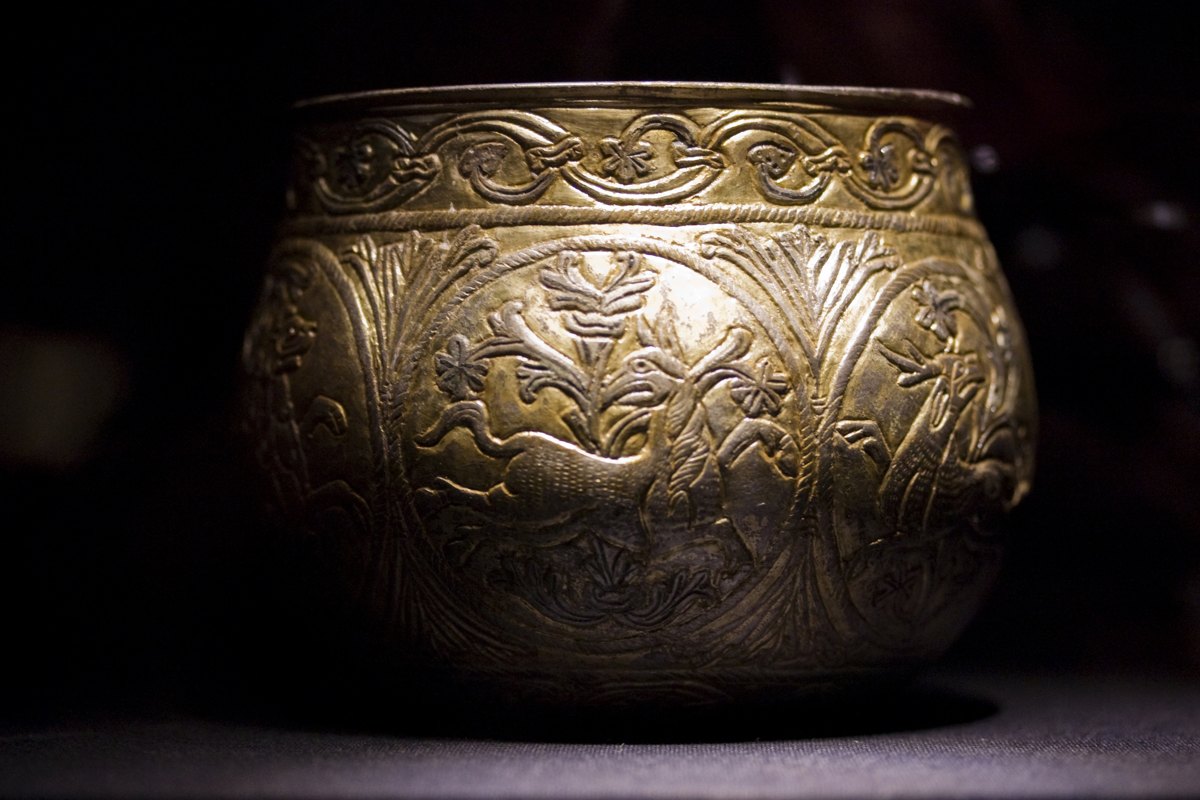
The British Museum dates the cup to the middle of the ninth century and classifies its manufacture as Carolingian, while identifying its archaeological context as Viking. Those two descriptions are compatible. An object could enter a Viking-associated collection without being made by a Scandinavian craftsperson. The distinction is especially useful here because the cup survived long enough to acquire a second purpose as a container for other valuables.
The vessel stands 92 millimeters high. Its rounded silver body carries gilding, dark niello decoration and six circular panels containing animals and vegetation. These details place the emphasis on a carefully finished luxury object, rather than a plain storage pot.
Sources for this section: 1
A church vessel?
The museum's catalogue offers several possible functional names, including pyx and ciborium, both associated with Christian ritual containers. Its question marks matter: identifying a possible liturgical form is not the same as knowing which church owned it. York Museums Trust places its production in what is now France or western Germany and suggests that it could have reached Viking hands through plunder or tribute.
Those possibilities should remain alternatives. The cup carries no surviving account of a particular raid. Naming a monastery, an attacker or a ship would turn a reasonable historical explanation into an invented biography.
Sources for this section: 1, 2
An object becomes a treasury
The wider hoard combines 617 coins with 67 other precious-metal objects, including intact ornaments, ingots and cut fragments. Most smaller pieces were placed within the cup, and a protective lead container helped preserve the deposit. The assemblage consequently brings together things that could be admired as finished possessions and things usable as weighed metal.
York Museums Trust emphasizes the far-reaching origins of the collection. That breadth demonstrates connections between economic networks; it does not require one owner to have personally visited every place represented. Objects can travel through many successive transactions before they enter the same bundle.
Sources for this section: 2, 3
Burial and rediscovery
The catalogue dates deposition to 927–928, considerably later than the cup's manufacture. David and Andrew Whelan discovered the hoard in North Yorkshire in January 2007 and reported it while keeping the material together. The Yorkshire Museum's account rightly makes that action part of the story: a collection of individually sold coins would have preserved much less information about the original assemblage.
Study the cup beside the contents, rather than as an isolated masterpiece. The older vessel and the newer deposit answer different questions. Decoration helps investigate manufacture; the association with coins and other silver helps investigate its final use. The gap between those events is what makes the cup such a compelling witness to the Viking Age.
Sources for this section: 1, 3
The Evidence
The sources below support this article. Interpretations and limits are explained in the text; this is not an exhaustive research review.