
Research & Sources · Deep dive
The Youngest Coin and the Date of a Viking Hoard
In Brief
A coin can establish the earliest possible burial date without recording the burial itself. Halton Moor, Vårby, Burray, and the Vale of York show how that distinction works.
On this page
Halton Moor provides a clear lower limitThe container can be much olderA coin may become something elseImitations require identification before datingSome hoards justify a narrow estimateCondition is evidence, not an independent clockBurray illustrates appropriate precisionA burial date does not identify a burial storySourcesHalton Moor provides a clear lower limit
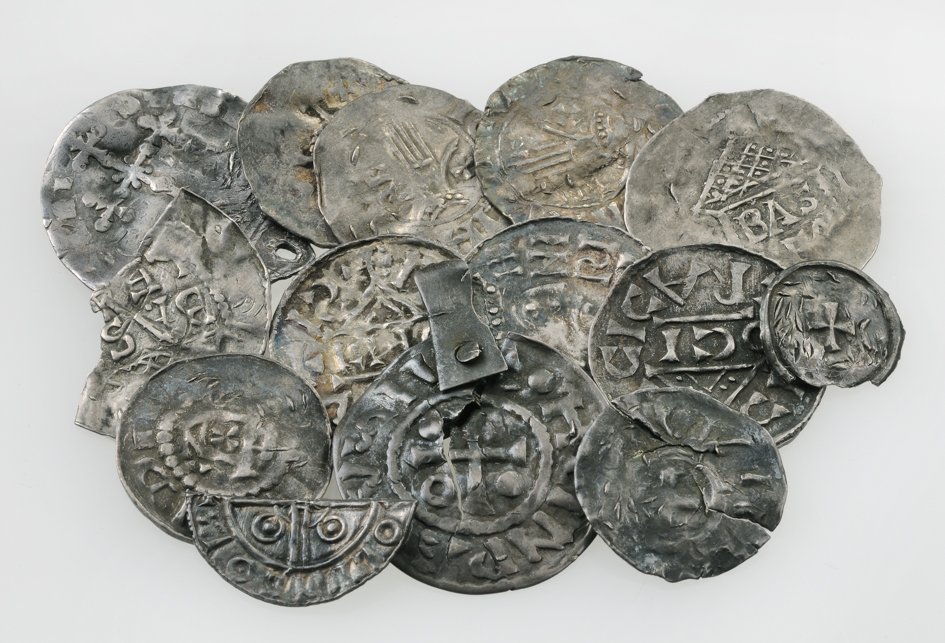
The British Museum’s account of the Halton Moor hoard explains that its latest coin was produced in the late 1020s. The assemblage therefore could not have been buried before that coin existed. Archaeologists call such a lower chronological limit a terminus post quem. The logic is simple but powerful: an object cannot enter a deposit before it is made. It does not follow that deposition occurred immediately afterward. The coin might have passed through several hands or remained stored before burial. A clear description should therefore distinguish the coin’s production date from the earliest possible date for the assembled hoard’s deposition.
Sources for this section: 1
The container can be much older
Halton Moor also included a decorated cup assigned to the late eighth or ninth century, alongside coins made under Cnut. The objects’ production dates thus describe different stages in a history that ended with their deposition together. Dating the burial by the cup alone would overlook the younger evidence. Conversely, assigning every object to the date of the youngest coin would erase the cup’s earlier life. This is why catalogs may include more than one date for an object or assemblage. Manufacturing, modification, accumulation, and burial are distinct events. A good timeline can show an old vessel entering a younger hoard without creating a chronological contradiction.
Sources for this section: 1

A coin may become something else
The Swedish History Museum’s account of the Vårby hoard describes Islamic coins transformed into pendants, with the youngest coin minted in 937–938. The museum places the hoard’s burial around the middle of the tenth century. Here a coin’s history includes use as ornament as well as its earlier monetary identity. That transformation does not remove its chronological value, but it warns against assuming rapid circulation from mint to burial. A pendant could have remained in use after comparable coins had left ordinary transactions. The date belongs first to the original object; the later conversion and deposition require their own sequence of interpretation.
Sources for this section: 2
Imitations require identification before dating
Vårby’s pendants include imitations as well as Islamic coins. That detail makes specialist identification important before an inscription or familiar design is treated as a straightforward manufacturing date. A copy can reproduce an older model’s appearance without having been made at the same time or place. For a hypothetical unidentified pendant, the first question is therefore what kind of object it is, not merely what date seems readable on it. The catalog should preserve the attribution and any uncertainty. A precise-looking number is not a substitute for identifying the coin or imitation whose history gives that number its chronological meaning.
Sources for this section: 2
Some hoards justify a narrow estimate
Andrew Woods’s York Museums Trust account explains why the Vale of York hoard is usually assigned to late 927 or early 928. It includes an almost unworn coin carrying Æthelstan’s claim to rule all Britain, associated with the political developments of 927. The interpretation combines identification, historical placement of the issue, and the coin’s condition. That is more than simply reading a number and applying it to the burial. The example shows how specialists can move from an earliest possible date toward a narrower likely interval when additional evidence supports the step. The estimate remains an argument about the assemblage, rather than a date stamped on its container.
Sources for this section: 3
Condition is evidence, not an independent clock
The Vale of York explanation uses the near-new condition of its latest issue as part of the case for prompt deposition. The inference is persuasive in context, but the general principle should not be converted into a universal rule that every unworn coin was buried immediately. In an illustrative counterexample, a newly acquired coin could be stored without much further handling. A reader should therefore ask how condition combines with the rest of the assemblage and the issue’s chronology. The strongest account keeps the steps visible: identify the coin, establish when it could have been struck, assess its history, and explain why a particular burial interval is likely.
Sources for this section: 3
Burray illustrates appropriate precision
National Museums Scotland describes the Burray hoard as dating to around AD 1000, with its coins suggesting burial between 997 and 1010. The general label and the narrower range serve different purposes without conflicting. “Around 1000” is a useful orientation; the interval communicates the proposed chronological resolution more clearly. A popular article should retain that distinction instead of silently replacing a range with its midpoint. Writing “buried in 1003” would look more precise but would add information the cited account does not establish. Precision should follow the evidence and the published interpretation, not the preference for a single year on a timeline.
Sources for this section: 4
A burial date does not identify a burial story
The Burray museum account describes a substantial assemblage dominated by complete and cut silver arm-rings, discovered during peat cutting in 1889. Its coin-based dating locates deposition broadly in time, but those facts do not identify the person who buried it or the particular event that prevented recovery. This separation is crucial whenever a hoard is attached to a nearby battle, ruler, or raid. A chronological overlap may make a proposal possible without proving it. The useful final explanation should state the date’s basis, the uncertainty around deposition, and the additional evidence supporting any historical narrative. Coins constrain the story; they do not automatically supply its missing characters.
Sources for this section: 4
For the introductory context, read Trade, silver, and the growth of towns.
For the introductory context, read Weights and Measures: Making Exchange Work.
For the introductory context, read Hoards: Why the Arrangement Matters as Much as the Silver.
The Evidence
The sources below support this article. Interpretations and limits are explained in the text; this is not an exhaustive research review.