

TRY IT AT HOME · MODERN INTERPRETATION
Lamb, cabbage & barley stew
Sheep, grain and vegetables offer a historical starting point. The cut, quantities, timing and combination are a present-day recipe, not evidence for one standard meal across Scandinavia.
Get cooking ↓By Nordic Viking History · Reviewed 22 October 2026
Estimated time. This recipe has not yet been kitchen-tested.
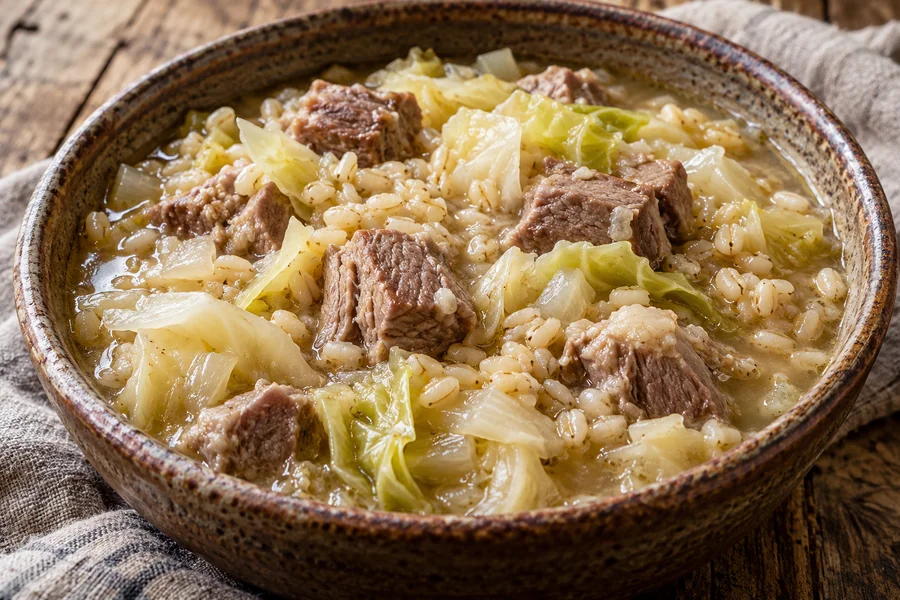
Ingredients
- 700 g boneless lamb shoulder, cut into 3 cm pieces
- 2 onions, chopped
- 100 g pearl barley, rinsed
- 400 g cabbage, sliced
- 1.5 litres water, plus extra if needed
- Salt to taste
Allergens: Gluten (barley)
Method
- Place the lamb, onions and water in a large pot. Bring to a boil, then reduce to a gentle simmer. Skim foam if desired.
- Cover loosely and simmer for 75 minutes. Add barley and continue for 35 minutes, stirring occasionally.
- Add cabbage and cook for another 20–30 minutes, until the lamb is thoroughly cooked and fork-tender and the barley is soft. Add water to maintain a stew consistency.
- Season near the end. Ladle into bowls, making sure meat and grain are distributed evenly.
What connects it to the Viking Age?
Sheep, grain and vegetables offer a historical starting point. The cut, quantities, timing and combination are a present-day recipe, not evidence for one standard meal across Scandinavia.
Sheep and cereals are supported by the linked evidence. Identifying particular ancient vegetables is less straightforward. Pearl barley, the chosen cut and staged cooking instructions belong to this modern adaptation.
Swedish History Museum: Food and animal husbandry at Birka ↗ · National Museum of Denmark: Meat and fish ↗ · Tomlinson and Hall, Internet Archaeology 1: Discussion of individual taxa ↗
Use safe modern ingredients and equipment. Read the kitchen safety notes.
Back to the Viking pantry →Recipe quantities and instructions are modern editorial adaptations; no surviving Viking-Age Scandinavian cookbook supplies this recipe.