

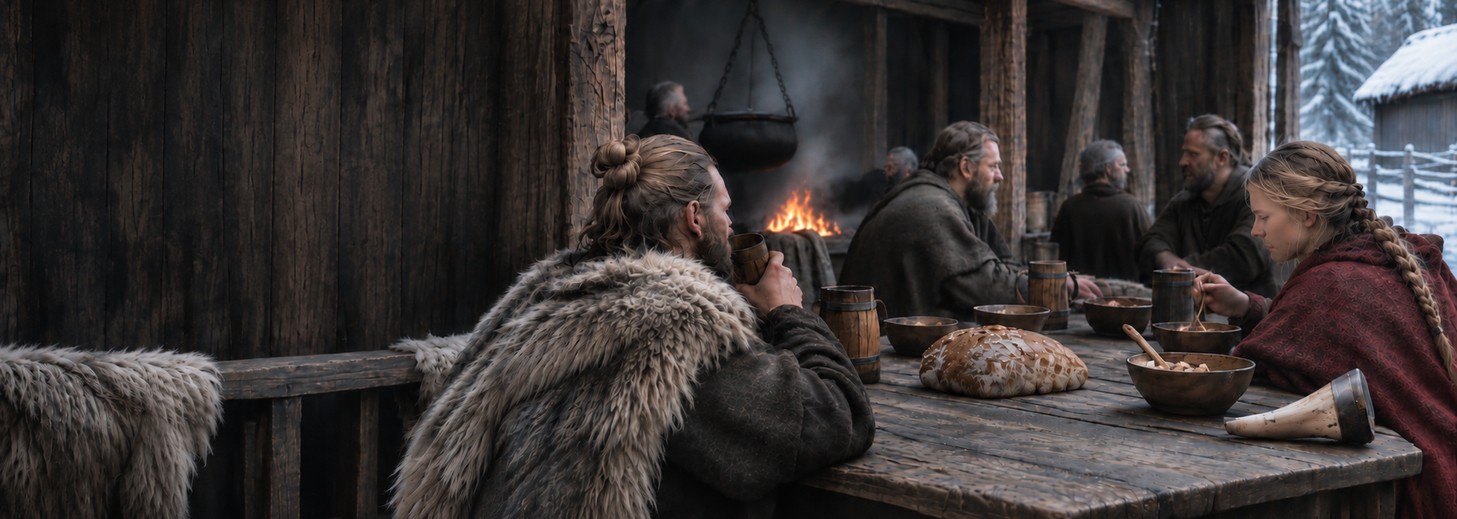
Every December, millions of people across Scandinavia celebrate Christmas with family gatherings, festive meals, candles and traditional foods. Some of these customs are often described as ancient Viking traditions. But how much of what we associate with Christmas today actually goes back to the Viking Age?
Long before Christianity became established throughout Scandinavia, people in the Nordic world observed a winter celebration known as jól (Yule). The surviving sources associate it with the winter season, communal gatherings, drinking and religious observances. They do not provide a complete description of one uniform “Viking Christmas”. Instead, they preserve fragments: an early skaldic poem, medieval accounts of sacrifice, legal provisions concerning ale and archaeological evidence for large communal meals.
What Did Jól Mean?
The Old Norse word jól is grammatically plural. It is related to forms found in other early Germanic languages, including Old English geōl. The deeper origin of the word remains uncertain, and it is better not to present one proposed translation or etymology as settled fact.
In Old Norse texts, jól refers to Yule or a winter festival. The name survived the conversion to Christianity and gradually became the Scandinavian word for Christmas. That linguistic continuity is important, but it does not mean that every modern Christmas custom is a direct survival of Viking practice.
What we can establish: the name existed before Christian Christmas became established in Scandinavia. Its later use for Christmas is evidence of historical change, not proof that the two celebrations were identical.
When Did the Vikings Celebrate Yule?
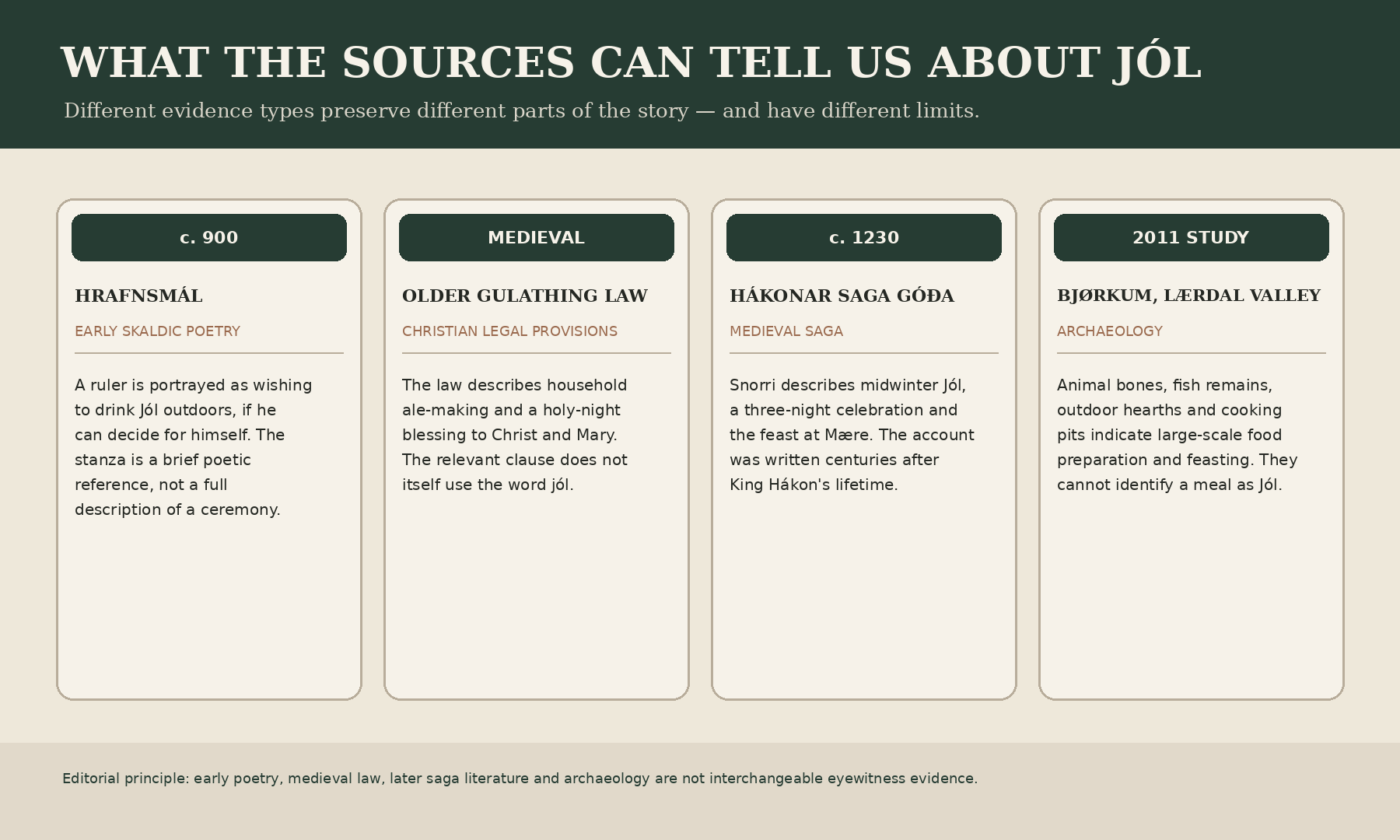
The exact timing of pre-Christian Jól remains debated. The most detailed account appears in Hákonar saga góða, part of Snorri Sturluson's Heimskringla, written in the thirteenth century.
Snorri says that King Hákon the Good aligned the Yule celebration with the Christian Christmas calendar. In his account, the earlier celebration began at hǫkunótt, which he identifies as miðsvetrarnótt, or midwinter night, and lasted three nights.
The Old Norse passage does not give a fixed Gregorian calendar date. Modern translations sometimes provide a calendar equivalent, but that should not be mistaken for a date explicitly written in the original text. Scholarly reconstructions of the pre-Christian calendar differ, and the relationship between Jól, midwinter and the winter solstice remains a subject of discussion.
The safest conclusion is that Jól was associated with the midwinter period. Its exact timing may have varied according to calendar, region and local tradition.
An Early Reference to Drinking Jól
One of the most important early references appears in a skaldic poem traditionally known as Haraldskvæði or Hrafnsmál. The poem is associated with King Harald Fairhair and is generally placed around the end of the ninth or beginning of the tenth century, although its dating and transmission require care.
One line reads “Úti vill jól drekka”, commonly translated along the lines of “he wishes to drink Yule outdoors”. The speaker imagines the ruler drinking Yule out at sea if he can choose for himself.
This is significant evidence that Jól was a recognised celebration in early skaldic poetry and that drinking was associated with it. But the verse is brief. It does not describe a complete ceremony, a standard menu or a set of customs followed by every household.
Winter Feasts, Food and Hospitality
Large communal meals were important in Viking-Age society. Providing a feast could demonstrate wealth, generosity and political influence. A successful leader was expected to maintain relationships with followers, neighbours and other powerful families.
Snorri's later descriptions of sacrificial feasts include gatherings where participants brought provisions, drank ale, sacrificed animals and shared the cooked meat. These passages help us understand the social setting of major feasts, but they should not automatically be treated as a description of every Jól celebration.
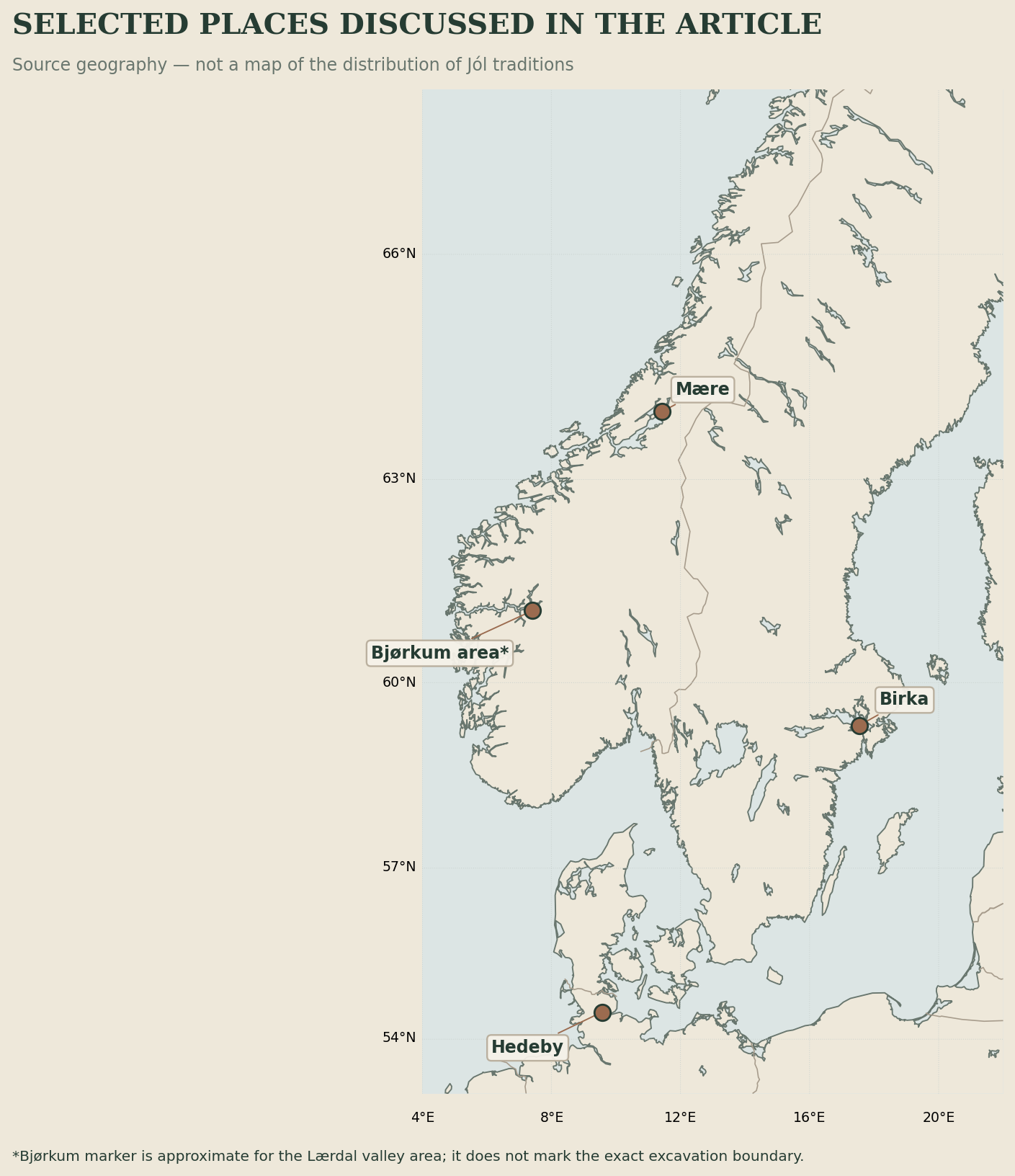
Archaeology provides another perspective. At Bjørkum in western Norway, excavations revealed animal bones from sheep, goats, cattle, pigs, horses and deer, as well as fish remains. Hearths and cooking pits indicate substantial food preparation and communal consumption.
The Bjørkum study supports the existence of large-scale feasting in Viking-Age society. It cannot, however, establish that a particular meal took place during Jól. The archaeological evidence should be described as evidence for feasting, not as a “Viking Christmas menu”.
Meat, fish, grain products and stored provisions all formed part of the wider food culture. There is no evidence that modern rice pudding was a Viking-Age Jól dish, and no basis for presenting a fixed Christmas menu as historical fact.
Ale, Drinking and Ritual Toasts
Drinking had an important place in the religious and social life of pre-Christian Scandinavia. The early poetic expression drekka jól is one indication of the association between drinking and the celebration.
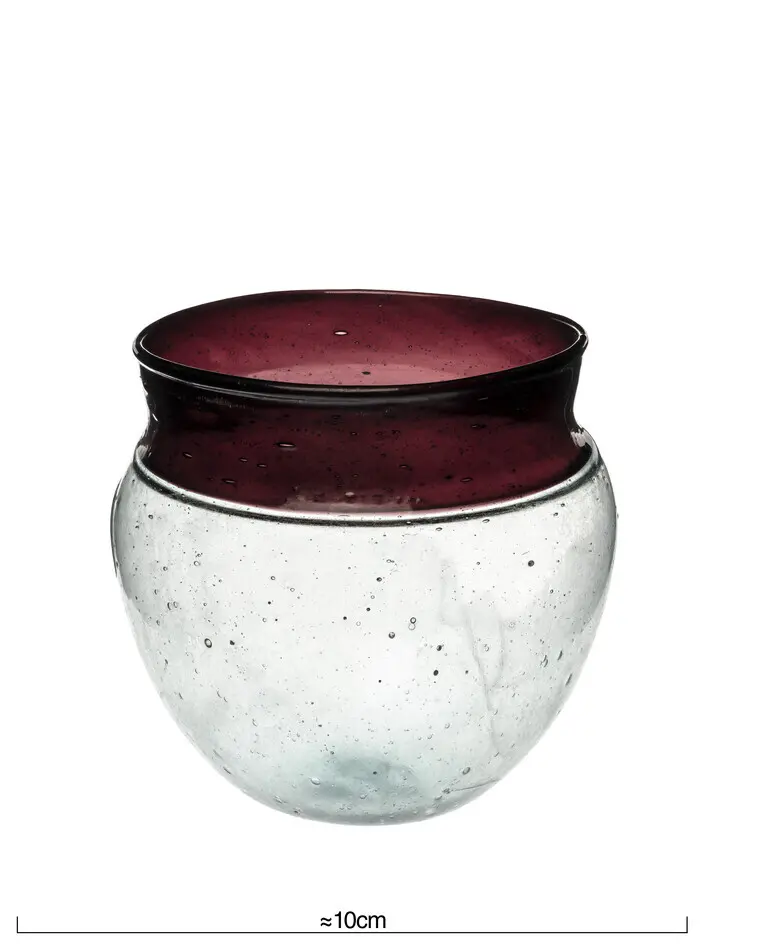
Snorri's later account gives more detail. In his description of sacrificial feasts, ceremonial drinks are dedicated to different gods. Toasts to Óðinn, Njǫrðr and Freyr are associated with victory, prosperity and peace. The saga also describes a bragafull and memorial drinking in honour of deceased relatives.
These details are valuable, but they come from a thirteenth-century narrative. We should not assume that every element belonged exclusively to Jól or that all communities followed the same sequence.
What does the Gulathing Law tell us?
Section 7 of the Older Gulathing Law calls on the householder and housewife to brew ale and bless it on the holy night. The relevant wording names Christ and Saint Mary and connects the blessing with a good year and peace. It is Christian legal evidence from medieval Norway; the clause does not itself use the word jól.
The provisions are important because they show how seasonal ale-making and household responsibilities were regulated within a Christian framework. They do not establish that every detail of a pre-Christian ritual remained unchanged. The law does not say that extra hops and honey had to be added or that the ale had to be consumed quickly.
Blót: Sacrifice and the Feast at Mære
The Old Norse term blót refers to a sacrificial or offering ceremony. Animals could be sacrificed as part of religious observances, and the meat could subsequently be eaten by those attending the gathering.
Snorri describes the use of sacrificial blood and the cooking of meat at religious feasts. A particularly vivid passage concerns a Jól celebration at Mære in Trøndelag, where King Hákon the Good attends a gathering with Earl Sigurðr.
According to the saga, local leaders and farmers expected the king to participate in the traditional observances. Hákon was Christian, while many of the local population continued to follow older religious practices. The disagreement became politically tense.
In the narrative, Hákon eventually eats a small amount of horse liver and drinks the ceremonial cups without making the sign of the cross. The episode illustrates how religious conversion could become a matter of political negotiation and local expectations.
It is an important account of a specific Jól feast, but it was written centuries after the events it describes. It should not be presented as a direct eyewitness record or as proof that every Viking community held the same ceremony.
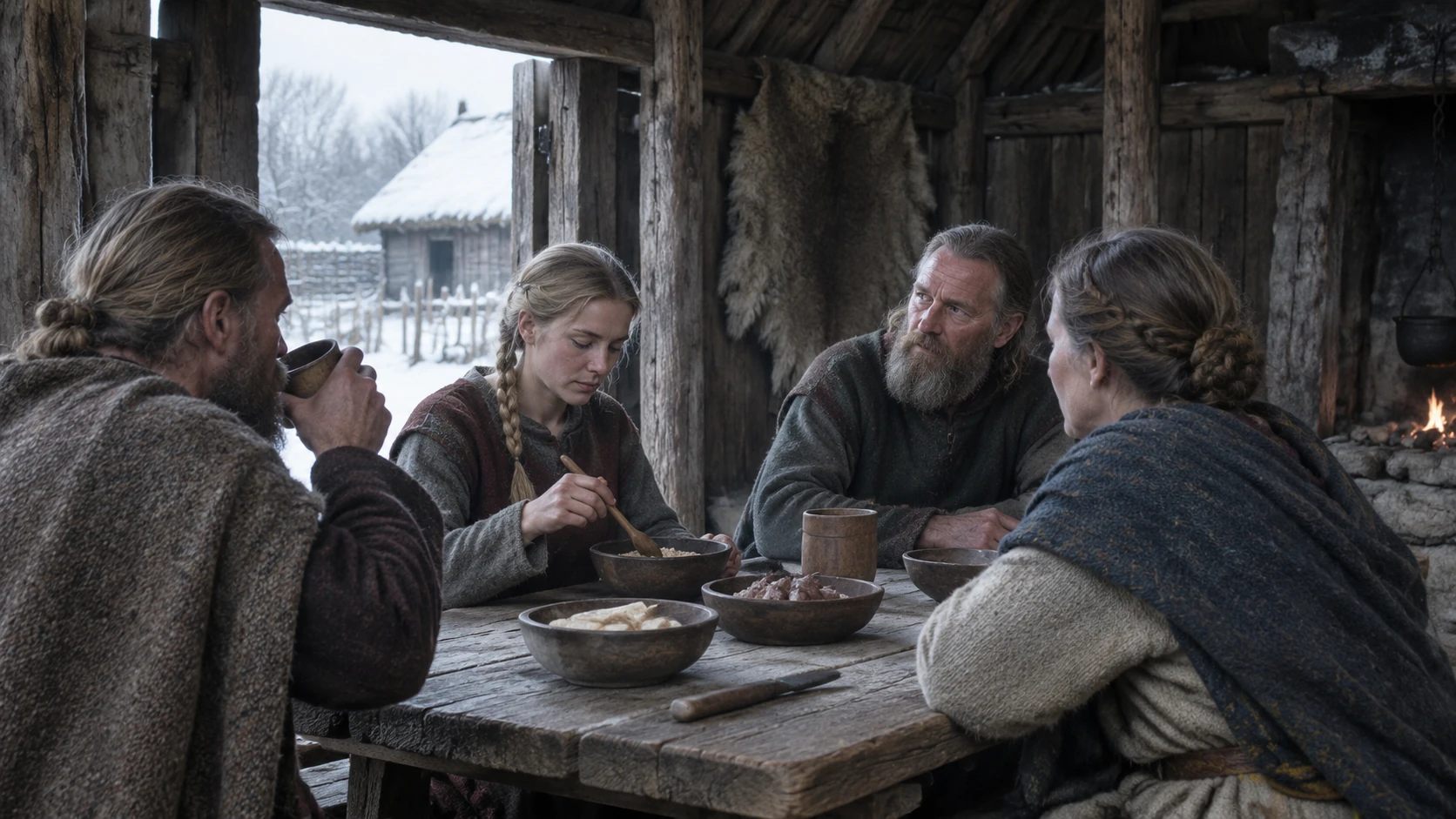
The Sacrificial Boar and Oaths
Another intriguing account appears in Hervarar saga ok Heiðreks. In the H-version of the text, a great boar associated with Freyr is brought into the hall on Yule Eve. Those present lay their hands over its bristles and make solemn vows. The animal is called a sonargǫltr.
The story connects a sacrificial animal with public vows. It is an important later saga tradition, but the manuscript versions differ. The H and U versions preserve details that are absent from the R version, and the U version associates the animal with Freyja.
The boar story should therefore be presented as a particular textual tradition, not as a universal custom practised by all Vikings. It should also be distinguished from the mythological boar Gullinbursti.
Hedeby and the Arabic Travel Accounts
One account relevant to religious life in Viking-Age Scandinavia comes from Ibrahim ibn Yaqub al-Tartushi, a tenth-century traveller from al-Andalus. The account survives in the later work of al-Qazwīnī and is generally associated with the Hedeby–Schleswig area. The precise location is debated. His description refers to a communal religious gathering involving eating, drinking and animal sacrifice.
The account is useful evidence for religious activity at Hedeby. However, the surviving passage does not specify that the gathering took place at the winter solstice or during Jól. It should not be used as direct proof of a particular Yule ceremony.
Al-Tartushi must also be distinguished from Ibn Fadlan. Ibn Fadlan travelled with a diplomatic mission from Baghdad to the Volga Bulgars in 921–922. He describes a group of Rus and a ship burial on the Volga, including human sacrifice. His account is not a description of Hedeby or a Scandinavian midwinter celebration.
Did Women Participate in Jól?
Women were part of the household economy and social life that supported major seasonal gatherings. The Older Gulathing Law mentions both the farmer and the housewife in connection with ale-making. This is useful evidence for shared household responsibilities in the medieval legal setting.
It does not establish the exact religious roles women held during pre-Christian Jól ceremonies. The claim that women generally led public Viking Yule sacrifices is not established by the sources examined here. Evidence about women's participation in household life should not be turned into a broader claim about formal religious leadership without further support.
Which Modern Christmas Traditions Come from the Vikings?
Many popular claims connect modern Christmas customs directly to Viking traditions. Some point to genuine similarities or older Nordic practices, while others are based on speculation or later folklore.
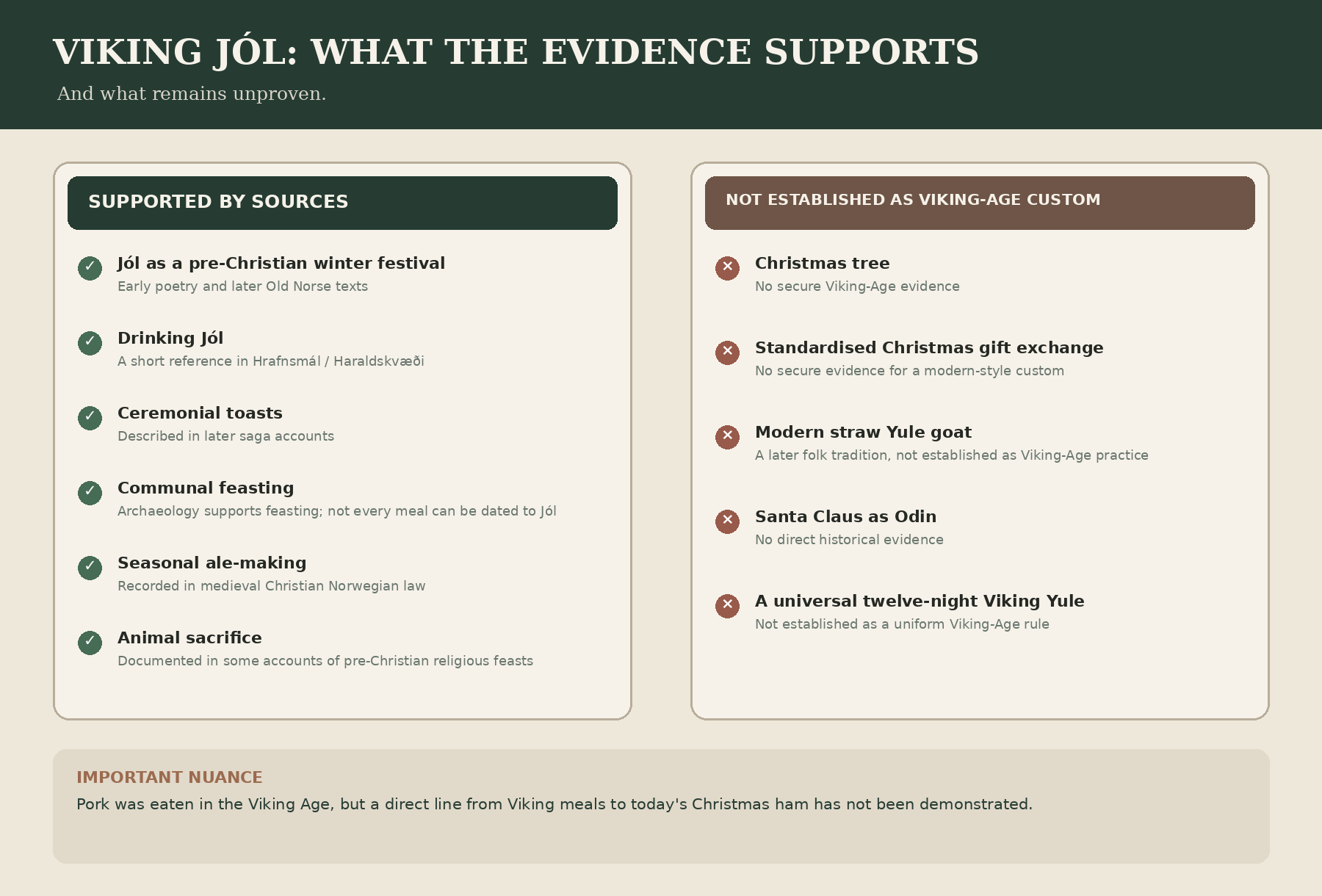
| Modern tradition | Historical assessment |
|---|---|
| Seasonal ale and drinking | Strong historical connection to Jól drinking in early poetry and to later medieval ale-making provisions. |
| Communal winter feasting | Supported by texts and archaeology, although not every archaeological feast can be identified as Jól. |
| Animal sacrifice | Documented in accounts of pre-Christian Nordic religious feasts; the precise practice varied and is not established for every Jól gathering. |
| Christmas ham | Pork was eaten in the Viking Age, but direct continuity from Viking meals to today's Christmas ham has not been demonstrated. |
| Christmas gifts | No secure evidence for a standardised Viking-Age gift exchange comparable to the modern custom. |
| Christmas tree and wreaths | No secure evidence that these were Viking-Age Jól customs. |
| Modern straw Yule goat | A later folk tradition, not established as a Viking-Age practice. |
| Santa Claus as Odin | No convincing historical evidence for a direct descent. |
| Twelve days of Christmas | Not established as a uniform Viking-Age rule; the familiar twelve-day framework belongs to later Christian calendrical tradition. |
What Can We Actually Say About Viking Jól?
The surviving evidence supports several broad conclusions. Jól was a pre-Christian Nordic winter celebration. Early skaldic poetry associates it with drinking. Later saga accounts describe sacrifices, feasting and ceremonial toasts. Medieval Norwegian law preserves provisions concerning ale-making and a holy-night blessing within a Christian framework. Archaeology confirms that large communal feasts took place in Viking-Age society.
Other details remain uncertain: the exact date in different regions, the duration of celebrations, the food served at individual gatherings and how closely later saga descriptions reflect tenth-century practice.
The evidence does not support one universal Viking Christmas. Instead, it reveals seasonal celebrations shaped by local traditions, religious beliefs and social relationships.
Perhaps the most interesting conclusion is not that modern Christmas is secretly a Viking festival. It is that older Nordic winter celebrations were important enough for their name and parts of their seasonal culture to survive long after the religious world that created them had changed.
Frequently Asked Questions
Did Vikings really celebrate Yule?
Yes. Early skaldic poetry and later medieval sources establish that Jól was a recognised pre-Christian Nordic winter celebration.
Was Viking Yule celebrated on 25 December?
Not necessarily. Snorri's later account describes an earlier celebration beginning at midwinter night and lasting three nights. He also describes a change aligning the festival with Christian Christmas.
Did Vikings drink ale at Yule?
Early poetry uses the expression drekka jól, “to drink Yule”. Later saga accounts describe ceremonial drinking, and medieval Norwegian law preserves provisions concerning ale-making and a holy-night blessing.
Did Vikings sacrifice animals at Yule?
Snorri describes a specific sacrificial Yule feast at Mære, as well as sacrificial feasts more generally. The evidence does not establish that every community performed identical sacrifices.
Did Vikings have Christmas trees or exchange Christmas gifts?
No secure evidence establishes the modern Christmas tree or a standardised modern-style gift exchange as Viking-Age Jól customs.
Was Odin the original Santa Claus?
There is no convincing historical evidence for this claim. Odin and Santa Claus belong to different religious and cultural traditions.
Sources and Further Reading
- Þorbjǫrn hornklofi, Haraldskvæði / Hrafnsmál, stanza 6. Haralds saga ins hárfagra, chapter 15, verse 39 (Finlay and Faulkes, p. 65, PDF).
- Snorri Sturluson, Heimskringla I: The Beginnings to Óláfr Tryggvason, translated by Alison Finlay and Anthony Faulkes, Viking Society for Northern Research, 2016. Full translation (PDF); especially Hákonar saga góða, chapters 13–18 (chapter numbering can vary by edition).
- Gulatingsloven, provisions on ale-making and the holy-night blessing. Norgeshistorie.no.
- Ramstad, M., Halvorsen, L. S. and Olsen, A. B. (2011), “Bjørkum: Feasting, Craft Production and Specialisation on a Viking Age Rural Site in Norway,” Antiquity 85(328). Project Gallery.
- Hervarar saga ok Heiðreks, edited by G. Turville-Petre, Viking Society for Northern Research, 1956. Viking Society edition and text.
- Murphy, Luke John (2018), “Paganism at Home: Pre-Christian Private Praxis and Household Religion in the Iron-Age North,” Scripta Islandica 69. Research paper (PDF).
- Juan Rothenhäusler (2022), 1258–1283: al-Qazwīnī Reports from Iraq on Schleswig or Haithabu. The Arabic account, its transmission and the identification of the settlement.
- Montgomery, James E., “Ibn Faḍlān and the Rūsiyyah,” Journal of Arabic and Islamic Studies 3. Article.
- Nordberg, Andreas (2009), “Tid, tideräkning och talsymbolik i Adam av Bremens skildring av kulten i Uppsala,” Utskrift 9. Research paper (PDF).
- Historiska museet, “Christmas in the Viking Age and the Middle Ages.” Institutional article.
- Historiska museet / Statens historiska museer, glass beaker 106819_HST, Birka Bj 644. Photographer Jens Mohr, CC BY 4.0. Object record.
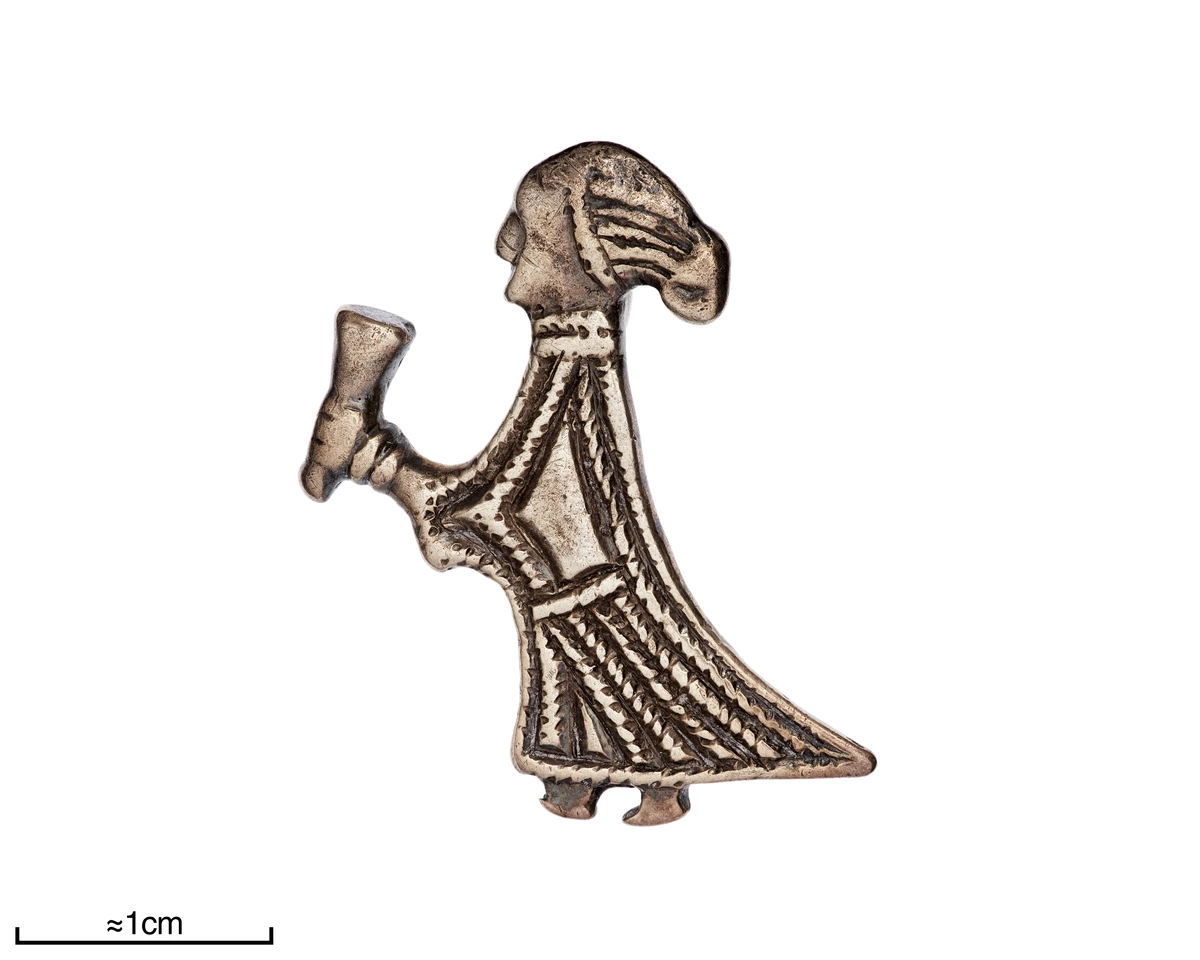
- Historiska museet / Statens historiska museer, silver pendant 108864_HST, Klinta, Öland. Photographer Ola Myrin, CC BY 4.0. Object record.