
Viking crafts · Follow the making
Bone & antler: from raw material to a finished comb
Follow a composite comb from a branching piece of antler to joined plates and carefully cut teeth. Then compare workshop waste, protective cases and the evidence for distant supplies.
Explore the craft ↓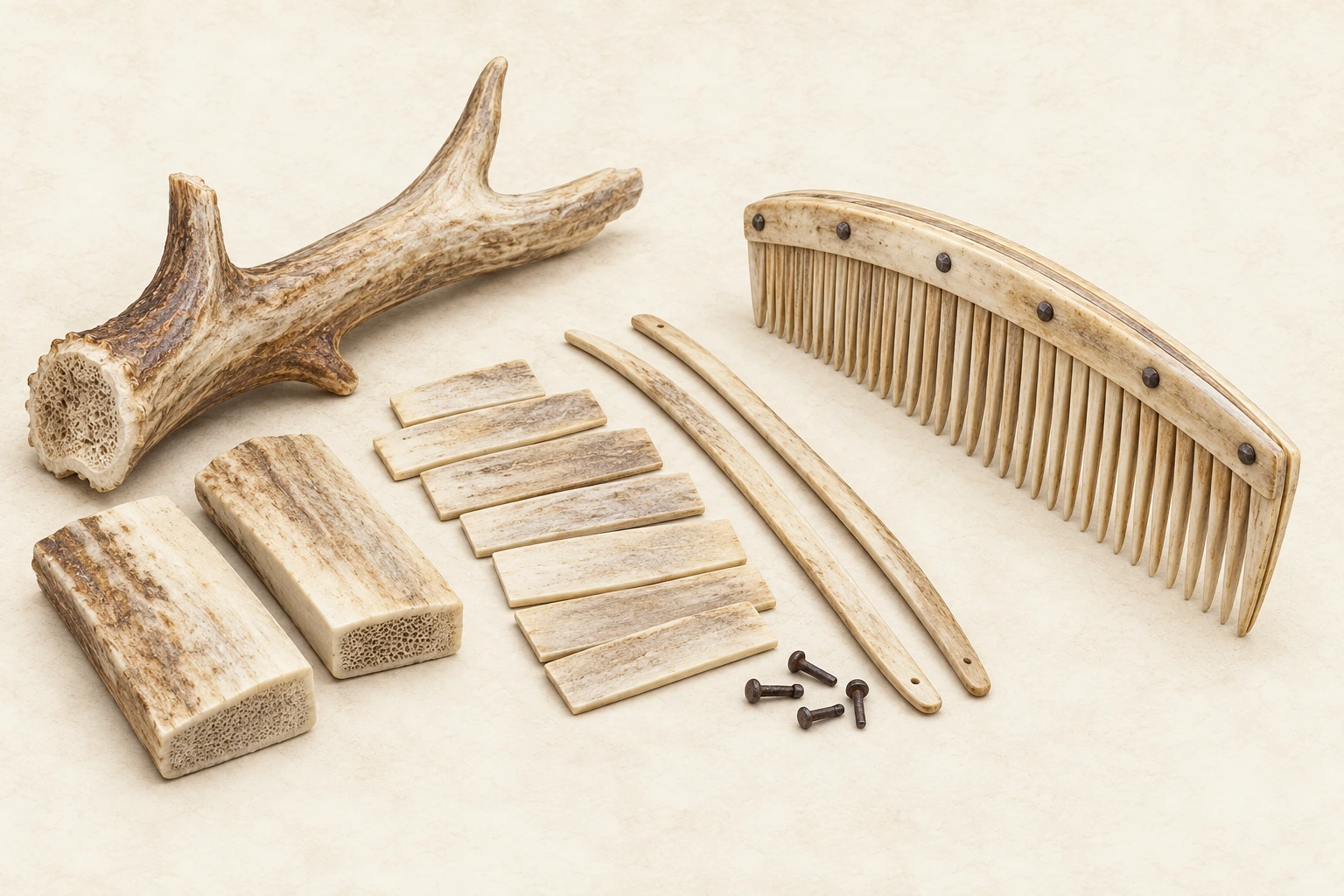
01 · Bone & antler crafts
Begin with the material
A finished comb hides much of the work that preceded it. Begin instead with a branch of antler: the maker had to select a useful portion from an irregular shape, then decide what could be cut from it. The National Museum of Ireland explains that naturally shed red-deer antler was gathered and traded for work in towns. Using antler therefore did not necessarily require killing a deer.
Keep the material name attached to the evidence. A catalogue entry for antler is not permission to relabel an object as horn or bone. Our illustrations follow an antler-comb example; they do not stand for every craft using animal materials. The interesting question is what this particular material allowed a maker to do.
Sources: [1].
02 · Bone & antler crafts
Read a discarded cut
Coppergate object 7277 is waste rather than a finished possession. Two angled saw cuts detached its crown from the antler beam. Another cut runs along the base, and a surviving tine carries further cuts. Its excavated context is dated approximately from 975 to the early or middle eleventh century.
Look at the piece as a record of decisions. Which cut separated a large section? Which began dividing it further? A drawing can help trace those relationships, but it should not add an unseen final product. The discarded crown tells us that antler was being worked; it does not reveal the name, speed or handedness of the worker, or prove what every removed piece became.
Sources: [2].
03 · Bone & antler crafts
Several pieces become one comb
The composite comb in our teaching model has separate tooth-bearing plates held between two long side plates. Rivets secure the assembly. This is a way to build a useful object from several prepared pieces rather than carve its entire outline from one large block.
JORVIK’s account of the Coppergate evidence places assembly before the careful cutting of the teeth. The still life places loose components beside a completed comb to make their different roles visible. In an assembled comb the tooth plates meet closely between the two side plates. It is not an excavated comb displayed in its original working arrangement.
Sources: [3].
04 · Bone & antler crafts
Follow the teeth to their base
On the completed illustrative comb, the joined tooth plates form a continuous row of teeth. Trace a tooth inward and notice where its base remains held by the body of the comb. The supporting plates, rivets and tooth-bearing material have different jobs; a convincing decorative silhouette is not enough to explain their relationship.
Compare the tooth-bearing pieces with the longer supporting plates beside them. The number and spacing of the teeth are illustrative, not a measurement of a named find. To compare a real comb, record its dimensions and condition before matching it to the model. Missing teeth, worn edges and damage should remain visible in documentary photographs.
Sources: [3].
05 · Bone & antler crafts
Useful objects could be finely finished
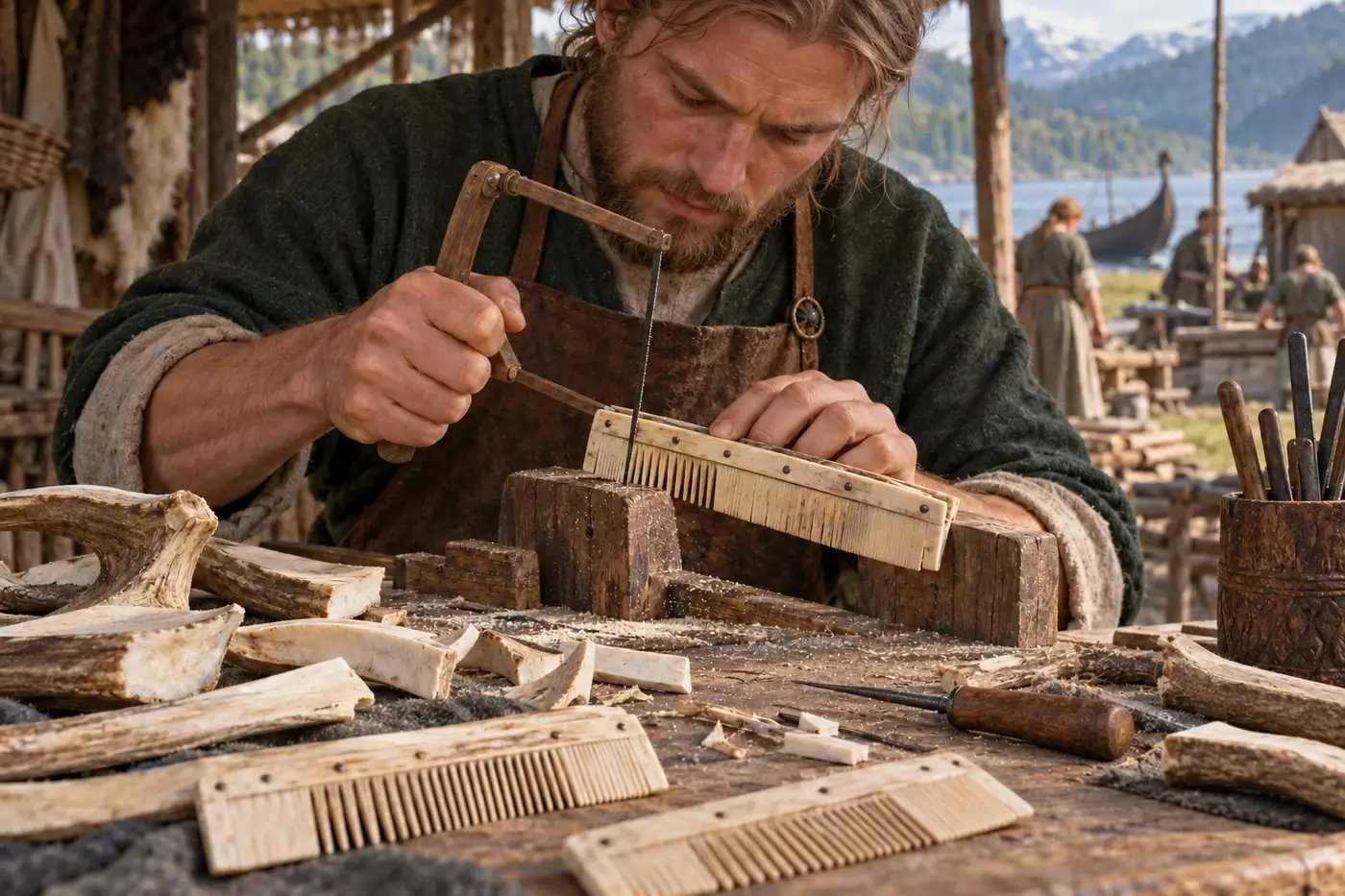
Ribe’s market-place finds include decorated combs, gaming pieces, awl handles and needles. Ribe VikingeCenter presents the quality of these objects as evidence for skilled artisans. The observation expands the workshop beyond the finished comb without making every object the product of the same pair of hands.
Compare two kinds of detail in a photograph: the features needed for the object to work and the marks added to its surface. Decoration may reward close looking, but it cannot supply the maker’s biography. Nor should a modern demonstration’s bench, lighting or workholding arrangement be treated as an excavated Viking workshop. Those are choices made to explain and practise the craft today.
Sources: [4].
06 · Bone & antler crafts
Was it made here, or used here?
The York monograph distinguishes production debris from objects that were used at the excavated sites. Its Anglo-Scandinavian Coppergate material strongly supports antler-comb manufacture, with more limited evidence for making beads. Other finished objects need not have been produced on the same plot.
This distinction changes how a workshop is reconstructed. A comb in a household can be a possession; unfinished pieces and characteristic offcuts can identify manufacture more directly. The report also includes later medieval material, so an attractive object elsewhere in the volume cannot automatically be assigned to the Viking Age. Start with its context and date, then ask what kind of activity its survival actually demonstrates.
Sources: [5].
07 · Bone & antler crafts
The case belongs in the story
A comb case from Coppergate, catalogue 7691, is dated around 975. Its antler plates are joined with iron rivets and carry incised decoration. One end has a suspension hole. The case shows that making and carrying a comb could involve another carefully assembled object.
Follow the edges of the case before imagining the comb inside it. Which parts define the opening? Where is the suspension hole? Which decorated surfaces would remain visible? These are questions that a recorded object can answer. Whether its owner wore it in one particular position, valued it as a gift or used it for a specific hairstyle requires evidence beyond the surviving case.
Sources: [6].
08 · Bone & antler crafts
A workshop depended on distant supplies
The workbench was only one point in a larger chain. Ashby, Coutu and Sindbæk analysed combs, manufacturing waste and raw antler from Ribe, Aarhus and Aggersborg using ZooMS, a method that examines surviving protein signatures. Their study identified reindeer antler in use by the 780s at the latest.
That evidence connects southern urban craft with material from the Scandinavian Peninsula. It does not provide a complete itinerary for every antler or name the collectors and traders. Keep the different possibilities visible: raw material could travel, finished objects could travel, and craftworkers could travel. Establishing a connection is not the same as reconstructing every movement within it.
Sources: [7].
09 · Bone & antler crafts
Compare finished combs with workshop waste
A 2023 study investigated Hedeby combs assigned by style to the ninth century. Nearly all the sampled combs proved to be reindeer antler. Much of Hedeby’s known antler-working waste, by contrast, is red deer. The authors argue that the sampled finished combs were probably made elsewhere, potentially far to the north.
The comparison is stronger than an animal identification alone because it brings objects and production debris together. Still, it is an argument about a studied assemblage, not a certificate of origin for every comb from Hedeby. Sample selection, dating and the character of the waste all matter. A map should show a proposed connection, not an invented exact route.
Sources: [8].
10 · Bone & antler crafts
One find can change a question
The Shotley comb was found on the shore of the River Orwell in Suffolk and reported through the Portable Antiquities Scheme. Researchers combined its form with biomolecular analysis and concluded that it had been made in Scandinavia in the middle of the tenth century before reaching south-east England.
This case shows why recording an apparently familiar object can still matter. Material analysis and comparison gave the comb a more specific history than appearance alone could supply. Its journey remains less precise than its identification: the study does not name its owner or establish whether it arrived as merchandise, a personal possession or through another movement of people and objects.
Sources: [9].
11 · Bone & antler crafts
Similar shapes do not prove one workshop
Dublin’s combs belong within a wider comparison. In his atlas, Steven Ashby questions an interpretation that makes Dublin the single manufacturing centre behind some widespread forms. Related types also occur elsewhere in Ireland and around the southern Baltic.
When comparing illustrations, separate three observations: similarity of shape, evidence of production and evidence of movement. They can support one another, but they are not interchangeable. A matching outline may reflect shared preferences or connections between makers. Local unfinished pieces address manufacture more directly. For the shorter workshop-focused study, continue to Bone and Antler Workshops Beyond the Finished Comb.
Sources: [10].
12 · Bone & antler crafts
Build a paper model, then test a claim
Use pre-cut card rectangles to represent a row of tooth plates and two longer strips for the side plates. Lay the smaller pieces beside one another and sandwich their upper ends between the long strips. Draw circles for the rivets and lines for the future teeth. This is a classroom model of assembly, not a guide to cutting antler.
Now make three labels: “observed”, “inferred” and “unknown”. Apply them to a museum object: its recorded material, the evidence for manufacture, and the owner’s identity. Explain your choices. Finally, compare your model with the actual find and name two features the model leaves out, such as wear, thickness, curvature or the behaviour of the material.
Follow the evidence
Sources & further reading
Follow the dated finds, published studies and documented experiments behind each section. Modern demonstrations explain workable choices; they do not establish one method for every Viking-Age workshop.
- National Museum of Ireland — An Interesting PointMuseum object discussion; collection of naturally shed antler. The decorated point has uncertain date, provenance and function.
- York Archaeology — antler waste, catalogue 7277Coppergate; context c.975–early/mid eleventh century; records individual saw cuts. Image licence CC BY-NC 4.0.
- JORVIK Viking Centre — How did they live?Museum account of Coppergate production: plates riveted before tooth cutting.
- Ribe VikingeCenter — The comb makerArchaeological finds discussed alongside modern craft interpretation. The documented objects support the examples in this guide.
- MacGregor, Mainman & Rogers — Bone, Antler, Ivory and Horn from York (1999)Excavation monograph covers c.850–1450; distinguish its Anglo-Scandinavian evidence from later material.
- York Archaeology — antler comb case, catalogue 7691Coppergate, c.975; iron rivets, incised decoration and suspension hole. Image licence CC BY-NC 4.0.
- Ashby, Coutu & Sindbæk — Urban Networks and Arctic Outlands (2015)Research on ZooMS identifications at Ribe, Aarhus and Aggersborg; reindeer antler by the 780s at latest. DOI 10.1179/1461957115Y.0000000003.
- Muñoz-Rodriguez et al. — In the footsteps of Ohthere (2023)Ninth-century-style Hedeby comb sample; animal species and production-waste comparison support an import interpretation. DOI 10.15184/aqy.2023.118.
- Ashby et al. — A Viking comb from Shotley, Suffolk (2023)Combined typology and biomolecular evidence; mid-tenth-century Scandinavian manufacture is the authors’ conclusion. DOI 10.11141/ia.61.11.
- Steven Ashby — Atlas of Medieval Combs: Dublin (2011)Comparative distribution; similar forms occur outside Dublin and in the southern Baltic.
Continue the exploration