
Journeys & Encounters · Deep dive
Skuldelev 5: A Small Warship with a Complicated Building History
In Brief
Skuldelev 5 combines an effective warship form with reused timbers and extensive repairs. Its archaeological value lies in that complicated history, not in an image of every fighting vessel as a newly built royal masterpiece.
On this page
Small within a fleet, substantial for its crewOld oar holes reveal an earlier vesselWhy useful old timber was worth keepingWhich moment should a reconstruction reproduce?An anchor from another find fills a defined gapMilitary context does not identify a battleSourcesSmall within a fleet, substantial for its crew
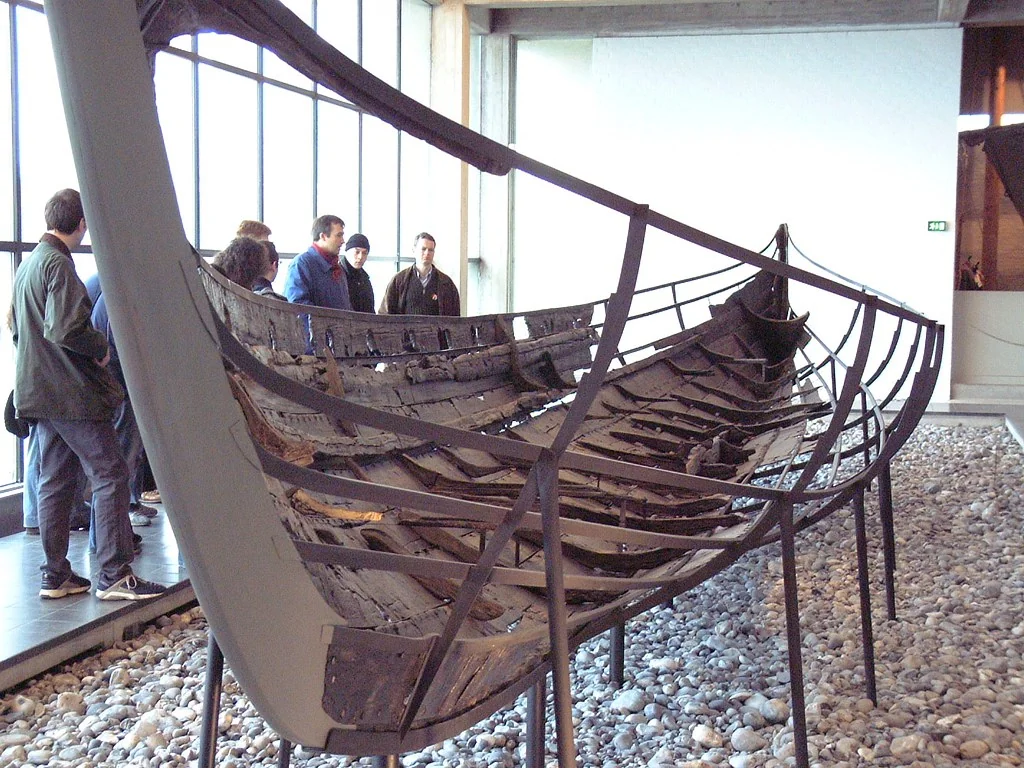
The museum reconstructs Skuldelev 5 as a vessel about 17.3 meters long and 2.5 meters wide, with twenty-six oars and a complement around thirty people. Built in Denmark around 1030, it belongs among the smaller longships rather than the exceptionally large vessels represented by Roskilde 6. Roughly half of its hull survives.
Small is therefore a relative description. For the people supplying and operating it, the ship still represented coordinated labor and a considerable commitment of material. Its many rowing positions contrast with a cargo vessel that devoted more of its interior to a hold. The arrangement fits movement of a substantial group, but the reconstructed crew figure should not become a claim that exactly thirty people occupied it on every journey. Loading and personnel could change, while the physical arrangement constrained the choices available.
Sources for this section: 1
Old oar holes reveal an earlier vessel
Among the reused components was an ash plank that had already served as an upper strake with oar openings. The earlier openings were spaced about seventy-eight centimeters apart, whereas the arrangement adopted for Skuldelev 5 required roughly ninety-centimeter spacing. Some older openings were filled and new ones cut to suit the receiving hull.
This is unusually direct evidence for adaptation. The plank carries traces of two arrangements, so the earlier ship is represented inside the later one without surviving as a complete vessel. Reuse was not simply a matter of taking any board and fastening it anywhere. The component had to be assessed, fitted, and modified to match a different structure. Its earlier holes could create weaknesses or unwanted openings, while its size and material made it worth retaining. The sequence is visible in the woodworking itself, even though the people who made those decisions remain unnamed.
Sources for this section: 2

Why useful old timber was worth keeping
Other reused pieces included very long pine planks and a substantial frame component. The museum's technical discussion considers more than one explanation: restricted access to suitable timber may have mattered, but unusually long pieces were also structurally valuable in a narrow hull. Reuse need not automatically mean that builders lacked skill or accepted poor workmanship.
That distinction changes the social interpretation. A recycled component can be an economical choice, a response to urgency, a preferred material, or several of those at once. The archaeological observation is that the wood had an earlier use. The motive requires additional evidence. Skuldelev 5 therefore supports questions about resource management without supplying a single answer about poverty, shortage, or emergency mobilization. Treating every repair as a sign of failure would overlook the expertise required to keep a complex wooden structure serviceable.
Sources for this section: 2, 5
Which moment should a reconstruction reproduce?
When building Helge Ask in 1990–91, the museum faced a choice between reconstructing an earlier condition and reproducing the repaired vessel found in the barrier. It chose an interpretation of the earlier ship. The modern painted decoration drew on additional evidence, including the Bayeux Tapestry, while a painted serpent referred to carved ornament on the original vessel.
The choice is fundamental because an archaeological ship can contain several historical states at once. A replaced plank, altered opening, or repaired keel records change rather than a single timeless design. A complete sailing reconstruction must select a consistent arrangement from that sequence. Its resulting appearance should therefore be labeled with the chosen interpretation. Helge Ask is valuable as a practical model, but its complete colors, equipment, and restored missing side are not all equally direct reproductions of surviving Skuldelev 5 material.
Sources for this section: 3
An anchor from another find fills a defined gap
The Skuldelev ships had been stripped of reusable loose equipment before their hulls were sunk. No anchor survived with Skuldelev 5. For the second reconstruction, a 2024 project therefore used the well-preserved Ladby anchor as the basis for a newly forged example. The museum worked with blacksmithing students to connect craft practice with archaeological reconstruction.
This is an explicit use of comparison, not the recovery of Skuldelev 5's own anchor. The distinction should follow the object into any later display or sailing account. A contemporary archaeological example can provide a plausible solution where direct evidence is missing, but it does not prove that the original ship carried an identical item. The project also exposes work often hidden behind a finished vessel: forming a large iron fitting requires its own tools, coordination, and specialist knowledge. A usable ship was an assembly of several crafts, not only a wooden hull.
Sources for this section: 4
Military context does not identify a battle
The museum's 2025 project account places Skuldelev 5 within the political changes following the later years of Cnut's empire. It also states that no concrete evidence identifies the ship's particular actions or voyages. The second reconstruction investigates unresolved questions about materials, hull form, and the circumstances behind reuse, drawing on experience accumulated since Helge Ask was built.
The suggestion that Skuldelev 5 served an organized levy belongs in this interpretive category. Later arrangements for providing ships offer comparisons, but a repaired hull is not itself a surviving administrative order. The secure historical contribution is narrower and stronger: a small warship was assembled through skilled work using both new and previously employed material, then maintained before its final deposition. That history complicates the assumption that military vessels must always have represented uniform, purpose-made construction from entirely fresh resources.
Sources for this section: 5, 2
For the introductory context, read The Skuldelev Ships: Traders, Warships, and a Fishing Boat.
The Evidence
The sources below support this article. Interpretations and limits are explained in the text; this is not an exhaustive research review.
- Viking Ship Museum: Skuldelev 5, the small longship ↗
- Viking Ship Museum: Reused timber and repairs in Skuldelev 5 ↗
- Viking Ship Museum: Reconstructing Helge Ask ↗
- Viking Ship Museum: Recreating a Ladby-type anchor for Skuldelev 5, 2024 ↗
- Viking Ship Museum: Questions behind the second Skuldelev 5 reconstruction, 2025 ↗