

Journeys & Encounters · Focused study
Eldgjá: The Eruption Experienced by Viking-Age Iceland
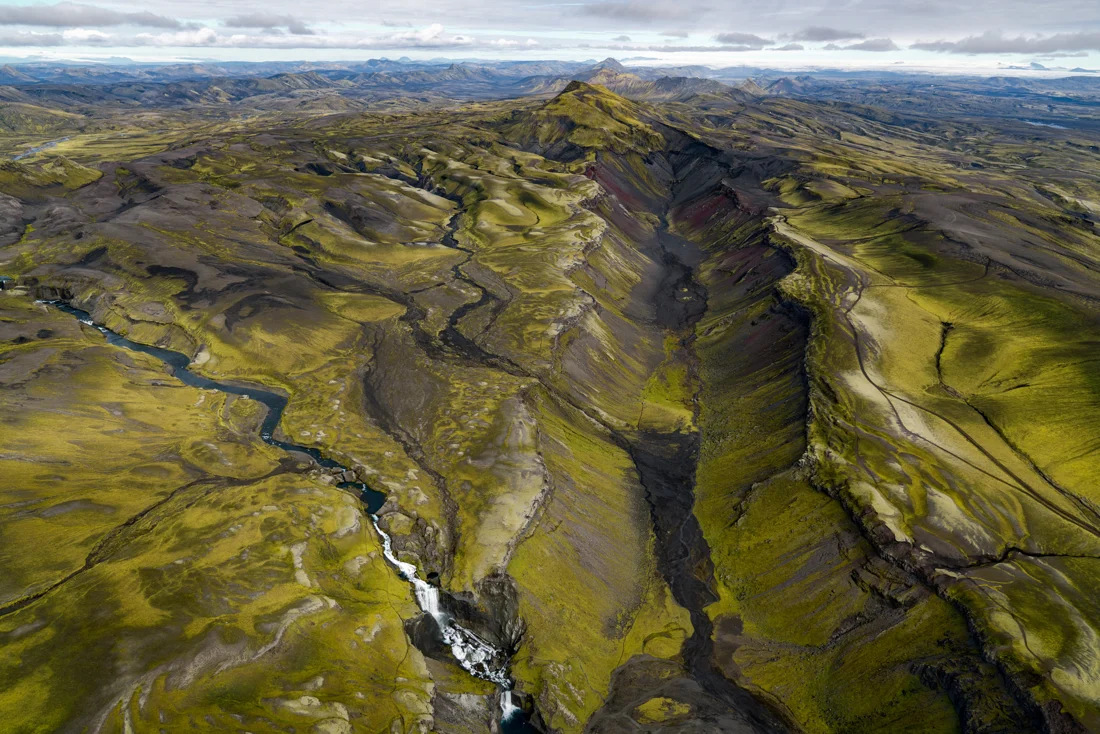

In Brief
An enormous eruption struck Iceland within the first generations of settlement. Its physical traces are clearer than its effects on belief: the attractive connection with Ragnarök remains a hypothesis, not an established explanation of conversion.
On this page
A disaster within living memory of settlementWhy the date became 939–940The tempting connection with RagnarökWhy Laki is not a ready-made reconstructionWhat a responsible reconstruction can showSourcesA disaster within living memory of settlement
Eldgjá was not an eruption in an empty, prehistoric landscape. Iceland already contained settler communities, and some people who arrived as children could still have been alive. Cambridge's account of the research emphasizes this human timescale: the event belonged to the first few generations of the new society. It was a prolonged lava-flood eruption rather than a single brief explosion.
That distinction changes how we should imagine the experience. A dramatic illustration of one fiery instant cannot represent months of uncertainty. The university's explanation also distinguishes local lava from a sulfurous atmospheric haze capable of reaching distant regions. Farms far from advancing lava did not necessarily inhabit an unaffected world.
Sources for this section: 3
Why the date became 939–940
Oppenheimer and colleagues used Greenland ice-core chemistry to place the beginning in spring 939, with activity continuing at least intermittently into autumn 940. They connected a strong volcanic signal with independently dated markers in the ice. Contemporary reports of unusual haze and tree-ring evidence of cooling offered additional comparisons. This is stronger than simply choosing the date that best fits a favorite story.
Sources for this section: 1
The tempting connection with Ragnarök
The same researchers proposed that the darkened sun and catastrophic fire in Völuspá preserve memories of Eldgjá. They further suggested that such imagery could have helped present the old gods as doomed before Iceland's formal conversion around 999–1000. The geological date does not prove that literary interpretation. A poem can combine inherited myth, religious argument, and experiences of nature; identifying one event behind its imagery remains an argument rather than an observation. Neither a volcanic deposit nor a cold summer demonstrates why an individual accepted Christianity.
Sources for this section: 1
Why Laki is not a ready-made reconstruction
A 2024 comparison by Morison and colleagues warns against transferring the better-documented consequences of the 1783–1784 Laki eruption directly onto tenth-century Iceland. Eldgjá was larger in erupted volume and included explosive phases involving water, but the societies exposed to the two events differed. The authors argue that tenth-century communities may have possessed greater resilience in important respects. That is not a claim that the earlier eruption was harmless; it means that disaster severity depends on social circumstances as well as magma volume.
Sources for this section: 2
What a responsible reconstruction can show
The 2024 review describes thick deposits near the eruption and substantial emissions, while stressing how little direct documentation survives for Icelandic social effects. We can therefore describe a major environmental shock without inventing a death toll, a national famine, or an island-wide abandonment. The useful historical question is how different communities experienced the same eruption, not whether every household shared an identical catastrophe. Keeping those limits visible makes the story more informative, rather than less dramatic.
Sources for this section: 2
The Evidence
The sources below support this article. Interpretations and limits are explained in the text; this is not an exhaustive research review.