
Viking crafts · Follow the making
Hides and Furs: Preparing a Material, Reading the Evidence
From a skin’s intended use to the traces left in waste, seams and proteins: a practical guide to understanding preparation without inventing a single Viking tanning recipe.
Explore the craft ↓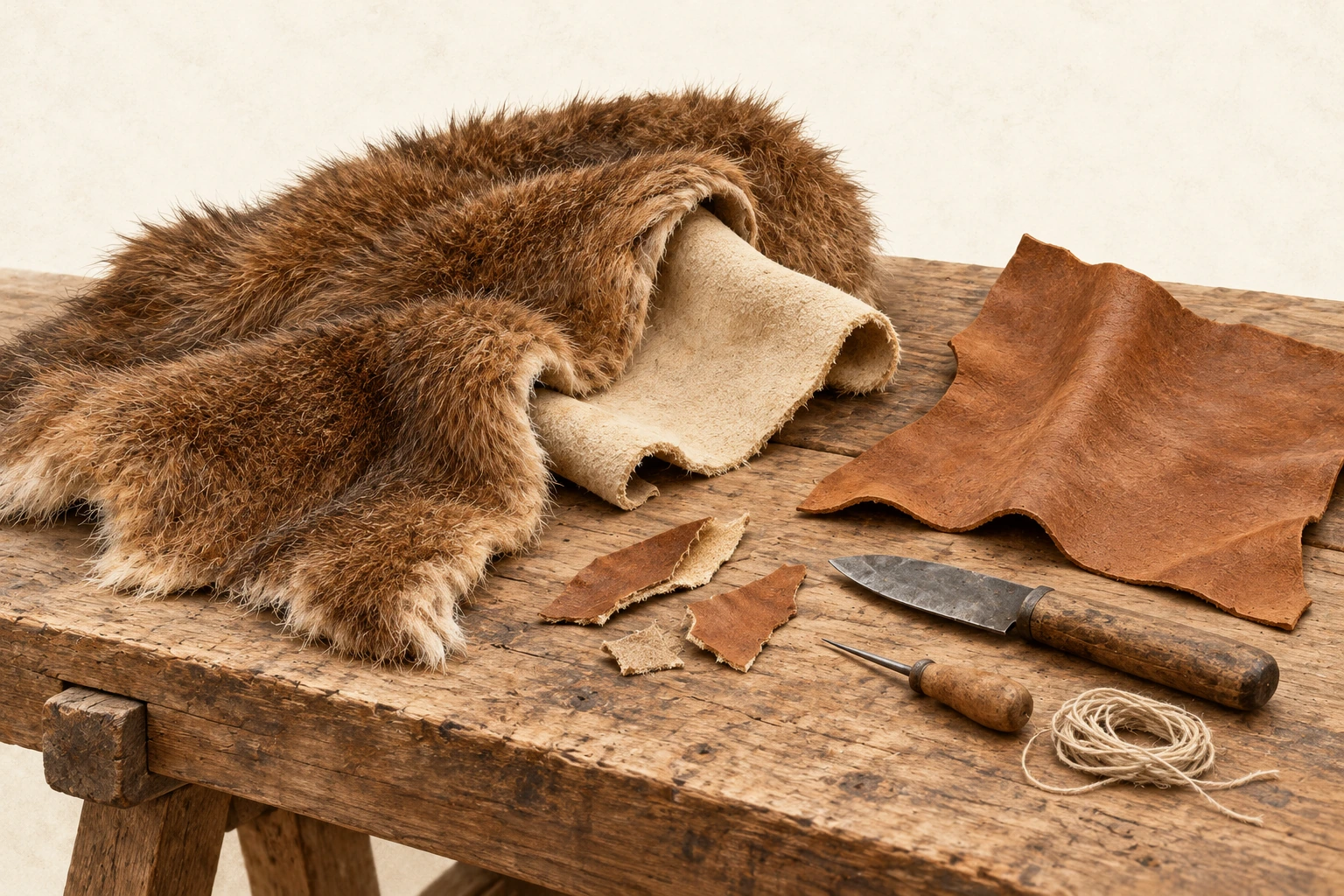
01 · Hides & furs
Begin with the material you want
Preparing a skin is a chain of decisions. Does the finished object need hair, a smooth leather surface, stiffness, flexibility or resistance to repeated handling? Asking these questions first keeps a fur garment, a shoe upper and a rawhide piece from becoming interchangeable props. The Swedish History Museum includes hide preparation and leatherworking among the crafts visible in Viking trading settlements, while also recognizing craft production at farms. That evidence establishes activity, not an identical workshop arrangement everywhere. This guide follows the decisions a maker must solve and then asks which parts archaeology can actually recover. It complements hunting and the northern fur trade; it does not assume that hunting, skin preparation and garment sewing always happened in one place. [H1]
02 · Hides & furs
Separate cleaning from stabilization
A fresh skin contains collagen, organized into a fibrous network. Removing unwanted tissue and working the material changes its condition; tanning changes its stability through the action of a tanning agent. These are related operations, but they are not synonyms. Modern conservation science distinguishes cleaning and mechanical preparation from the chemical transformation called tanning. Drying alone can produce a stiff material that behaves very differently when wetted. Use this distinction when reading an excavation report: a scraped skin is not automatically demonstrably vegetable-tanned leather. Nor does a surviving knife identify every stage it performed. The sequence presented here is a way to understand material problems, not a recovered Viking recipe with known quantities, timing and ingredients. [H2]
03 · Hides & furs
Decide whether the hair belongs in the object
Hair-on fur and hairless leather require different outcomes at the surface. For a fur, the relationship between hair and skin must survive preparation and use. For a hairless product, hair removal is part of making the desired material. Rawhide, as defined in conservation literature, is cleaned and dried without the stabilizing change associated with tanning; it can be hard and tough when dry yet sensitive to water. These definitions help explain why the word ‘hide’ cannot tell us a completed object’s properties. When examining a modern teaching sample, turn it over: compare the hair or grain face with the flesh side. This observation is informative, but appearance alone cannot securely identify an ancient processing chemistry. [H2]
04 · Hides & furs
Keep tanning and tawing distinct
Vegetable tanning uses tannins from plant material to transform prepared skin into leather. Alum tawing is a different treatment, associated with pale, flexible skins that can be vulnerable to water. The Canadian Conservation Institute distinguishes these material categories; its account is modern conservation guidance, not evidence that a particular Viking workshop followed its described preparations. Oils or fats applied after vegetable tanning can help flexibility, which also means that finding fatty material does not automatically identify the entire treatment. For a reconstruction record, give the modern supplier’s actual process and state separately what the chosen archaeological find demonstrates. Avoid the convenient but misleading label ‘Viking-tanned’ when neither the original chemical method nor the modern substitution has been specified. [H3]
05 · Hides & furs
Match the skin to its intended job
Species is one variable, not a complete material specification. A skin’s thickness, age, body region and condition also affect what a maker can cut from it. Research on 115 shoe parts from Danish towns considered both the animals selected and the properties relevant to construction. Its material spans approximately AD1000–1300, so much of the evidence belongs to the medieval period. It should not be projected unchanged across all Viking communities. The useful craft lesson is to inspect the actual piece before laying out a pattern. Mark thin areas, damaged edges and directional stretch on a modern sample. For shoe construction itself, consult leather shoes and urban shoemaking rather than treating every skin as an equally suitable blank. [H4]
06 · Hides & furs
Follow the pelt through its waste
Preparation is sometimes easier to recognize in discarded material than in a finished garment. Wigh’s study of Birka drew attention to fur-animal bones, especially paws, in interpreting pelt processing. Body parts retained with a transported skin can arrive at a settlement without the rest of the animal. This changes the question asked of a bone deposit: it may represent work on pelts rather than a meal or the local capture of whole animals. The inference depends on which bones occur together and in what context. A single paw is not a complete trading itinerary. Keep procurement, arrival, final trimming and sewing as separate possible stages when mapping the process; the surviving waste may illuminate only one of them. [H5]
07 · Hides & furs
Ask what chemical traces actually demonstrate
Chemical analysis can investigate treatments that a photograph cannot show. A 2024 study examined four fur capes from Jutland bogs using several laboratory methods. Three contained vegetable tannins, all showed fats, and the researchers also reported indications of aluminium and iron compounds. Crucially, these capes date centuries before the Viking Age. They demonstrate an earlier and varied material history, not a standardized tenth-century method. The study also detected conservation residues, a reminder that an object can accumulate substances after manufacture. Before using any analysis to recreate a process, ask about date, burial environment, later treatment and alternative explanations. A plausible historical ingredient becomes a documented one only when the relevant evidence can support that specific claim. [H6]
08 · Hides & furs
Let surviving proteins refine identification
Modern protein analysis can recover information where a fragment’s appearance is ambiguous. A study of fur from six Danish high-status Viking burial sites identified animal sources through surviving proteins; reliable ancient DNA was not recovered from those samples. The results included beaver fur and combinations of species within the clothing evidence. This establishes sophisticated material selection in the studied contexts, but neither every household’s wardrobe nor the chemistry used to prepare each pelt. In a research notebook, separate the columns ‘animal identified,’ ‘object function’ and ‘processing evidence.’ Filling one column does not fill the others. Small preserved fragments can be decisive, yet their survival in richly furnished graves also shapes the picture available to us. [H7]
09 · Hides & furs
Reconstruct the joins as carefully as the surface
A finished fur object is a construction of pieces, not simply an animal skin draped over a person. The Fashioning the Viking Age project brought analyses, craft experience and comparative evidence together when interpreting clothing from Bjerringhøj and Hvilehøj. Its reconstructed garments include different fur species and combinations, while missing elements of the outfits were informed by other finds and sources. The distinction matters when a complete display looks more certain than its fragments. For a learning exercise, make paper pieces for the securely identified fragments and use a different colour for proposed additions. Consider where joins are needed and which edges are unknown. The exercise makes a reconstruction’s reasoning visible without claiming to recover a complete lost cutting pattern. [H8]
10 · Hides & furs
Place the work within a longer chain
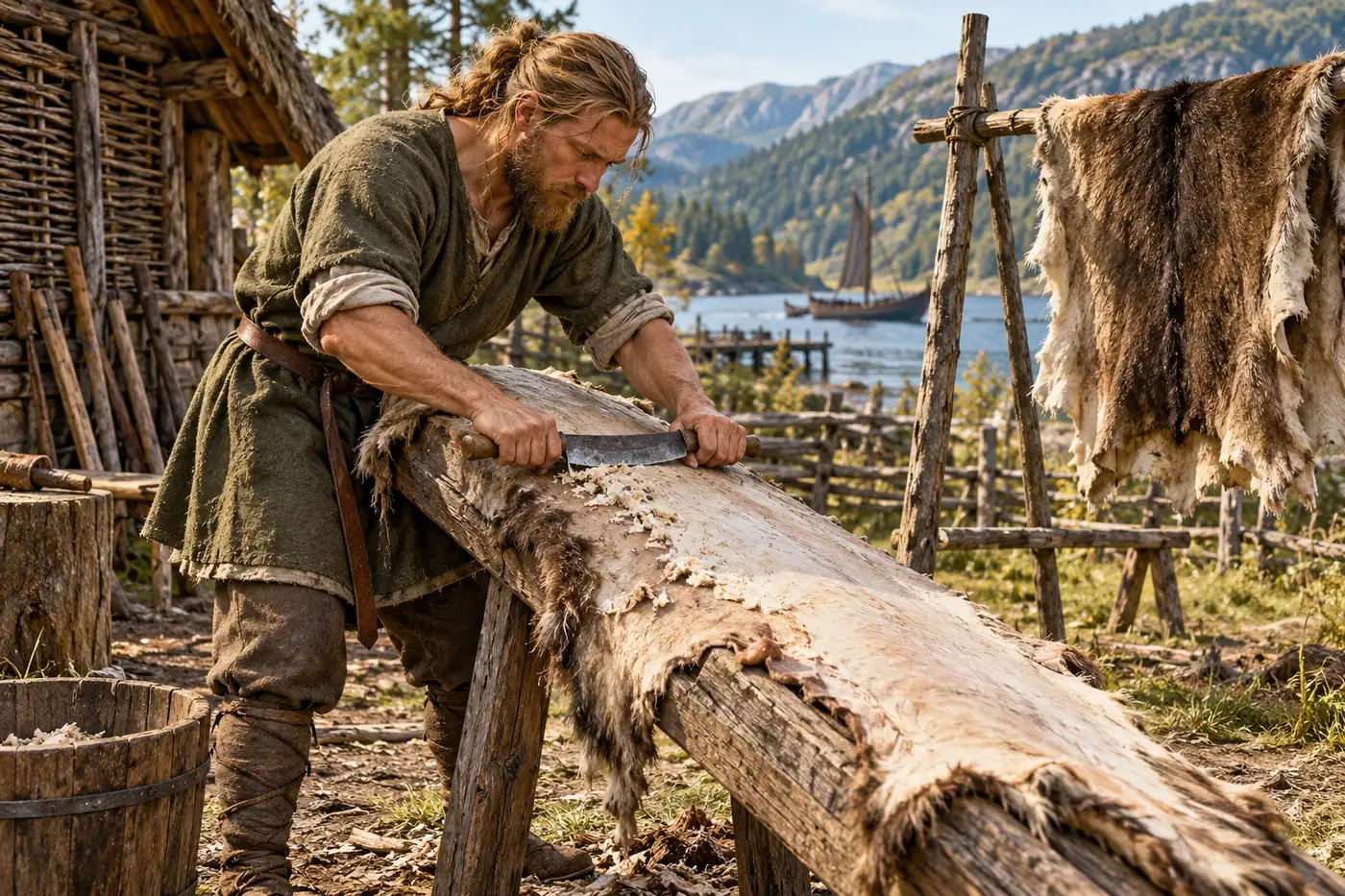
The UrbNet research project on fur and skin trade treats biomolecular identification as a way to revisit material movement and use. A species name can narrow questions about resources and supply, but identifying the animal alone does not reveal who hunted it, where its skin was dressed or who sewed the final object. A craft account should therefore allow several hands and several locations. Draw a process sheet with spaces for animal source, initial preparation, movement, final working, use and discard. Fill only the stages supported by your chosen find; leave the others visibly open. This is especially valuable when pairing a vivid illustration with sparse evidence: the image can communicate texture and skilled work without pretending to document an entire workshop economy. [H9]
11 · Hides & furs
Build a comparison with an evidence key
A useful hands-on study can begin with already prepared modern offcuts, labelled by the supplier. Compare a hair-on sample, a hairless leather sample and, if available, rawhide. Record thickness, flexibility, surface and edge appearance without assuming that a similar feel means an identical ancient treatment. Photograph each side under the same light and keep the material labels beside your notes. Then compare the observations with the questions asked in archaeological skin research: species, treatment, construction, date and context. This is a modern teaching exercise, not an experiment reproducing a Viking tannery. Its value is to make the uncertainties concrete. A carefully qualified fragment tells us more than a complete but unsupported recipe presented with confidence. [H9]
Follow the evidence
Sources & further reading
Follow the dated finds, published studies and documented experiments behind each section. Modern demonstrations explain workable choices; they do not establish one method for every Viking-Age workshop.
- Swedish History Museum — Poor waste management and high-risk craftworkMuseum account of urban crafts including hides and leather; does not document a universal tanning recipe.
- Canadian Conservation Institute — Caring for leather, skin and furModern conservation material science. Definitions and general mechanical processes; not Viking-specific ethnographic evidence.
- Canadian Conservation Institute — Care of Alum, Vegetable and Mineral-tanned LeatherModern conservation definitions of vegetable tanning and alum tawing; not a documented Viking recipe.
- Brandt and colleagues (2020) — Leather shoes in early Danish citiesOriginal study of 115 shoe parts, AD1000–1300. Most material is medieval; useful for species/property methods, not universal Viking preferences.
- Wigh (2001) — Animal husbandry in Viking Age Birka and its hinterlandWigh’s doctoral thesis: the institutional abstract links the distribution of fur-animal paw bones to pelt processing. This guide uses the abstract, not a full-text assessment.
- Larsen and colleagues (2024) — Iron Age Fur Skin Tanning: a Sustainable Practice?Original chemical/morphological analyses of four Jutland bog capes. All predate the Viking Age by centuries; conservation residues complicate analysis.
- Brandt and colleagues (2022) — Palaeoproteomics identifies beaver fur in Danish high-status Viking Age burialsOriginal protein study of rare furs from six high-status burial sites. Elite and preservation-biased sample; species identification does not reveal a tanning recipe.
- University of Copenhagen / National Museum of Denmark — Fashioning the Viking AgeResearch reconstruction project. Separates garments grounded in Bjerringhøj and Hvilehøj from missing pieces supplied using comparisons.
- Aarhus University, UrbNet — Fur and skin trade in Viking and medieval DenmarkPrimary research-project description of biomolecular identification and material trade questions.
Continue the exploration