
Viking crafts · Follow the making
Leatherworking: shoes, seams and repair
Explore how flat leather became footwear and protective covers. Follow the seams, compare real shoes and discover why scraps and repairs are as revealing as a complete object.
Explore the craft ↓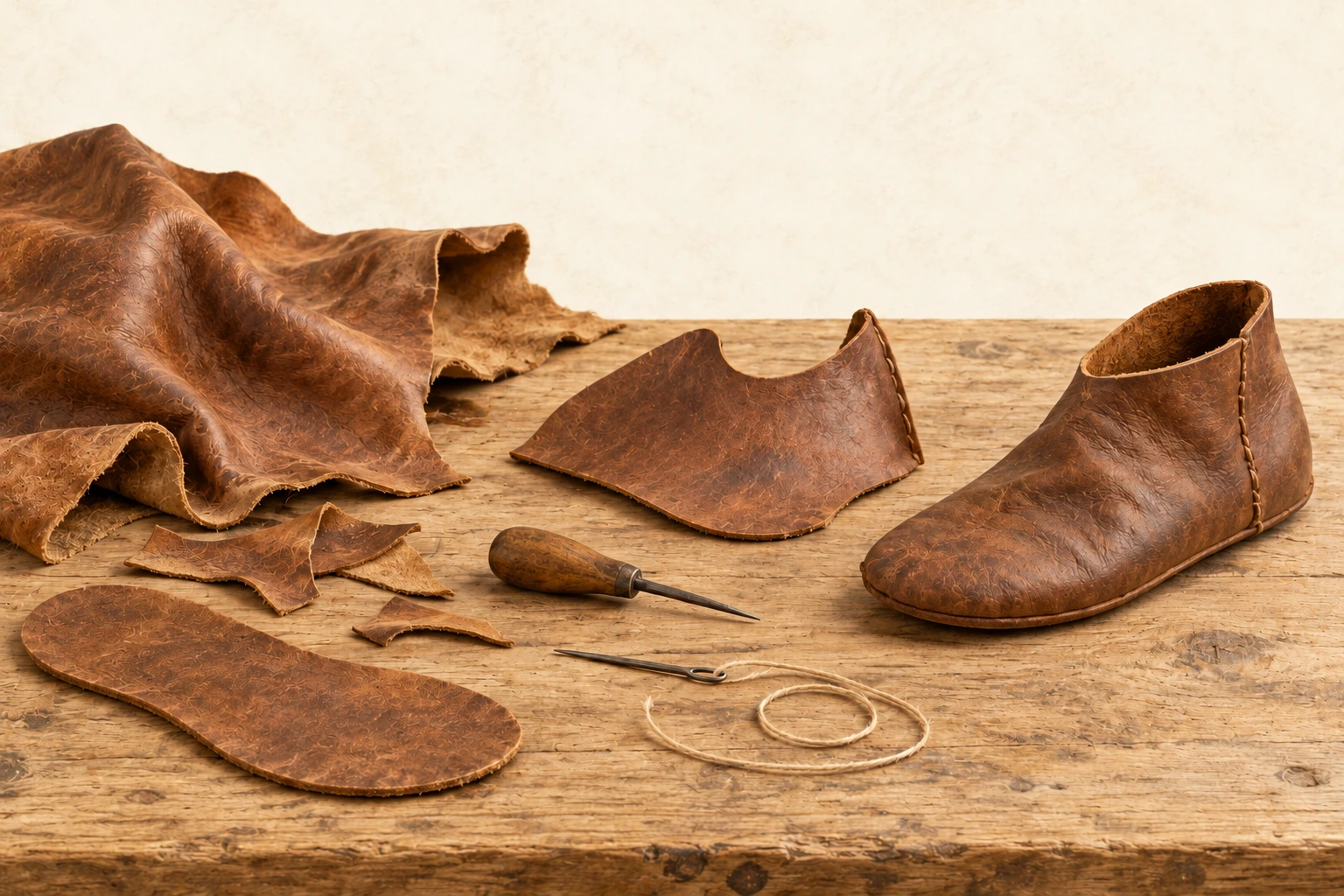
01 · Leatherworking & shoes
Choose the object before the pattern
A shoe, a strap and a knife sheath ask different things of leather. Begin with the intended object, then inspect the pieces and joins that make its form possible. Leatherworking is also distinct from preparing a fresh hide: a finished shoe does not reveal every earlier treatment of its material.
The York study separates shavings made during preparation from offcuts produced while cutting out components. Those traces help identify different operations. For our teaching model, the leather is already prepared. Its colour and thickness are illustrative choices, not a universal Viking recipe. Follow a specific find when asking which animal supplied the material or which construction the maker used.
Sources: [1].
02 · Leatherworking & shoes
Why a turnshoe is turned
Wikinger Museum Haithabu describes shoes sewn inside out and then turned so the finished seams lie inside. That operation gives the turnshoe its name. It is worth following the change of orientation slowly: the same join is seen from a different side before and after turning.
The still life introduces leather, cutting pieces, tools and a finished illustrative shoe. It is not a cutting pattern: a reconstruction of one excavated shoe requires its measured upper, sole and seam documentation. The museum also describes differences in seams, edging and heel construction. Its reconstruction specialist’s work helps explain the process, while the dimensions and pattern of an individual original still require that find’s documentation.
Sources: [2].
03 · Leatherworking & shoes
A different solution: one piece of leather
Coppergate shoe 15354, dated about 930–975, was made from a single piece of cattle leather. The catalogue records drawstring slits, a seam over the front of the foot, fine impressed decoration and stitching from a repair beneath the tread. It is a particularly useful comparison with the separate upper-and-sole teaching model.
Trace the surviving seam and ask how the flat leather enclosed the foot. A reconstruction should follow that evidence rather than impose the outline of a modern shoe. This object also reminds us that “complete” need not mean untouched: repairs form part of its surviving construction. Its unusual form alone cannot identify the wearer’s birthplace or social position.
Sources: [3].
04 · Leatherworking & shoes
Compare an opening and a fastening
Two other Coppergate finds make variation tangible. Catalogue 15439 is an almost complete left ankle shoe fastened with a toggle; its material is recorded as cattle or calf. Catalogue 15395 is a complete left slip-on shoe of calf leather. Both belong to contexts dated approximately from 975 to the early or middle eleventh century.
Place the records side by side and compare the openings before comparing decoration. How would the foot enter? What keeps the upper in position? A fastening is part of the structure, not simply a decorative extra. These are two documented objects, not a chronological ladder from “primitive” to “advanced”, and their recorded sizes do not identify their owners.
05 · Leatherworking & shoes
A hole is evidence of an operation
JORVIK identifies awls, punches and creasers among the leatherworking tools from Coppergate. Their tasks differ: piercing, punching and marking a decorative line are not the same operation. A teaching scene should make the chosen action legible rather than surround a craftworker with an arbitrary collection of implements.
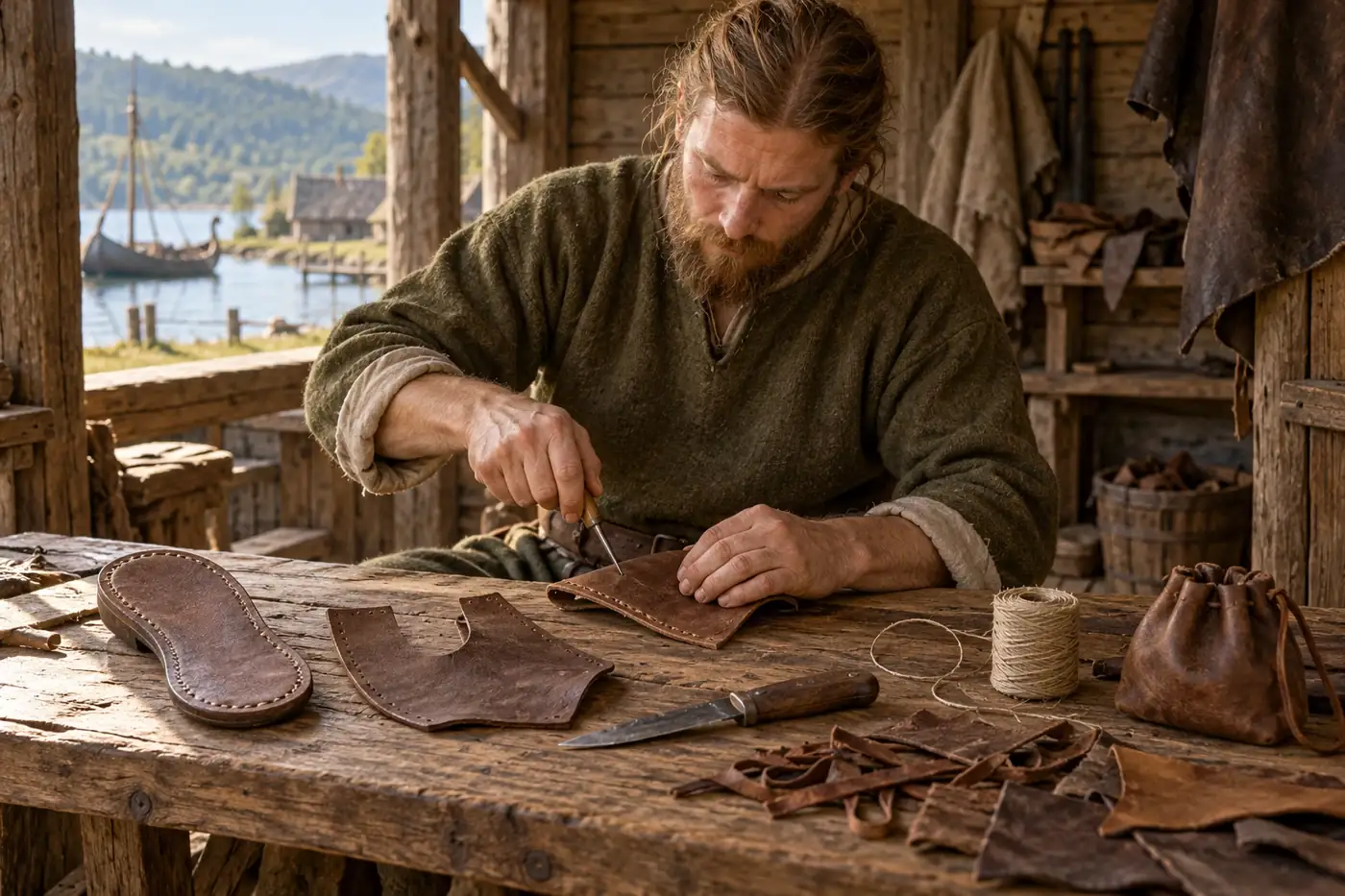
When inspecting a documented seam, follow one prepared edge and its corresponding edge. Ask where the thread will pass and whether the holes actually meet. The workshop illustration shows the use of an awl, without prescribing one stitch for every Viking-Age shoe. Keep any named stitch, unusual tool or decorative technique tied to a specific documented example.
Sources: [6].
06 · Leatherworking & shoes
Repair belongs to manufacture’s history
York’s leather study identifies repaired footwear and shoes made partly from reused shoe components. It also reports refurbishment of knife sheaths in Anglo-Scandinavian contexts. Making an object and keeping it useful were connected activities.
Look for a second set of holes, a patch or a changed edge before treating a surviving shape as its first form. In a reconstruction, keep the initial seam and later repair distinct. A repair is evidence of another intervention, but it is not a simple measure of the owner’s wealth. The duration of use, access to replacement material and circumstances of repair remain questions unless the object or its context supplies more information.
Sources: [1].
07 · Leatherworking & shoes
Scraps can reveal a working place
The National Museum of Ireland’s Viking Challenge booklet describes a leather accumulation approximately a metre high beside a building in Viking Dublin. The example helps make the physical scale of craft waste imaginable. It is not a measurement of how many shoes one worker made in a year.
Consider the information needed to turn a heap into a production estimate: its area, composition, period of accumulation and whether material was brought from elsewhere. A photograph or drawing of scraps should not quietly supply those missing facts. The strongest lesson is simpler: discarded material deserves investigation alongside finished objects, and its archaeological context matters as much as its visual abundance.
Sources: [7].
08 · Leatherworking & shoes
Footwear for children
The World-Tree Project documents a child’s leather boot from High Street, Dublin, held by the National Museum of Ireland as E71:13204. It adds a smaller wearer to a subject often illustrated only with adult footwear.
Study the recorded object before scaling down a modern adult pattern. Which features can actually be observed, and which are hidden by the display or preservation? The identification does not provide the child’s exact age, the maker’s identity or the family’s circumstances. Those should not be invented in a caption. Compare its opening and surviving seams with the adult shoes. Small footwear deserves the same close attention to construction, wear and archaeological context as a larger find.
Sources: [8].
09 · Leatherworking & shoes
Follow footwear beyond urban workshops
Waterlogged towns are prominent in museum displays, but manufactured footwear was not limited to townspeople. The National Museum of Ireland includes shoes and other leather objects among rural finds. It presents Ballinderry crannog as a probably prosperous household occupied between the later ninth and early eleventh centuries.
A rural findspot demonstrates that an object reached that place; it does not establish where it was made. Local manufacture, exchange and movement with a wearer remain different possibilities. Comparing town and countryside therefore means comparing production evidence as well as possessions. A cutting offcut and a worn shoe may belong to the same economy while preserving different parts of its history.
Sources: [9].
10 · Leatherworking & shoes
Leatherwork also protected tools
A sheath from Parliament Street in York, catalogue 753, encloses an angle-backed knife. Its edge is fastened with iron rivets. The front has separate decorative fields associated with blade and handle, while the reverse carries incised net-like ornament. The catalogue identifies it as Anglo-Scandinavian.
This object widens the craft beyond footwear and challenges the assumption that every leather join was sewn. Follow its fastening and surface layout as separate features. A modern explanatory cutaway can show how a cover surrounds a blade, but it should not pretend to expose the unseen interior of this actual find. Use a genuine credited photograph when discussing its particular decoration.
Sources: [10].
11 · Leatherworking & shoes
Separate evidence from the teaching model
A model can show a hidden join, enlarge a stitch or place successive stages beside one another. A museum photograph records the surviving object, including folds, wear and missing areas. These two kinds of image answer different questions. Our workshop illustrations are modern explanations, not photographs of newly discovered Viking footwear.
For the shorter study of towns and their shoemakers, read Leather Shoes and the Work of Urban Shoemakers. When moving between the two guides, keep the object number with the claim. A generic reconstruction can demonstrate a possibility; it cannot settle the material, date or exact pattern of a specific shoe.
12 · Leatherworking & shoes
Try a paper upper and read a seam
Take a paper sole shape and a broad paper strip for a simplified upper. Bring their edges together without glue at first. Mark matching points where a join would be needed, then use short pieces of tape to hold the model. Notice the difference between matching the edge and merely matching the outline when viewed from above.
Label the inside and outside. Explain how the orientation would change in the turnshoe sequence, without claiming that stiff paper behaves like leather. This is an original classroom exercise, not a wearable historic pattern. Finish by choosing a museum shoe and recording three observations, one reasonable interpretation and one question that the surviving evidence cannot answer.
Follow the evidence
Sources & further reading
Follow the dated finds, published studies and documented experiments behind each section. Modern demonstrations explain workable choices; they do not establish one method for every Viking-Age workshop.
- Mould, Carlisle & Cameron — Leather and Leatherworking in York (2003)Excavation monograph covering the later ninth to fifteenth centuries. The guide distinguishes Anglo-Scandinavian footwear from later material.
- Wikinger Museum Haithabu — Der Schuhmacher von HaithabuMuseum account by a reconstruction specialist; turnshoe manufacture and variation. Winter insulation is explicitly uncertain.
- York Archaeology — one-piece leather shoe, catalogue 15354Coppergate, c.930–975; cattle leather, drawstring slits, decoration and repair. Image licence CC BY-NC 4.0.
- York Archaeology — toggle-fastened ankle shoe, catalogue 15439Coppergate, c.975–early/mid eleventh century; left shoe, cattle/calf leather. Image licence CC BY-NC 4.0.
- York Archaeology — slip-on shoe, catalogue 15395Coppergate, c.975–early/mid eleventh century; complete left calf-leather shoe. Image licence CC BY-NC 4.0.
- JORVIK Viking Centre — How did they live?Museum discussion of leatherworking tools and waterlogged preservation.
- National Museum of Ireland — Viking Challenge (2014), p.10Museum education publication describes a metre-high leather accumulation beside a Dublin building.
- World-Tree Project — child’s leather boot, E71:13204University College Cork project documents NMI object from High Street, Dublin. Photograph is personal-use-only.
- National Museum of Ireland — The Viking Age in IrelandRural leather finds; Ballinderry crannog interpreted as prosperous household, late ninth–early eleventh century.
- York Archaeology — decorated knife sheath, catalogue 753Anglo-Scandinavian sheath from Parliament Street, York; iron-riveted edge and incised ornament. Image licence CC BY-NC 4.0.
Continue the exploration