
Gods & companions
Kvasir
Wisdom turned into the mead of poetry
Kvasir begins as a figure of extraordinary wisdom and becomes the victim whose blood is transformed into the mead of poetry.
Explore the stories ↓
A person made from peace
In Skáldskaparmál, the Æsir and Vanir make peace and create Kvasir from the shared substance of their agreement. He can answer any question and travels teaching people. Two dwarfs, Fjalar and Galar, kill him and mix his blood with honey to make a drink that grants poetic or learned ability.
Knowledge that changes hands
The mead passes through further violence before Odin obtains it. Kvasir’s story therefore stands at the beginning of a chain in which knowledge becomes a coveted material possession. It is not simply a pleasant explanation of inspiration. Gylfaginning also names Kvasir in the pursuit of Loki, where he recognises the design of a burned net. That later appearance does not fit neatly into a single chronology after his death; the sources preserve overlapping uses of the figure.
The killers’ explanation
Fjalar and Galar invite Kvasir into private conversation before killing him. They collect his blood in vessels named Ódrerir, Bodn and Són and mix it with honey. To the gods they offer a grotesque explanation: Kvasir supposedly suffocated in his own wisdom because nobody could question him adequately. Their lie turns his defining gift into an excuse for his death. The narrative therefore makes the origin of poetic inspiration inseparable from murder and concealment, rather than presenting mead merely as a pleasant drink that makes people eloquent.
How the mead leaves the dwarfs
The dwarfs then cause the deaths of the giant Gilling and his wife. Their son Suttung retaliates by placing the killers on a reef threatened by the rising tide. To save themselves, they surrender the mead as compensation. Suttung hides it at Hnitbjörg under Gunnlod’s guard, setting up Odin’s later attempt to obtain it. Kvasir’s transformed blood thus passes from murderers to an avenger before reaching the gods. The sequence explains several poetic expressions: a reference to Kvasir’s blood, the dwarfs’ drink or Suttung’s mead can all point towards poetry.
Read behind the retelling
Sources & limits
Kvasir appears alive in a narrative that does not fit neatly after his death in another story. Do not invent a resurrection to repair the chronology.
Retold in contemporary English. Dialogue is summarized, not presented as a translation. How to read our sources and versions.
Follow the thread
Stories & related reading: Kvasir
2 min read
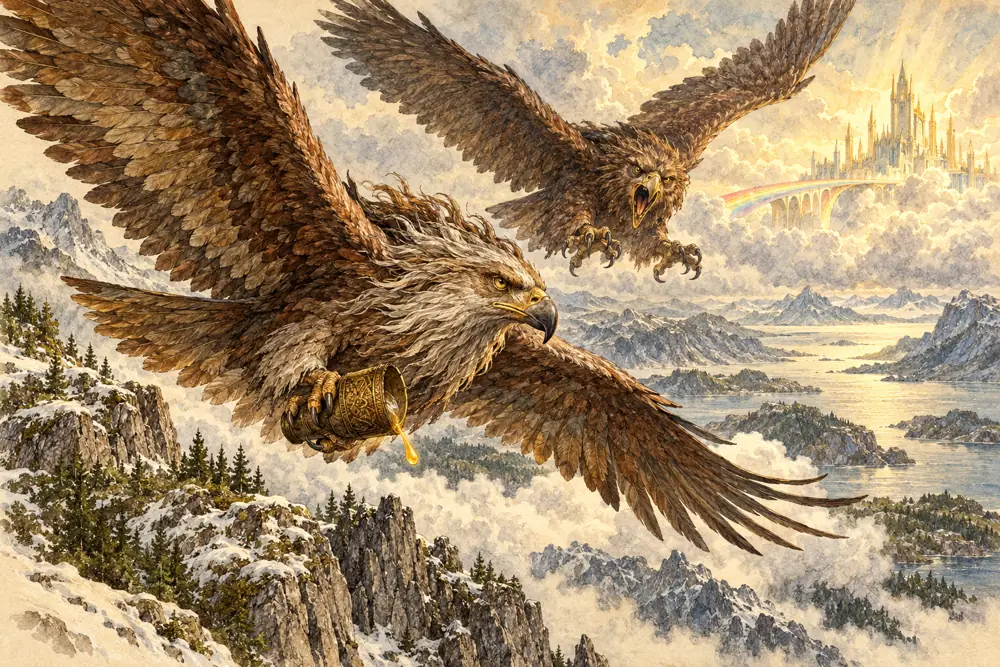
The mead of poetry
The blood of Kvasir passes through murder, bargaining and deception before the poetic mead reaches the gods.
Read the story ↗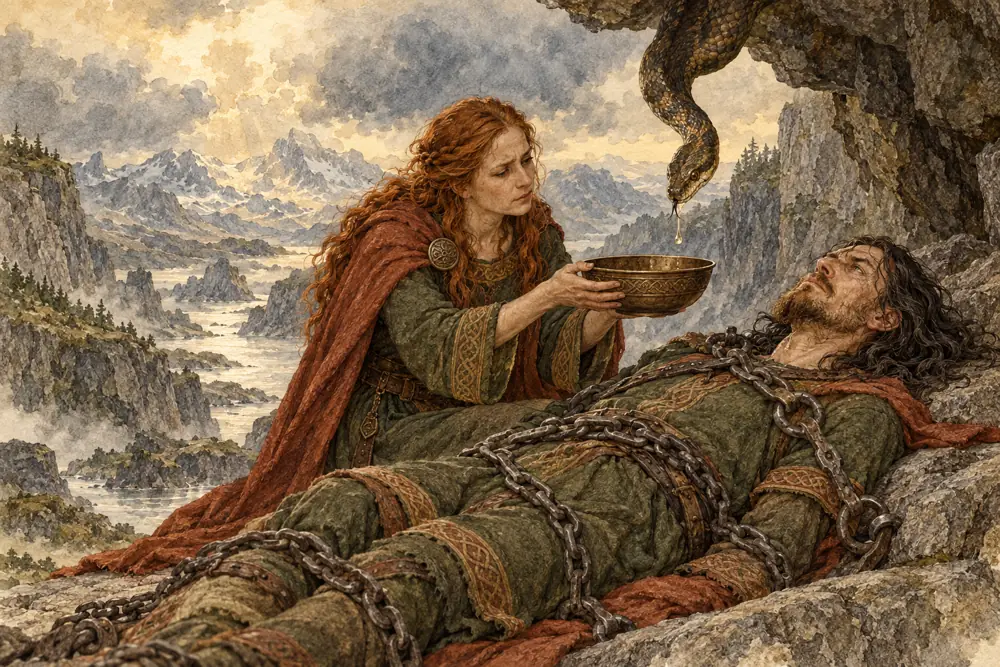
2 min read
The binding of Loki
The gods capture Loki after his flight and bind him beneath a venomous snake. Sigyn remains beside him.
Read the story ↗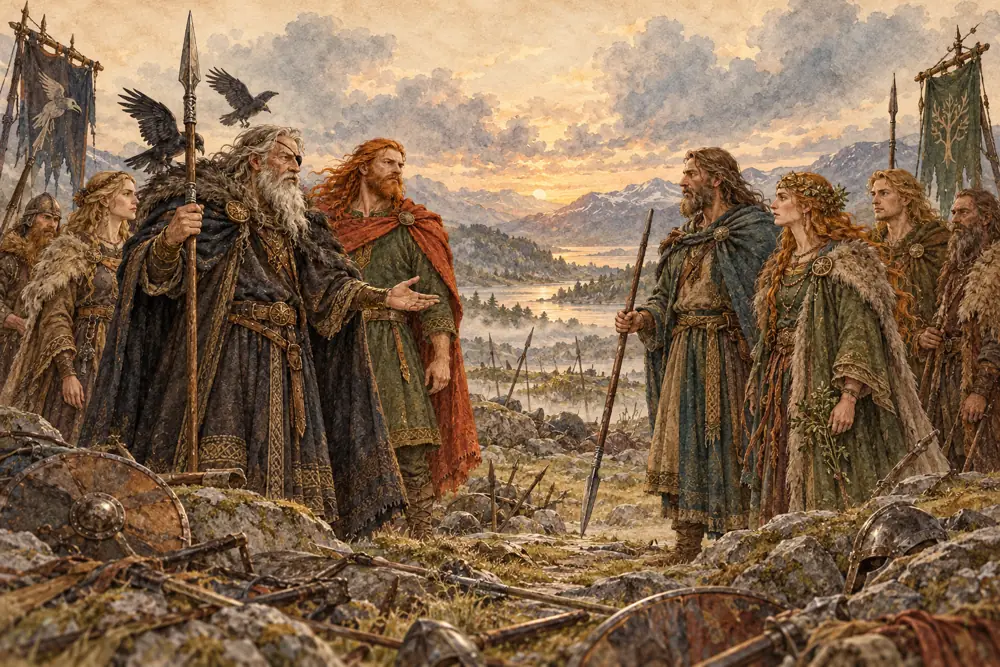
2 min read
The war between the Æsir and Vanir
An early war, a mysterious woman and an uneasy peace survive in accounts that do not fit together neatly.
Read the story ↗