
A Norse story · 2 min read
The binding of Loki
A hidden salmon, a net and a punishment that shakes the earth.
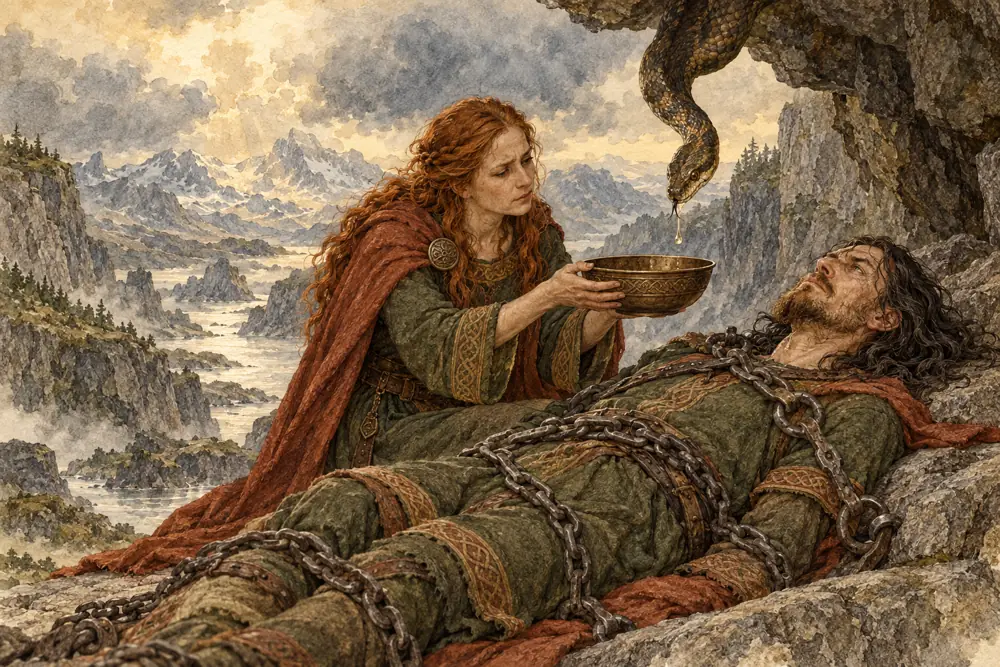
The gods capture Loki after his flight and bind him beneath a venomous snake. Sigyn remains beside him.
A fugitive watching every direction
Following the death of Baldr, Gylfaginning describes Loki hiding in the mountains. His house has four doors so that he can watch in every direction. By day he becomes a salmon and hides in a waterfall. Thinking about how the gods might catch him, he devises a fishing net. When he sees them approaching, he burns it and leaps into the water. The invention meant to anticipate danger leaves a trace: the gods recognise the net’s pattern in the ashes and reconstruct it. Loki’s ingenuity has supplied the means of his own capture.
The salmon and the hand
The gods draw the net through the water. Loki evades it by lying between stones, but the search becomes more effective when they weight its lower edge. He must choose between being driven toward the sea and leaping over the net. When he jumps, Thor catches him. The fish slips through Thor’s hands until he grips it near the tail. Snorri connects this grip with the salmon’s narrowing shape. It is one of the tale’s explanatory details: a feature of the natural world is given a place inside the mythic action.
Sigyn beneath the snake
The captors bind Loki using the remains of his son, after a second son has been transformed into a wolf and killed his brother. The bonds become iron. Skaði places a venomous snake above Loki’s face. His wife Sigyn holds a vessel to catch the dripping poison. When she must empty it, drops reach him and his convulsions shake the earth. He remains bound until the events of Ragnarök. The punishment is disturbing, and the involvement of Loki’s children should not disappear behind an easy description of a villain getting what he deserves. Sigyn’s repeated act of protection gives the scene its other enduring centre.
Two endings, different details
The prose epilogue to Lokasenna also tells of the capture, bonds, snake and earthquakes, but its treatment of the sons’ names differs from Gylfaginning. In Snorri’s version the wolf-transformed son is Váli and the dead son is Nari or Narfi; the Lokasenna epilogue gives a different arrangement. It is better to flag that variation than present one family list as if every text agreed. The placement also differs: Snorri’s sequence follows the Baldr narrative, while the poem’s prose conclusion follows Loki’s insults at Ægir’s feast. These are surviving literary arrangements, not proof of one universally fixed mythological chronology.
Read behind the retelling
Sources & limits
The sources differ over Loki’s sons’ names and roles. Loki’s son Váli must not be confused with Odin’s son Váli, the avenger of Baldr.
Retold in contemporary English. Dialogue is summarized, not presented as a translation. How to read our sources and versions.
Another thread to follow

2 min read
Loki’s quarrel at Ægir’s feast
Loki enters the gods’ feast and attacks one guest after another in a formal exchange of insults.
Read the story ↗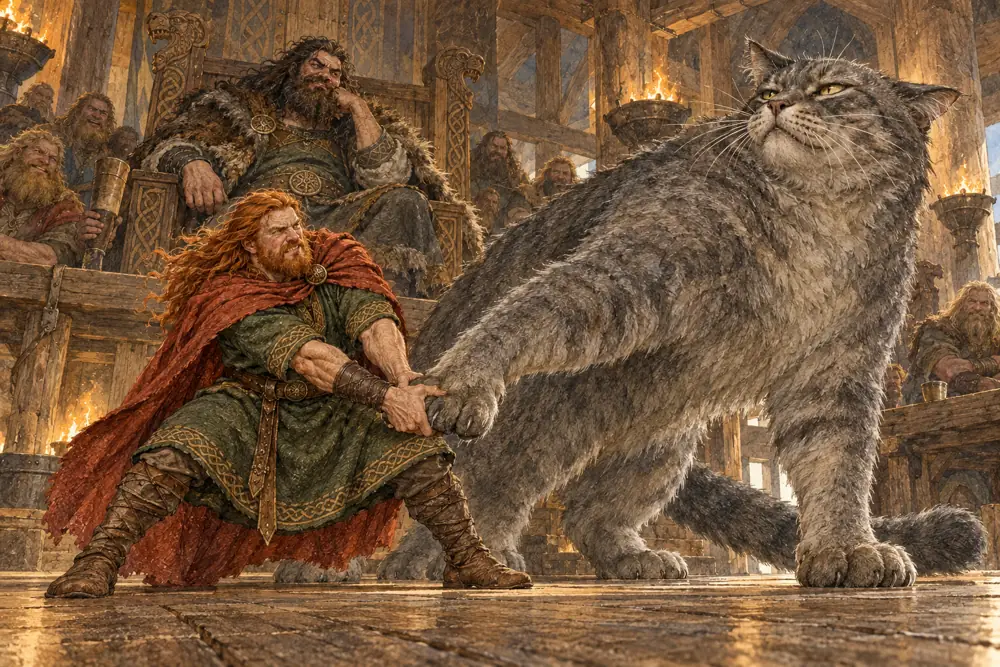
4 min read
Thor at Útgarða-Loki’s hall
Thor and his companions fail a series of apparently simple tests—until their host reveals what they were really facing.
Read the story ↗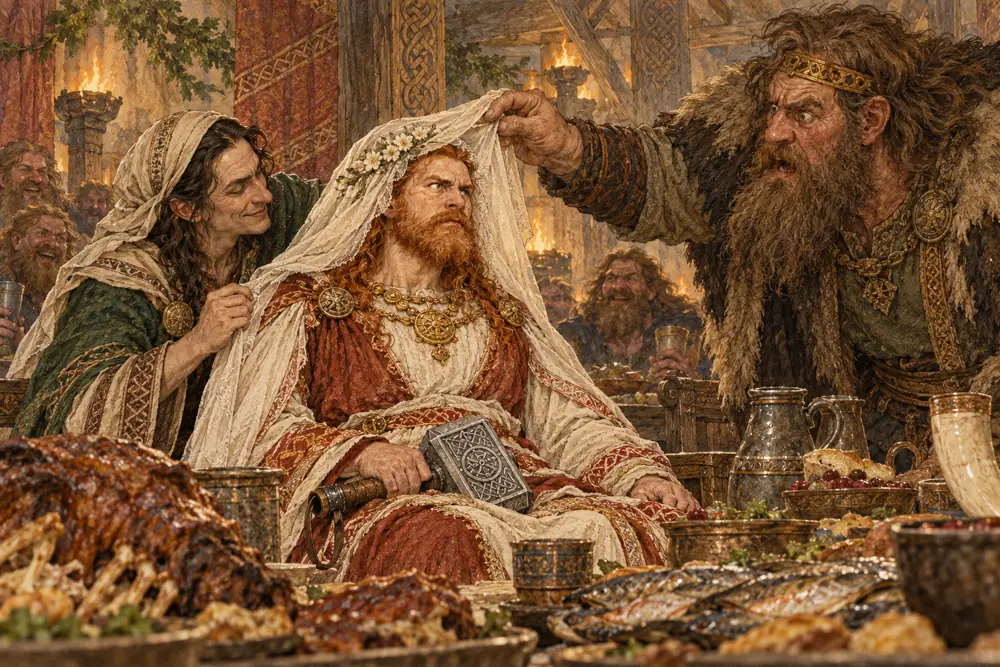
2 min read
Thor’s extraordinary wedding
When Thrym demands Freyja in exchange for Mjölnir, the gods send a very different bride.
Read the story ↗